Best price Used
Angénieux Paris S1 50mm f/1.8 – Leica M Conversion
Sold by Camera Obscura Elburg
€4,979 ≈ $5,377
A rare French 50mm f/1.8 six-element Double Gauss lens, documented in original rangefinder-coupled Leica M39 and Contax RF factory mounts.
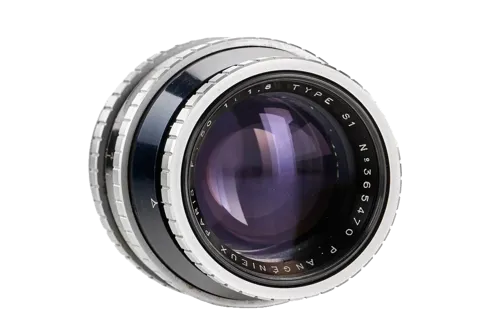
LTM / Contax RF mount
The Angénieux Type S1 50mm f/1.8 is a LTM / Contax RF-mount lens for Leica rangefinder cameras. As of October 2026, it sells from €4,979 used across 1 listing, with a 30-day median of €5,012. Leica price index →
Measured against the 121 other 50mm lenses in the catalogue.
The P. Angénieux Type S1 50mm f/1.8 is an early high-speed French standard lens based on a six-element, four-group Double Gauss design. It was produced for several camera systems, including exceptionally rare factory rangefinder versions in Leica Thread Mount and Contax RF mount.
Original LTM examples use a complete Angénieux focusing barrel and are rangefinder coupled. Original Contax examples use the external bayonet and their own focusing assembly. These are factory-produced mount variants of the same S1 lens, not later adaptations, and both are therefore covered by this profile.
Two documented lenses provide especially strong evidence for this relationship. A Contax example carries serial number 160746, while an original rangefinder-coupled M39 example carries serial number 160767. The nearly consecutive numbers support their treatment as parallel factory versions of the same optical model.
The physical specifications currently associated with the profile, including the approximately 110g weight of some aluminium examples, describe documented LTM lenses. They should not automatically be applied to the Contax barrel.
Rendering
The Type S1 has a comparatively gentle image at f/1.8, with moderate contrast and reduced fine-detail definition away from the centre. Stopping down increases contrast, definition and overall uniformity.
Bokeh and transitions
The combination of a 50mm focal length and f/1.8 aperture provides substantial background separation. The Double Gauss design produces a recognisably vintage transition from focused to unfocused areas, although the exact appearance varies with aperture, optical condition and individual production version.
Contrast and coating
Both uncoated and coated examples are documented. Early coated lenses can show pale blue reflections, while later coatings may appear more strongly blue or purple. Coating type has a noticeable influence on flare resistance and contrast.
Flare and aberrations
Uncoated and lightly coated examples can lose contrast rapidly in strong backlighting. At maximum aperture, glow, spherical aberration and reduced edge definition may be visible. These characteristics improve when the lens is stopped down.
No verified optical distinction has been established between the original LTM and Contax RF versions.
Development and Launch
The Type S1 belongs to Angénieux's early S-series of high-speed photographic lenses. The design appeared during the 1940s and was manufactured for several European camera systems.
Factory LTM and Contax RF examples are both documented. Auction dating for surviving lenses is not completely consistent, even for nearly consecutive serial numbers, so exact manufacturing years should be treated cautiously unless supported by additional factory records.
Production Evolution
The Type S1 appeared in several mounts and barrel configurations. Original rangefinder versions were produced alongside lenses for Alpa, Rectaflex, Exakta and other systems.
Some Alpa lenses carry the Alitar name. These share the broader S1 optical family but are not automatically original Leica or Contax rangefinder lenses. Modern specialists have converted optical heads from these other systems into Leica M and M39 focusing mounts.
Coating was introduced gradually. Surviving lenses with close serial numbers can differ in coating, suggesting that coated and uncoated production overlapped.
Special Editions/Variants
No factory special edition with a separate model or catalogue number is confirmed. Uncoated lenses, pale-blue-coated lenses and the different factory mounts are production variants. Alitar-marked lenses belong to a related factory application and should not be listed as a special edition of the rangefinder S1.
Collector Notes
Originality of the focusing mount is critical. A genuine factory LTM or Contax RF lens should be distinguished from an S1 optical head later fitted to a modern rangefinder mount.
Collectors should inspect for balsam separation, haze, coating wear and cleaning marks. Separation is regularly encountered in surviving S1 lenses and can significantly reduce contrast.
The mount-specific focusing mechanism, engravings, serial number and overall construction should be documented whenever possible.
Collectors should verify the engraved maker and model, native mount, focusing mechanism and rangefinder cam instead of relying on a seller title. A later conversion is not evidence of a factory variant, while cosmetic engraving changes do not automatically prove a new optical version. Serial numbers can support comparison when used with specialist records, but an isolated number does not establish a production date.
Check focusing travel, aperture action, glass condition and signs of incorrect reassembly. Rangefinder agreement should be tested at close, middle and distant settings. Caps and cases add context but do not change the identity of the lens.
About the usual price. The lowest listing is around the 30-day average.
Over the last 2 weeks the median price for the Angénieux Type S1 50mm f/1.8 has fallen, ranging from €5,012 to €5,017 (now €5,012).
Weekly price (EUR). Median (Good or better) and lowest (Good or better) across 2 weeks. The full figures follow in the table below.
| Week | Median | Lowest |
|---|---|---|
| Sep 28, 2026 | €5,017 | Unknown |
| Oct 5, 2026 | €5,012 | Unknown |
Every shop grades differently. Leica Classic uses letters, Ffordes uses E++ and E+, German dealers write "Zustand B", Japanese dealers write A−. We map all of them onto the one ladder below. Where a shop states its own grade, we print it under ours.
As of October 2026, the Angénieux Type S1 50mm f/1.8 sells from €4,979 used, with a 30-day median of €5,012, across 1 active listing.
As of October 2026, the Angénieux Type S1 50mm f/1.8 is sold by 1 source (1 listing), from €4,979 used: all compared cheapest-first on this page.
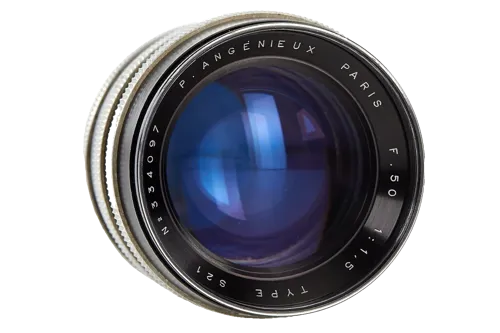
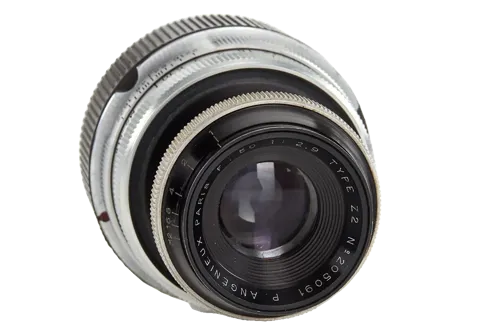
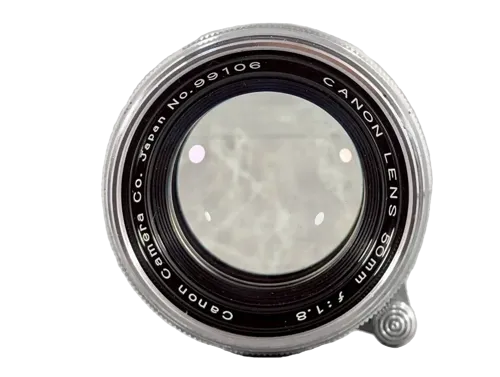
Similar lenses you might be interested in
Comments