A circa-1953 Angénieux Type S21 50mm f/1.5 fast normal lens with six elements in four groups, original coupled LTM mounting and 1m focus.
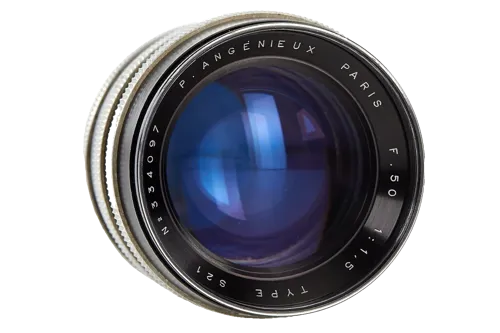
Angénieux Type S21 50mm f/1.5
LTM mount
No listings tracked for this lens right now.
The Angénieux Type S21 50mm f/1.5 is a LTM-mount lens for Leica rangefinder cameras. Leica price index →
How it compares
Measured against the 108 other 50mm LTM-mount lenses in the catalogue.
Specification
About this lens
Angénieux Type S21 50mm f/1.5
The Angénieux Type S21 50mm f/1.5 is a fast French normal lens documented in an original Leica M39 rangefinder mount. Its optical system contains six elements in four groups in a double-Gauss arrangement. Leitz Auction dates a factory screw-mount example to circa 1953, the same year specialist records identify as the debut of the broader S21 family.
This profile is restricted to the original coupled Leica-thread construction. Type S21 lenses made for Exakta, M42 and other applications, later conversions to Leica M, and modern reinterpretations remain separate mechanical and commercial identities. Similar optics do not make those barrels historically interchangeable.
Optical qualities
Rendering
The six-element, four-group double-Gauss formula provides full 35mm coverage with a high f/1.5 maximum aperture. It belongs to the family of fast normal-lens arrangements developed to balance spherical aberration, coma, astigmatism and field curvature around the central stop. Element count alone does not show how completely the final prescription corrects each aberration.
No factory performance curves for the rare original LTM version have been located. Modern reviews, remakes and converted examples can illustrate the S21 concept, but they are not substitutes for controlled testing of an original coupled lens. Coating wear, haze, separation and previous disassembly can produce substantial variation among surviving copies.
At f/1.5
Maximum aperture provides strong subject separation at close and middle distances. It also makes focus error easy to see. The rangefinder cam and camera body should be checked together at more than one distance, because a small mechanical discrepancy can be mistaken for optical softness.
Specialist descriptions of period S21 lenses often note lower contrast and visible spherical-aberration glow near full aperture, followed by clearer definition when stopped down. Those observations are useful as tendencies, not guarantees. A clean and correctly spaced example may differ markedly from one with damaged coatings or internal haze.
Stopped down
Closing the aperture increases depth of field and normally improves contrast and field consistency. Middle settings make the lens more practical for general photography when selective focus is not the goal. The exact diaphragm blade count and smallest aperture of the original LTM barrel are left unspecified because published figures frequently describe Exakta versions or modern reproductions.
Handling and compatibility
The factory M39 version operates through a coupled focusing cam and is recorded in LeicaLensList with an approximately 1m near limit. The actual scale and cam should be checked rather than assuming that specifications from an SLR barrel carry over. A 50mm finder is standard on many screw-mount bodies, while compatible Leica M cameras can use an LTM adapter.
An adapter provides the correct physical interface but cannot compensate for an inaccurate cam or an optical block installed at the wrong register. Direct mirrorless focusing is useful for evaluation. Filter size, external dimensions and weight are omitted because reliable factory figures for the rare LTM barrel have not been established.
History
Development and Launch
Angénieux traces its foundation to Paris in 1935. The company developed still-camera and cinema primes before becoming internationally associated with retrofocus wide-angle and professional zoom designs. The S21 emerged during the postwar expansion of fast 35mm photographic lenses.
Specialist records date first-year S21 production to 1953. Leitz Auction documents a Type S21 manufactured circa 1953 in original Leica M39 mount, providing strong evidence that the coupled screw-mount lens was a factory product. That record is more specific than listings for later Leica conversions of Exakta or M42 lenses.
Production Evolution
The broader S21 family appeared in several mounts and in early and later barrel styles. Flashback Camera documents early 1953 and later 1957 examples while consistently identifying the six-element, four-group double-Gauss construction. Reflex versions often use preset aperture mechanisms and focusing arrangements specific to their host cameras.
Original Leica-thread production appears far less often than Exakta and converted examples. The profile therefore preserves the factory M39 identity without treating every S21 optical head as an LTM lens. Modern Leica M remakes inspired by the S21 are new products with their own glass, coatings and mechanics, not production variants of this entry.
Special Editions/Variants
No official commemorative edition of the original LTM S21 has been documented. Metre and feet scales, finish changes and early or late exterior forms occur across the family. They should be described as production variations unless reliable evidence establishes a separate optical generation.
Collector Notes
Identification requires more than the Type S21 engraving. Confirm the original Leica-standard thread, coupled cam, focusing construction and period barrel as a coherent assembly. A converted SLR lens may be well engineered and photographically desirable, but it should not be represented as a factory M39 example.
Test focus agreement from infinity to the approximate 1m near limit and inspect for helicoid play. Examine the glass for haze, fungus, separation, cleaning damage and coating wear. Check aperture movement without transferring the blade count from another mount. Individual serials, caps, cases, auction condition and sale prices do not define the generic lens.
Sources
Where to buy
Related lenses
Similar lenses you might be interested in
Comments