The Konica Hexanon 50mm f/1.9, a scarce LTM screw-mount standard lens from Konishiroku, prized by rangefinder collectors for its Ultron-derived six-element optics.
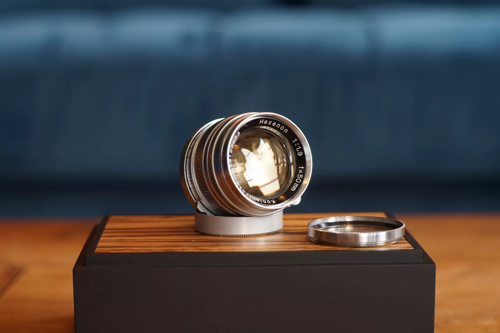
Konica Hexanon 50mm f/1.9
LTM mount
No listings tracked for this lens right now.
The Konica Hexanon 50mm f/1.9 is a LTM-mount lens for Leica rangefinder cameras. Leica price index →
How it compares
Measured against the 108 other 50mm LTM-mount lenses in the catalogue.
Specification
About this lens
Konica Hexanon 50mm f/1.9
Among the standard lenses Konishiroku built for Leica thread-mount bodies, the 50mm f/1.9 Hexanon stands out for its optical pedigree: it is a coated six-element, five-group design described by collectors as an Ultron derivative, a configuration that was fairly unusual in the crowded LTM 50mm field of the 1950s [1]. Konishiroku, the predecessor to Konica, had earned a strong reputation for its fixed-lens 35mm rangefinders of the era, and the screw-mount Hexanon brought that lens-making to a removable barrel for users of Leica-pattern cameras [2]. The faster Hexanon is closely related in character to the 48mm f/2 fitted to the Konica III, which is part of its appeal to those who admired that camera's results.
The lens is a compact, rigid standard optic with rangefinder coupling, a brass barrel, and the heavy, well-machined build typical of quality 1950s glass. The diaphragm uses ten blades and stops down from f/1.9 to f/22 in positive full-stop clicks, and the barrel carries the conventional infinity lock of the period. It focuses to one meter and uses a single amber-tinted coating characteristic of Konica's lenses of the time. Sources describing examples in the field note a 40.5mm front filter thread, while LeicaLensList records a 40mm filter diameter for this entry.
The screw-mount Hexanon was one of just three Leica thread-mount lenses Konishiroku produced, alongside the collapsible 50mm f/3.5 Hexar and the very rare, essentially unobtainable 60mm f/1.2 Hexanon. The f/3.5 and f/1.9 lenses were normally supplied with several mid-1950s Japanese-market screw-mount cameras, including the Chiyotax IIIF and Leotax models such as the F and the T, and it appears that neither these cameras nor the standalone lenses were marketed in North America, which contributes to their present scarcity. The exact end of production is not documented; one reviewer estimates it continued only until roughly 1957 or 1958, after which Konica's efforts shifted toward an SLR system and a new generation of fixed-lens rangefinders.
Optical qualities
Rendering Documented impressions of this lens are limited, but the available accounts are consistent. Users report that it is sharp even wide open and produces images with a notable three-dimensional quality, matching the character of the related 48mm f/2 Konica III lens. The single amber coating is typical of its period and places it among the higher-quality Japanese screw-mount standards of the mid-1950s rather than the more basic offerings. There is not enough published testing to make firm claims about bokeh, flare resistance, distortion, or vignetting, so those are best treated as undocumented.
History
Development and Launch During the 1950s Konishiroku built a reputation for high-quality fixed-lens 35mm rangefinders in its I, II, and III series, and in the same period it also produced a small number of Leica screw-mount lenses. The rigid 50mm f/1.9 Hexanon was the fast standard among them, sitting above the slower collapsible 50mm f/3.5 Hexar and below the exotic 60mm f/1.2 Hexanon in the lineup. These lenses arrived during a boom in Japanese screw-mount cameras built around the Leica III pattern and optimized for the 50mm focal length, a market in which numerous makers offered standard lenses with overlapping specifications.
Production Evolution Firm records of running changes are scarce. The lens is consistently described with a chrome-finished brass barrel, click-stopped aperture to f/22, the period infinity lock, and a single amber coating, and there is no widely documented evidence of multiple optical formulas or major barrel revisions. The duration of production is itself uncertain, with one estimate placing its end around 1957 to 1958.
Special editions No major factory special variants of the screw-mount 50mm f/1.9 Hexanon are widely documented. Its scarcity comes largely from limited original distribution rather than from distinct collector editions.
Collector Notes Because the f/3.5 and f/1.9 lenses were typically bundled with Japanese-market bodies such as the Chiyotax IIIF and Leotax F and T, examples are most often encountered in Japan and were not sold new in North America, so prices tend to be high relative to other LTM 50mms. Buyers should weigh the documented 40.5mm filter thread reported by users against the filter diameter recorded here, and verify coupling and aperture clicks on inspection. As with any single-coated 1950s lens, the condition of the amber coating and the clarity of the internal glass are worth checking before purchase.
Sources
Where to buy
Related lenses
Similar lenses you might be interested in
Comments