A very rare Italian Officine Galileo TESOG 35mm f/4.5 in Leica screw mount (LTM/M39), a coated wide-angle from the Florence optical maker prized by collectors.
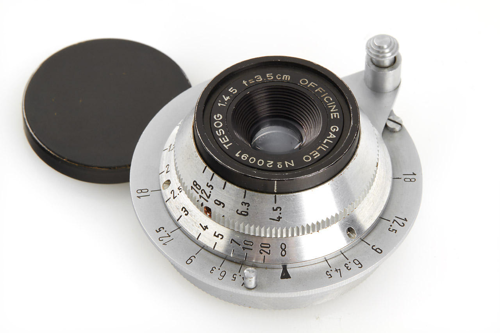
Officine Galileo TESOG 3.5cm f/4.5
LTM mount
No listings tracked for this lens right now.
The Officine Galileo TESOG 3.5cm f/4.5 is a LTM-mount lens for Leica rangefinder cameras. Leica price index →
How it compares
Measured against the 45 other 35mm LTM-mount lenses in the catalogue.
Specification
About this lens
Officine Galileo TESOG 3.5cm f/4.5
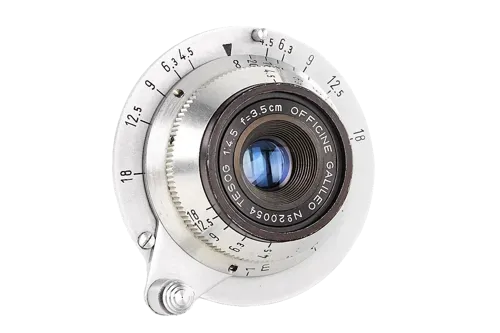
The TESOG is a wide-angle lens from Officine Galileo, the long-established Florentine optical works better known to camera collectors for the Italian Leica-type rangefinders it built in the late 1940s and early 1950s. The firm was founded in the nineteenth century and supplied periscopes, rangefinders and other optics to the Italian navy before moving into civilian photographic products [1][3]. Its lens names followed a consistent house pattern ending in "-og": the standard 5cm lens fitted to the Ferrania/Galileo Condor was the Eliog, and the TESOG was the matching 35mm wide-angle for the Leica thread (LTM/M39) format [2]. Surviving examples are scarce; one auction house that handled a coated specimen described it as a very rare Italian-made wide-angle in M39 mount, supplied with a matching universal finder, with the short focal length and modest f/4.5 maximum aperture suited to scale-focus snapshot use [4].
Optically the TESOG is a four-element design in three groups, an arrangement consistent with the classic Tessar/Elmar-type wide-angle layout; a chrome example was catalogued as a four-element 35mm of Elmar type[5]. It is a coated lens that focuses to about one metre and uses the 39mm Leica screw thread, so it physically mounts on Leica and Leica-copy screw bodies. LeicaLensList records the lens as not rangefinder coupled, meaning it is intended for use with a separate finder and scale focusing rather than coupling to the camera's coincident-image rangefinder. The pairing of a 35mm field of view with a relatively slow f/4.5 aperture reflects its intended role as a compact wide-angle for general and snapshot photography rather than low-light work.
Documented examples are so few that variation between them is hard to establish. Both detailed auction records describe chrome, coated lenses from around 1950, one of which the cataloguer noted was the only specimen they had seen, with no recorded sales or published information, raising the possibility that it was a prototype or near-prototype rather than a series product. Collectors should therefore treat any TESOG as a rarity whose exact production history is not well established.
Optical qualities
Rendering Independent rendering reports are essentially absent because so few examples are known, so no reliable account of sharpness, contrast or bokeh can be given. What is documented is that the lens is a coated, four-element wide-angle of Elmar/Tessar type at f/4.5, a configuration that in its era was associated with moderate but usable performance for general photography rather than high-speed or critical work. Any further characterisation would be speculation.
History
Development and Launch Officine Galileo, based in Florence, traces its origins to the nineteenth century and built its reputation on military and scientific optics, including naval rangefinders and periscopes, before entering camera production in the 1940s. Its first camera was a Leica III-type body, the Condor, made for Ferrania, followed by the Condor Junior; the standard taking lens for these cameras was the Eliog 5cm, a coated three-element design. The TESOG 35mm f/4.5 belongs to the same family of Galileo lenses for the Leica screw format and dates to around 1950, the period when Italy was briefly competitive in precision camera manufacture.
Special editions No factory special editions, military variants or alternative finishes of the TESOG are widely documented. The known surviving examples are chrome and coated, and one was described by an auction cataloguer as possibly a prototype, which underlines how thin the documented record is.
Collector Notes The TESOG is a rare item that appears mainly through specialist auctions, where realised and estimated prices have been high relative to its modest specification, reflecting scarcity rather than optical reputation. Because it is not rangefinder coupled, a period-correct accessory finder, such as the matching universal finder noted with one example, adds to completeness and value. As with any coated lens of this age, prospective buyers should check for haze, cleaning marks and coating damage, and confirm that the M39 thread and focusing helicoid are intact. One point worth flagging for accuracy: at least one auction listing described its TESOG as rangefinder coupled, which conflicts with the value recorded here; given the very small number of known examples and the cataloguer's own note that one specimen may be a prototype, the coupling status may not have been uniform, and the listing's wording should not be assumed to apply to every example.
Sources
- Camera-wiki.org. Officine Galileocamera-wiki.org →
- Leitz Photographica Auction. Officine Galileo TESOG 4.5/3.5cm (AI_27_32193)leitz-auction.com →
- Mike Eckman. Ferrania Condor I (1947)mikeeckman.com →
- Leitz Photographica Auction. Officine Galileo f. Leica M39 Tesog 4.5/3.5cm snapshot lens (A00368)leitz-auction.com →
- Leitz Photographica Auction. Officine Galileo TESOG 4.5/3.5cm, four-element Elmar-type description (AI_27_32193)leitz-auction.com →
Where to buy
Related lenses
Similar lenses you might be interested in
Comments