An original rangefinder-coupled 250mm f/5.5 Tele-Megor in Leica M39, from Meyer's four-element long-focus family produced circa 1935 to 1954.
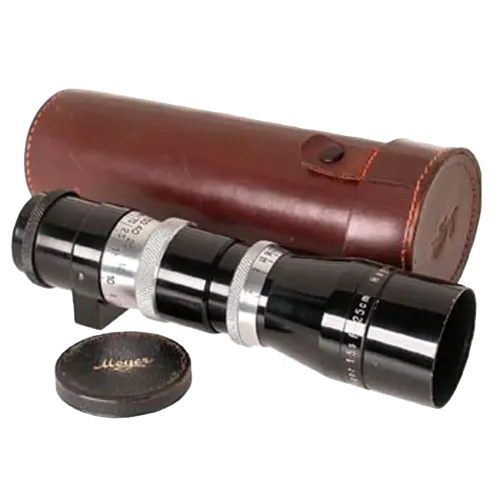
Meyer-Optik Gorlitz Tele-Megor 250mm f/5.5
LTM mount
No listings tracked for this lens right now.
The Meyer-Optik Gorlitz Tele-Megor 250mm f/5.5 is a LTM-mount lens for Leica rangefinder cameras. Leica price index →
Specification
About this lens
Meyer-Optik Gorlitz Tele-Megor 250mm f/5.5
The Meyer-Optik Gorlitz Tele-Megor 250mm f/5.5 is a manual-focus long-focus lens documented in an original Leica M39 mount with mechanical rangefinder coupling. Meyer offered the Tele-Megor family from approximately the mid-1930s into the first half of the 1950s, and the name was used for long lenses in several focal lengths and camera mounts. The exact year and detailed mechanical specification of the 250mm Leica version are not established by the surviving sources reviewed here, so specifications from later M42 examples should not be transferred to it.
The broader 250mm f/5.5 Tele-Megor family is documented as a four-element, two-group design. Its telephoto arrangement provides a 250mm focal length in a barrel shorter than a simple long-focus lens of the same focal length. The Leica version is a rigid, all-manual lens. Aperture setting and focusing are performed on the lens, and there is no automatic diaphragm or electronic communication. The number of diaphragm blades, minimum focusing distance, filter fitting, weight and exact finish can vary within the family or remain undocumented for this specific M39 version.
On a Leica screw-mount rangefinder, the original coupling allows the camera rangefinder to indicate focus, but the narrow field of view still requires an appropriate 250mm or adjustable external finder for composition. On Leica M cameras the lens can be mounted with a suitable M39-to-M adapter, while live view or an electronic viewfinder is the most dependable way to frame and confirm focus on a digital body. The long focal length magnifies camera movement and small focusing errors, making a firm support, an effective hood and careful calibration especially useful.
Optical qualities
Rendering
There is not enough controlled, version-specific evidence to assign a fixed rendering signature to the original rangefinder-coupled M39 model. Tests of later versions cannot prove how every Leica-mount example behaves. The safest description is therefore functional: this is a relatively slow vintage 250mm lens intended to isolate distant subjects with the compressed perspective and narrow angle of view associated with its focal length.
Sharpness and contrast
The four-element, two-group construction is economical in the number of glass-air surfaces, but actual contrast depends strongly on the state of an individual lens. Haze, internal reflections, element separation, scratches and changes to blackening can matter more than small theoretical differences between versions. At f/5.5 the focusing tolerance is still demanding because of the long focal length. Stopping down can increase depth of field and may improve consistency away from the center, but no exact aperture-by-aperture performance claim is supported for the M39 version.
Bokeh and subject separation
A 250mm lens can give pronounced subject separation when the subject is relatively close and the background is distant, even at f/5.5. The shape of defocused highlights depends on diaphragm geometry and the individual example, so a blade count or promise of uniformly smooth blur would be speculative here. Background character also changes with focus distance, aperture and subject spacing.
Color, flare and aberrations
Coating status is not sufficiently documented for every original Leica-mount example. Early and later Tele-Megors span a period in which construction and surface treatment evolved, and the 250mm family is known in visibly different barrels. A deep hood is sensible because the long front section and older internal finishes can admit veiling light. Longitudinal color fringing, flare and edge behavior should be judged from the actual lens rather than inferred from the model name alone.
History
Development and Launch
Tele-Megor was Meyer's name for a group of compact long lenses. A detailed survey of the 250mm f/5.5 family places its production at approximately 1935 to 1954 and identifies the optical construction as four elements in two groups. The compressed name combines references to telephoto construction, Meyer and Gorlitz. Period examples use focal lengths engraved in centimetres, while later examples may use millimetres, reflecting a change in notation rather than a different nominal focal length.
Production Evolution
The 250mm Tele-Megor appeared in more than one mount, including Exakta, Leica screw, M42 and Praktina according to the family survey. Mechanical specifications published for one of those versions do not automatically apply to another. Later lenses can differ in barrel material, tripod support, diaphragm, minimum focusing distance and coating. The shift from prewar centimetre engravings to postwar millimetre engravings is one visible part of that evolution.
Special Editions/Variants
The meaningful variants are primarily mount and barrel versions rather than commemorative editions. The original coupled Leica M39 lens is distinct from uncoupled barrel lenses, reflex-camera versions and later conversions. A seller's description, mount engraving, rear-coupling mechanism and flange geometry should all agree before a lens is classified as original LTM. The presence of an M39 thread alone is not sufficient, since later conversions can reproduce the thread without reproducing the original rangefinder mechanism.
Collector Notes
Collectors should verify that the focusing movement is smooth, that the rangefinder cam travels correctly and that the optics are free from major haze or separation. Accurate coupling is particularly important at 250mm, where a small error at the camera or lens can move the plane of focus visibly. A practical test on the intended body is more informative than assuming compatibility from the thread alone.
Sources
Where to buy
Related lenses
Similar lenses you might be interested in
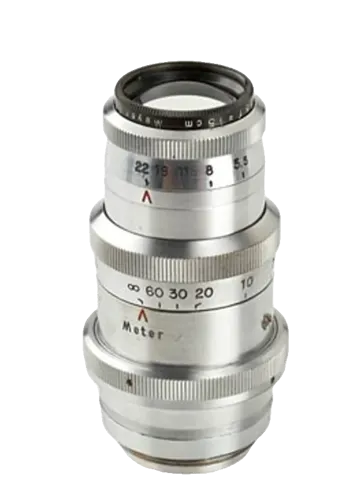
Tele-Megor 150mm f/5.5
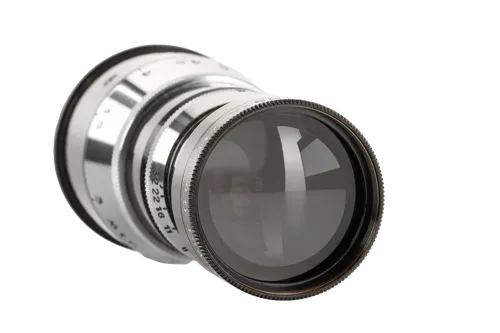
Tele-Megor 180mm f/5.5
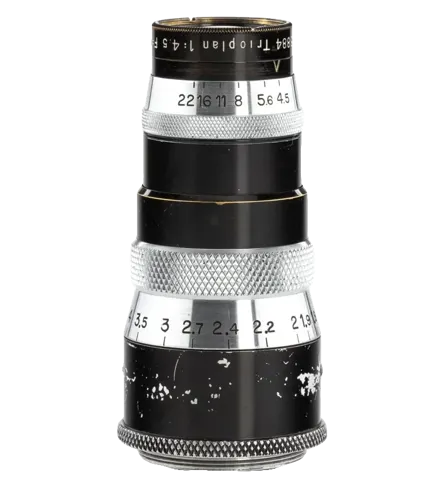
Trioplan 105mm f/4.5
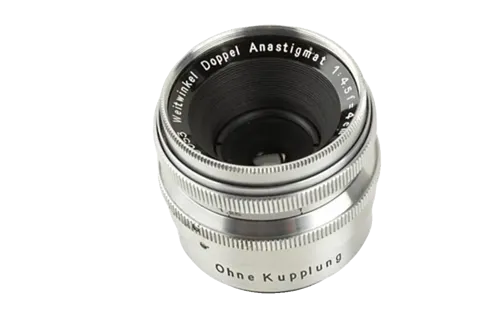
Weitwinkel Doppel Anastigmat 40mm f/4.5
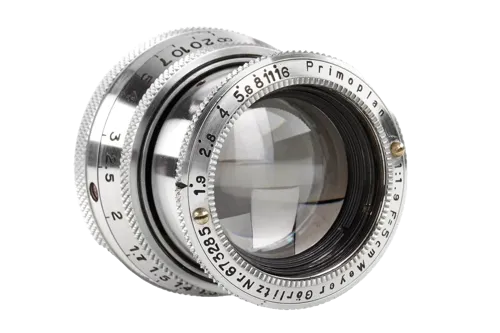
Primoplan 50mm f/1.9 (Collapsible)
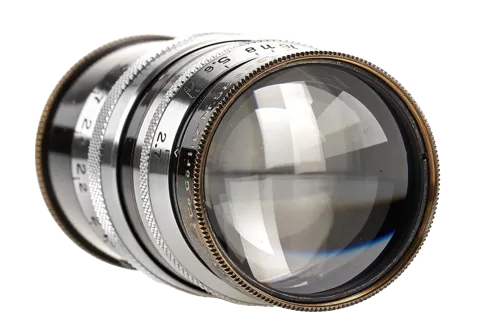
Comments