An original rangefinder-coupled 150mm f/5.5 Tele-Megor in Leica M39, using Meyer's four-element, two-group telephoto formula introduced after 1934.
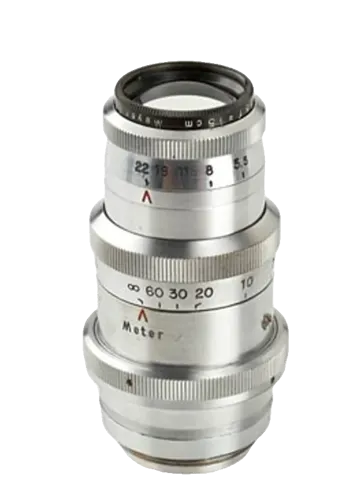
Meyer-Optik Gorlitz Tele-Megor 150mm f/5.5
LTM mount
No listings tracked for this lens right now.
The Meyer-Optik Gorlitz Tele-Megor 150mm f/5.5 is a LTM-mount lens for Leica rangefinder cameras. Leica price index →
Specification
About this lens
Meyer-Optik Gorlitz Tele-Megor 150mm f/5.5
The Meyer-Optik Gorlitz Tele-Megor 150mm f/5.5 is a manual-focus telephoto documented in an original Leica M39 mount with mechanical rangefinder coupling. The 150mm focal length was the shortest member of Meyer's early f/5.5 Tele-Megor range, which also extended to substantially longer lenses. The exact production year of the documented Leica example is not stated by the auction source, so this profile dates the optical family to the 1930s without assigning a precise year to the M39 barrel.
The early Tele-Megor formula uses four elements in two groups, with positive and negative groups separated to give a shorter physical barrel than a simple long-focus lens of the same focal length. It is a rigid, fully manual lens: aperture and focus are set on the barrel, and there is no automatic diaphragm or electronic communication. The exact diaphragm-blade count, minimum focusing distance, filter fitting, weight, dimensions and coating status of the coupled M39 version are not established by the sources reviewed here.
On a Leica screw-mount rangefinder the focusing cam can operate the camera's rangefinder, but composition requires a 150mm or adjustable external finder. The lens can be mounted on many Leica M bodies with a suitable M39-to-M adapter. Live view or an electronic finder is useful on compatible digital bodies because a 150mm lens magnifies small calibration errors and camera movement. A hood and stable support are practical additions for this focal length.
Optical qualities
Rendering
No controlled test of the exact rangefinder-coupled 150mm M39 version was found. Reviews of 180mm and 250mm Tele-Megors establish the behavior of related lenses, but differences in focal length, barrel, coating and condition prevent those results from defining this entry. The dependable description is functional: 150mm gives a narrow field of view, compressed perspective and useful subject isolation at portrait and distant-subject working distances, even with the modest f/5.5 maximum aperture.
Sharpness and contrast
The four-element, two-group construction has relatively few glass-air surfaces, yet actual contrast depends heavily on optical condition and internal reflections. Haze, separation, scratches, decentered groups or faded blackening can matter more than the nominal formula. Stopping down increases depth of field and may improve consistency across the frame, but no aperture-by-aperture measurements are available for this specific M39 lens. Accurate rangefinder calibration is also part of practical sharpness at 150mm.
Bokeh and separation
Long focal length can separate a subject from the background when the background is sufficiently distant. The shape and texture of defocused highlights depend on diaphragm geometry, focus distance and the individual lens, so the undocumented blade count should not be replaced with a value from another mount. Sample images from other Tele-Megors are useful as family references only and do not support a universal promise of smooth or structured blur.
Flare and color
Coating status is not stated for the documented M39 example. Early and later Tele-Megors span a period in which surface treatments and barrel finishes changed, making a visual inspection preferable to assumption. A deep hood can reduce veiling light, while color fringing and flare should be judged from the actual lens. A visibly low-contrast result may indicate age-related haze or internal reflection rather than the intended design alone.
History
Development and Launch
Meyer's Tele-Megor family followed the classic four-element telephoto principle that became broadly available to competitors after an earlier Zeiss patent expired in 1934. A historical lens survey places the early Tele-Megor line in the 1930s and lists 150mm, 180mm, 250mm and 400mm f/5.5 versions. The name compresses “Teleobjektiv,” “Meyer” and “Gorlitz.”
Production Evolution
Tele-Megors were made for several camera systems and in visibly different prewar and postwar barrels. Broader family sources list reflex and screw mounts and show that later lenses could use different diaphragm arrangements, finishes and mechanical fittings. Mechanical data from a measured 250mm M42 lens, including its filter size, blade count and minimum focus, do not apply automatically to the 150mm M39 lens.
Special Editions/Variants
The important distinctions are focal length, mount and focusing barrel. An original coupled Leica M39 lens differs from Exakta, M42, Praktina and later converted examples even when the optical name is the same. An M39 thread alone does not prove factory origin; the cam, flange register, barrel construction and engravings should agree with a documented original.
No commemorative or numbered special edition of the 150mm coupled M39 lens is established. Differences in caps, case, hood, finish or distance units should be recorded as attributes of the individual example unless a reliable catalogue ties them to a defined series.
Collector Notes
Check that the focusing helicoid moves smoothly, the cam travels consistently and infinity focus agrees with the intended body. At 150mm, small coupling errors are easy to see. Inspect both optical groups for haze, separation and cleaning damage, and confirm that the diaphragm moves freely. A practical focus test is more informative than assuming that every old M39 lens remains correctly calibrated.
The source record proves original coupled production but does not establish a production total or survival rate. Collector descriptions should therefore emphasize originality, condition and provenance rather than unsupported rarity rankings. Original accessories can add context, but they do not replace inspection of the mount and optics.
Sources
Where to buy
Related lenses
Similar lenses you might be interested in
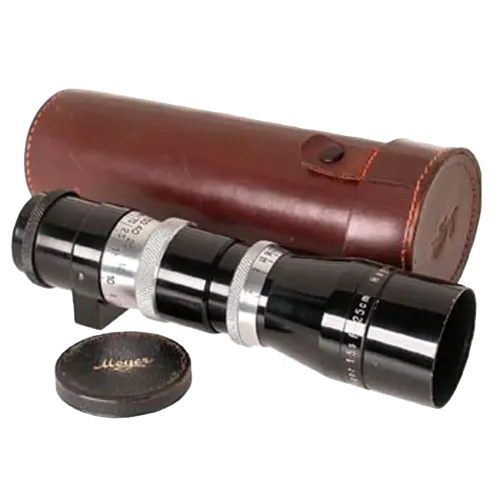
Tele-Megor 250mm f/5.5
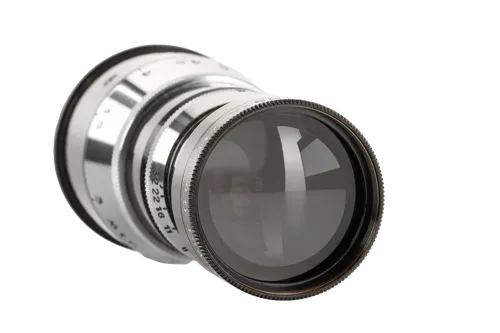
Tele-Megor 180mm f/5.5
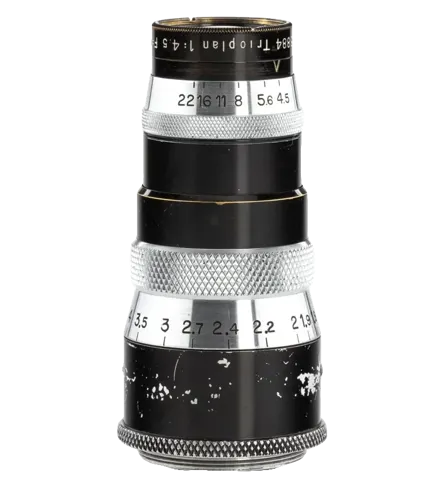
Trioplan 105mm f/4.5
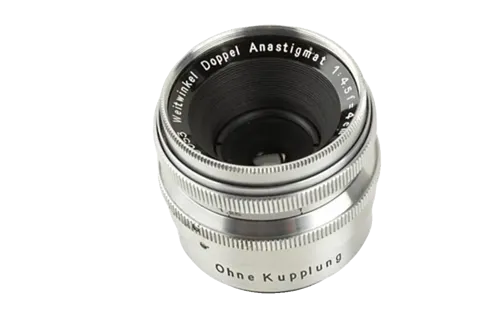
Weitwinkel Doppel Anastigmat 40mm f/4.5
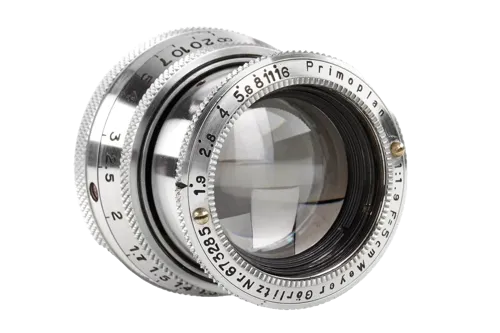
Primoplan 50mm f/1.9 (Collapsible)
Comments