A 1934 Meyer 180mm f/5.5 telephoto in its original rangefinder-coupled Leica M39 mount, a long-focus pre-war form distinct from later SLR versions.
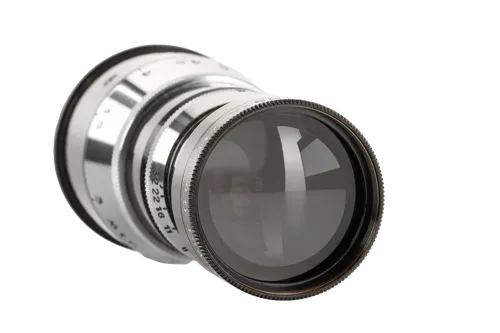
Meyer-Optik Gorlitz Tele-Megor 180mm f/5.5
LTM mount
No listings tracked for this lens right now.
The Meyer-Optik Gorlitz Tele-Megor 180mm f/5.5 is a LTM-mount lens for Leica rangefinder cameras. Leica price index →
Specification
About this lens
Meyer-Optik Gorlitz Tele-Megor 180mm f/5.5
The Meyer-Optik Gorlitz Tele-Megor 180mm f/5.5 is a pre-war long telephoto documented in an original Leica M39 focusing mount. The exact rangefinder version dates to 1934 and includes mechanical coupling, making it a native Leica-thread camera lens rather than a later SLR lens placed on an adapter.
Its 18cm focal-length engraving corresponds to 180mm in modern notation. The lens has a rigid focusing barrel, manual diaphragm and a long projecting optical assembly typical of an early telephoto. A period hood and leather case are documented accessories. Accessible exact-version material does not provide a reliable element and group count, diaphragm-blade count, minimum focus distance, filter fitting, mass or universal coating specification.
Later Telemegor 180mm f/5.5 lenses in Exakta, M42 and Praktina mounts are often described as four-element, two-group designs, but their barrel specifications and close-focus distances differ. Those later figures are not copied into this 1934 coupled M39 profile without evidence that the original rangefinder version is identical.
Classic Leica-thread cameras generally require an external 180mm or adjustable telephoto finder for framing. The lens can mount on a Leica M body with a suitable adapter, but most M finders do not provide a 180mm frame. Rangefinder calibration becomes particularly important at this focal length, and live view is the more direct focusing method on compatible digital cameras.
Optical qualities
Rendering
Dependable image testing for the exact 1934 coupled M39 Tele-Megor has not been located. Modern photographs made with later SLR versions establish that the broader 180mm family remains usable, but they do not prove the performance of the earlier rangefinder lens. Specific claims about softness, bokeh, contrast, distortion or flare are therefore omitted.
The f/5.5 maximum aperture gives substantially greater depth of field than a fast portrait telephoto at the same distance, yet precise focus can still be demanding because of the 180mm focal length. That geometric observation is not a substitute for measured resolution or aberration data.
Handling and digital use
The narrow angle of view magnifies camera shake and makes accurate framing more difficult than with a normal lens. A sturdy grip, faster shutter speed or support can improve practical results. On a classic rangefinder, the long lens also places a high demand on the accuracy of the camera's base length and the lens cam.
Mirrorless live view allows direct sensor-plane focusing and avoids dependence on a vintage rangefinder adjustment. It also makes the correct field of view visible without a separate finder. Any adapter must preserve the Leica register and provide secure support for the long barrel.
History
Development and Launch
Hugo Meyer of Gorlitz used the Tele-Megor name for a family of compact telephoto lenses produced in several focal lengths and mounts. Specialist sources explain the name as a contraction of telephoto, Meyer and Gorlitz. The line began before the Second World War and later continued through multiple camera systems.
The version catalogued here is securely documented as a 1934 18cm f/5.5 in original, rangefinder-coupled Leica M39 mount. This date places it near the early phase of the Tele-Megor family and before the much more frequently encountered post-war SLR barrels.
Production Evolution
The 180mm f/5.5 designation persisted for decades, but later examples adopted different finishes, focusing mounts, diaphragm mechanisms and camera interfaces. Specialist data sheets for 1950s SLR versions report specifications that should not be projected backward onto the 1934 LTM lens.
Accessible sources do not establish how long the coupled 18cm M39 version was offered or whether its optical formula changed. No production total or complete rangefinder-specific sequence is known. The original mount and 1934 dating are therefore more secure identifiers than any borrowed family specification.
Special Editions/Variants
No commemorative edition has been documented. Other pre-war Tele-Megors exist in different focal lengths, and later 180mm lenses were made in several SLR mounts. Those are related family members, not automatic variants of the exact coupled Leica-thread profile.
Aftermarket conversions also exist. A 39mm rear thread alone does not establish original LTM construction because other registers and custom helicoids can use the same nominal diameter. A genuine rangefinder version should have period-consistent focusing mechanics and a cam designed to operate the Leica coupling roller.
Collector Notes
The principal identification points are the Tele-Megor 18cm f/5.5 engraving, original Leica-standard screw mount, complete focusing barrel and functional rangefinder cam. It should not be catalogued from the specifications of a later black or silver SLR lens simply because the focal length and maximum aperture match.
For practical use, inspect the long barrel for play, verify the diaphragm, test infinity focus and compare rangefinder agreement at more than one distance. A compatible long-lens finder or live view is essential for accurate framing. Individual lens numbers and auction-copy condition do not belong in the generic description.
Sources
Where to buy
Related lenses
Similar lenses you might be interested in
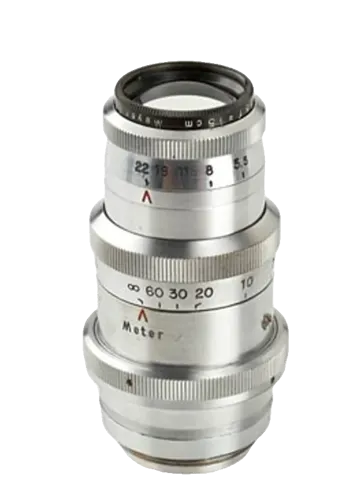
Tele-Megor 150mm f/5.5
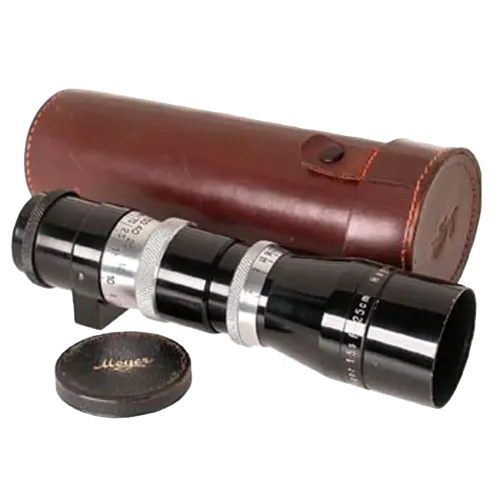
Tele-Megor 250mm f/5.5
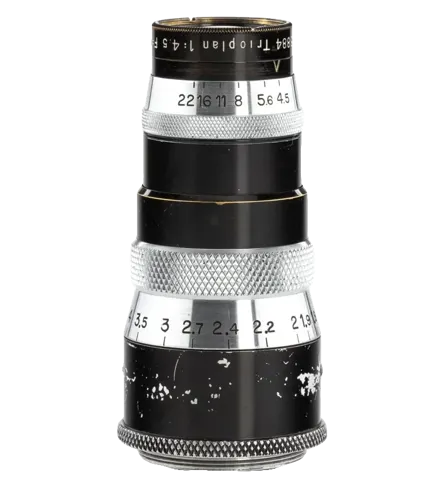
Trioplan 105mm f/4.5
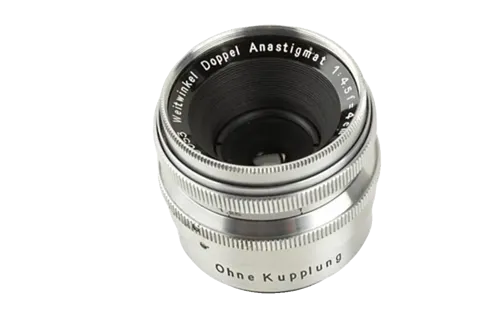
Weitwinkel Doppel Anastigmat 40mm f/4.5
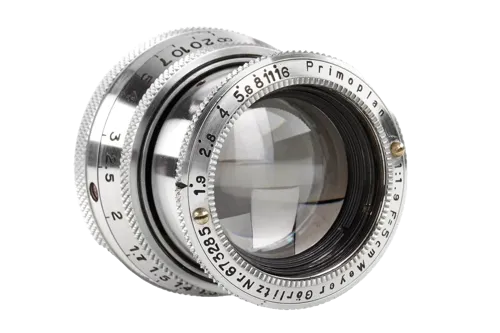
Primoplan 50mm f/1.9 (Collapsible)
Comments