A 1940s German 105mm f/2.7 portrait lens with six elements in five groups, original coupled LTM focusing, 15 blades and 1.5m close focus.
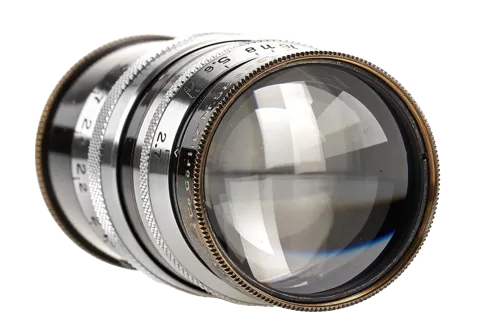
Meyer-Optik Gorlitz Makro-Plasmat 105mm f/2.7
LTM mount
No listings tracked for this lens right now.
The Meyer-Optik Gorlitz Makro-Plasmat 105mm f/2.7 is a LTM-mount lens for Leica rangefinder cameras. Leica price index →
How it compares
Measured against the 9 other 105mm LTM-mount lenses in the catalogue.
Specification
About this lens
Meyer-Optik Görlitz Makro-Plasmat 105mm f/2.7
The Meyer-Optik Görlitz Makro-Plasmat 105mm f/2.7 is a German short telephoto documented in a rangefinder-coupled Leica M39 barrel. Its optical construction uses six elements in five groups, and the substantial chrome-plated brass focusing mount incorporates a fifteen-blade diaphragm. The database records a minimum focusing distance of approximately 1.5 metres.
This profile is restricted to the coupled Leica-thread version of the historical 10.5cm f/2.7 lens. Makro-Plasmat optical units were supplied for other camera types, and modern APO-Makro-Plasmat revivals are separate products with different glass, coatings and mechanical specifications.
Optical qualities
Rendering
The Makro-Plasmat formula is associated with Dr. Paul Rudolph and is recorded here as six elements in five groups. A relatively fast f/2.7 aperture at 105mm provides selective focus and a narrow field of view suitable for portraits and isolated details. The construction should not be confused with the specifications of the modern apochromatic revival, even when both use the Makro-Plasmat name.
At wider apertures, central detail may be accompanied by lower global contrast and more visible residual aberration away from the focus plane. The transition into defocus depends on distance and background structure. The fifteen-blade iris keeps the opening relatively rounded as the lens is stopped down, but blade count alone does not guarantee identical bokeh in every scene.
At f/2.7
Full aperture gives the strongest subject separation and the shortest available exposure. Rangefinder calibration becomes important because depth of field is limited at portrait distance. Uncoated examples require particular care with oblique light, and a hood can help reduce veiling flare. Haze, separation and cleaning damage can lower contrast beyond the behaviour intended by the design.
The Makro name should not be read as a modern magnification claim for this barrel. A 1.5m close-focus limit is useful for portraiture but does not provide contemporary macro reproduction ratios. The historical designation belongs to the lens family and its period context.
Stopped down
Closing the aperture increases depth of field and usually improves contrast and field consistency. The middle settings are the more appropriate starting point when even detail matters across the frame. At the smallest apertures, diffraction limits fine resolution. No verified laboratory chart has been located for the coupled LTM version, so numerical claims are avoided.
Handling and compatibility
The heavy brass mount should be supported when used on an older screw-mount body. Its native coupling cam should agree with a calibrated rangefinder from infinity to the near limit. An accessory finder may be needed on bodies without a 105mm field. Mirrorless adaptation provides direct sensor focus but does not establish whether the original cam remains accurate.
History
Development and Launch
Paul Rudolph developed the Makro-Plasmat concept for Hugo Meyer during the interwar period. Jo Geier's historical account cites a German patent dated 19 August 1926 and describes the design as an attempt to provide strong correction using relatively modest surface curvature and without expensive heavy crystal glass.
The 105mm f/2.7 became a prominent Makro-Plasmat specification during the 1930s. Leitz Auction dates its documented coupled M39 example to the 1940s and records an uncoated optical unit in a heavy brass mount. The exact catalogue date for this rare Leica-thread execution remains unconfirmed.
Production Evolution
The wider 105mm family appeared in several camera mounts and focusing arrangements. Coated and uncoated examples are discussed in collector literature, but no complete factory chronology for the coupled M39 barrel has been located. Differences should be recorded per example rather than forced into unsupported generations.
The modern APO-Makro-Plasmat 105mm f/2.7 was inspired by Rudolph's work but uses modern coated glass and a newly manufactured barrel. It must not be merged with this historical coupled lens, particularly because modern Leica M versions are not rangefinder coupled.
Special Editions/Variants
Mount is the most important variant distinction. Lens heads intended for plate, roll-film or SLR cameras may later have been adapted to M39. This profile applies to the documented coupled Leica-thread configuration. A conversion without the appropriate cam is not the same commercial version.
Collector Notes
Verify the Hugo Meyer or Meyer Görlitz engraving, 10.5cm f/2.7 specification, heavy chrome-plated brass focusing mount and functional coupling cam. The fifteen aperture blades should move evenly. Check rangefinder agreement at several distances and confirm that the barrel reaches the recorded near limit.
Uncoated glass should be inspected for haze, fungus, scratches, separation and internal reflections. Provenance can be especially useful when establishing mount originality. Auction prices, condition grades and accessories describe an individual lot and are excluded from the generic profile.
Sources
Where to buy
Related lenses
Similar lenses you might be interested in
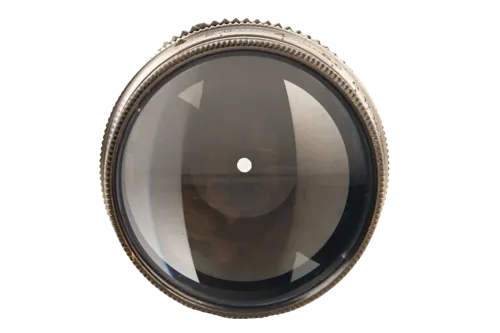
Trioplan 105mm f/2.8
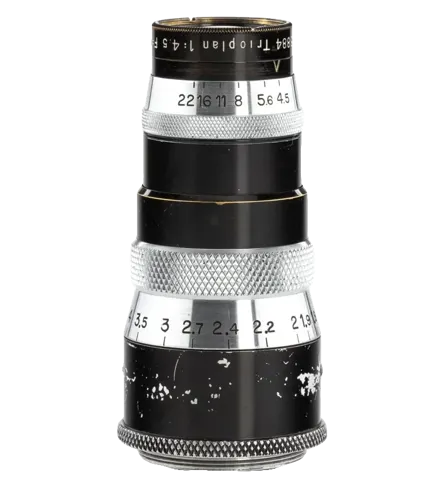
Trioplan 105mm f/4.5
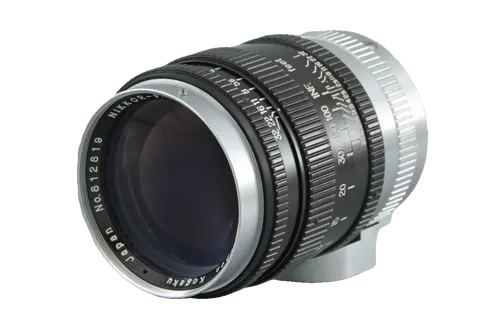
Nikkor-P.C 10.5cm f/2.5
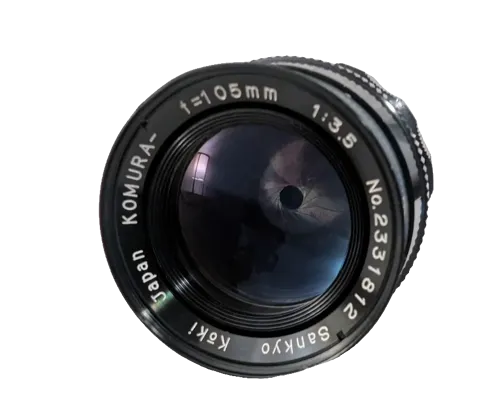
Komura 105mm f/3.5
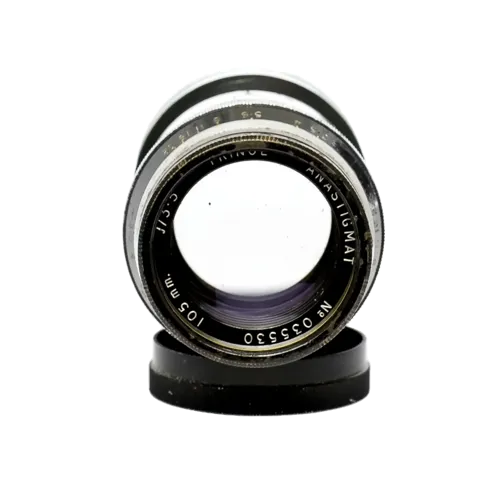
Trinol Anastigmat 105mm f/3.5
Comments