A 1930s uncoated Trioplan 105mm f/2.8 in original rangefinder-coupled Leica M39 mount, using Meyer's three-element, three-group triplet formula.
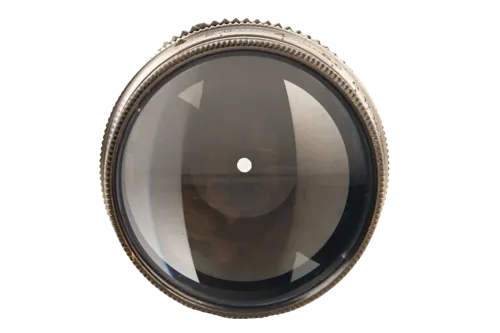
Meyer-Optik Gorlitz Trioplan 105mm f/2.8
LTM mount
No listings tracked for this lens right now.
The Meyer-Optik Gorlitz Trioplan 105mm f/2.8 is a LTM-mount lens for Leica rangefinder cameras. Leica price index →
How it compares
Measured against the 9 other 105mm LTM-mount lenses in the catalogue.
Specification
About this lens
Meyer-Optik Gorlitz Trioplan 105mm f/2.8
The Meyer-Optik Gorlitz Trioplan 105mm f/2.8 is a prewar short telephoto documented in an original, rangefinder-coupled Leica M39 mount from the 1930s. Leitz Auction describes the optics of the recorded example as uncoated. The 10.5cm focal-length engraving corresponds to 105mm, giving a field suited to portraits and selective details on 35mm film.
Trioplan identifies Meyer's three-element, three-group version of the Cooke triplet. Each element is air spaced, with the aperture between the second and third elements. The Leica lens is fully manual and has its own focusing helicoid and mechanical rangefinder cam. The exact diaphragm-blade count, minimum focusing distance, filter fitting, weight and dimensions of this M39 barrel are not published by the reviewed sources and are therefore left unspecified.
A screw-mount Leica can use the rangefinder coupling for focus, while framing normally requires a 105mm or adjustable external finder. A suitable M39-to-M adapter permits use on many Leica M cameras; a 90mm frame can only approximate the narrower 105mm view. On digital bodies, live view helps confirm focus and the true frame edges. A hood is useful with the documented uncoated optics.
Optical qualities
Rendering
No controlled test of the exact 105mm coupled M39 version was found. The wider Trioplan family is associated with pronounced highlight outlines under some conditions, but that reputation is based mainly on later 100mm lenses in reflex mounts. It should not be treated as a guarantee for every 105mm example. Focus distance, background structure, aperture and lens condition all change the result.
Sharpness and contrast
A triplet balances simplicity with useful correction, but pushes fewer elements to perform several tasks at once. At f/2.8, residual spherical and off-axis aberrations may be more visible than when the lens is stopped down. The documented lens is uncoated, so flare and internal reflection can lower contrast in difficult light. Exact center and corner performance should be judged from the individual example rather than imported from a 100mm Trioplan test.
Bokeh and subject separation
The 105mm focal length and f/2.8 aperture can produce shallow depth of field at portrait distances. Out-of-focus highlights may show a defined edge when the background contains small bright points, a behavior often discussed for triplet lenses. The strength of that effect is scene dependent and can diminish as the lens is stopped down. Diaphragm shape is also barrel specific, and the blade count of the original M39 version has not been established.
Color and flare
An effective hood helps prevent oblique light from washing across the uncoated surfaces. Haze, scratches, separation and changes to internal blackening can reduce contrast further and should not be mistaken for a fixed artistic signature. Color response also depends on film, sensor and processing, so this profile does not assign a universal palette to the lens.
History
Development and Launch
Meyer used the Trioplan name for a broad series of triplet lenses, with “Trio” referring to the three elements. Historical summaries place the line in the 1930s, although triplet-based Meyer lenses existed in several formats and roles. The better-known 100mm f/2.8 began as a medium-format design and was repurposed as a bright telephoto for 35mm cameras.
The 105mm f/2.8 was an early 35mm-format variation. JAPB lists it separately from the common 100mm version, and Leitz Auction confirms an original coupled Leica M39 example from the 1930s. The auction record establishes the mount, period and uncoated state of that example without providing a complete factory production chronology.
Production Evolution
Trioplan lenses appeared in numerous focal lengths, formats and camera mounts. The 105mm form preceded the later and more frequently encountered 100mm f/2.8 reflex lenses. After 1958, Meyer revised the 100mm line as the Trioplan N using different glass and fewer diaphragm blades. Those changes belong to the later 100mm product and should not be applied to the prewar 105mm M39 barrel.
Modern Trioplan-branded lenses introduced from 2015 onward use a related triplet concept with contemporary glasses, coatings and mounts. They are new products rather than continuations of the exact coupled 105mm Leica lens. Their focusing distances and rendering tests are not specifications for this profile.
Special Editions/Variants
The primary distinctions are the 105mm prewar lens, the later 100mm family and versions made for other formats. An original Leica M39 focusing barrel must be distinguished from an adapted cine or reflex lens. Rangefinder coupling, flange register and period construction are more probative than the presence of a 39mm thread alone.
The documented M39 lens was accompanied by a rear cap and black-painted aluminium hood. Those accessories describe one surviving set and are not a special edition. No numbered commemorative run or reliable factory production total was found.
Collector Notes
Confirm that the rangefinder cam, helicoid and infinity position agree on the intended camera. Fast 105mm focusing is sensitive to calibration, and an adapter can add another tolerance. Inspect the uncoated glass for haze, separation, scratches and cleaning damage, and ensure the diaphragm is dry and responsive.
Because the 105mm lens is less often illustrated than the 100mm Trioplan, provenance and an original barrel deserve careful documentation. Avoid identifying an adapted lens as factory M39 from thread size alone. The available sources do not support a numerical rarity or value statement.
Sources
Where to buy
Related lenses
Similar lenses you might be interested in
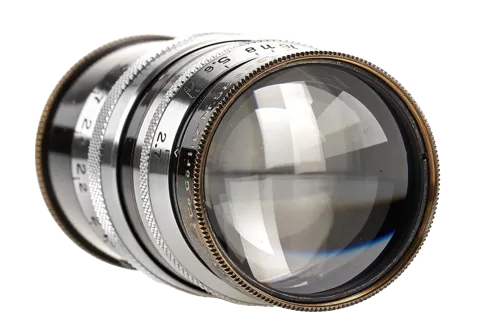
Makro-Plasmat 105mm f/2.7
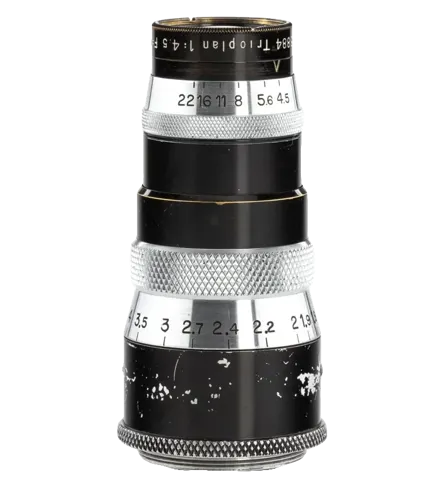
Trioplan 105mm f/4.5
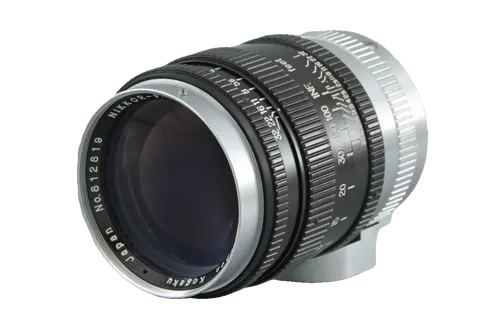
Nikkor-P.C 10.5cm f/2.5
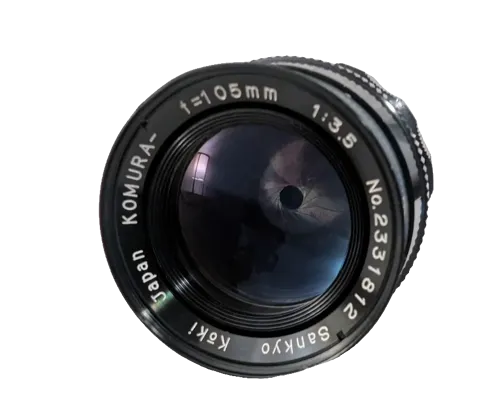
Komura 105mm f/3.5
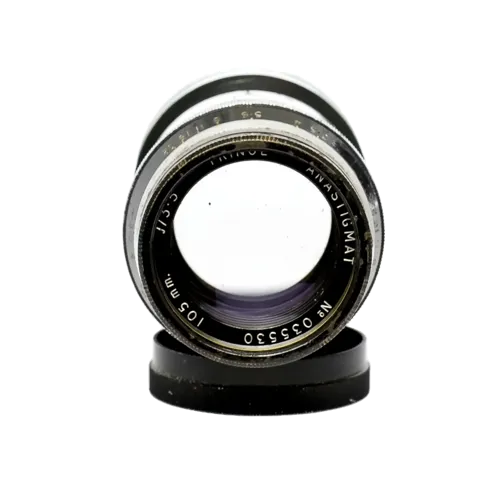
Trinol Anastigmat 105mm f/3.5
Comments