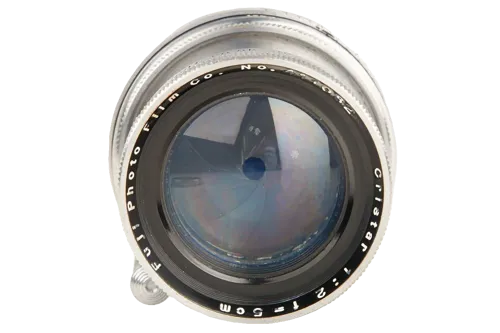
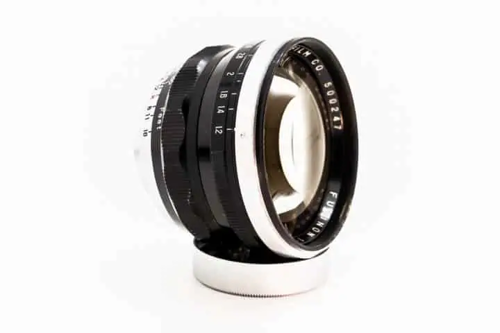
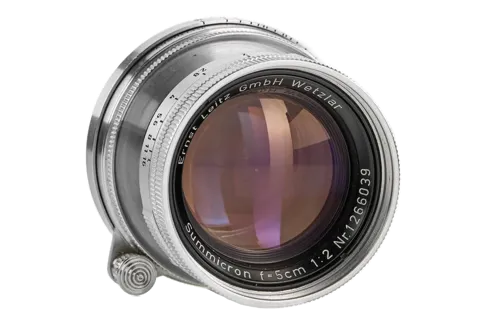
A 1957-era Fuji Photo Film 50mm f/2 standard lens for coupled Leica-thread rangefinders, with six elements in five groups and a black-and-chrome barrel.

Fujifilm Fujinon-L 50mm f/2
LTM mount
No listings tracked for this lens right now.
The Fujifilm Fujinon-L 50mm f/2 is a LTM-mount lens for Leica rangefinder cameras. Leica price index →
How it compares
Measured against the 108 other 50mm LTM-mount lenses in the catalogue.
Specification
About this lens
Fujifilm Fujinon-L 50mm f/2
The Fujinon-L 50mm f/2 is a late-1950s standard lens made by Fuji Photo Film for Leica-thread rangefinder cameras. Period-derived specialist documentation places its introduction around 1957, and Leotax research records the lens among the standard options supplied with late Leotax cameras. It is a native Leica M39 lens with its own focusing helicoid and mechanical rangefinder coupling.
The optical construction is documented as six elements in five groups. Specialist references also report a ten-blade diaphragm, a minimum focus of approximately 1 metre and a 43mm filter thread. The black barrel with a chrome front ring is consistently documented in surviving examples and distinguishes this lens visually from many all-chrome contemporary standards. A matching hood used a 45mm clamp-on fitting rather than screwing directly into the filter thread.
Aperture and focusing controls are fully manual. The 50mm focal length matches the normal finder field of most Leica-style cameras. On a Leica M body, a suitable 50mm LTM-to-M adapter preserves mechanical rangefinder operation when lens and camera are correctly calibrated. Other mirrorless systems can use a passive adapter and live view.
The make name is written here as Fujifilm for catalogue consistency, while the period manufacturer engraving and documentation use Fuji Photo Film. The L suffix identifies the Leica-thread application and should not be dropped when distinguishing this lens from Fujinons in other mounts.
Optical qualities
Rendering
A modern full-frame digital review of one Fujinon-L reports visible residual aberrations and reduced contrast in some wide-open photographs, followed by a marked increase in detail and contrast by approximately f/4. The review also describes a softer transition outside the plane of focus. These findings are useful exact-lens evidence, but they come from one surviving example and should not be presented as guaranteed behaviour.
The same test found the centre usable at f/2 and showed that stopping down produces a more even, higher-contrast result. No period factory MTF data or controlled multi-copy comparison has been located. Coating condition, internal haze, rangefinder calibration and element centring can therefore explain substantial differences between surviving lenses.
Bokeh and flare
The ten-blade diaphragm supports a comparatively rounded aperture shape through much of the range, but blade count alone does not determine background rendering. The modern review reports smooth out-of-focus areas in its test scenes and some flare behaviour it considered visually acceptable. Lighting, subject distance and sample condition remain decisive, so stronger universal claims are omitted.
Digital use
Live-view magnification is helpful for checking focus independently of a vintage rangefinder cam. On a coupled body, calibration should be tested at f/2 and at several distances before judging optical sharpness. A 43mm filter fits the documented thread, while the original-style hood clamps around a larger outer diameter.
History
Development and Launch
Fuji Photo Film produced a small range of Leica-thread lenses during the 1950s, including standard, wide-angle and telephoto focal lengths. Specialist cataloguing dates the Fujinon-L 50mm f/2 to 1957. Contemporary Leotax research shows that Fuji's f/2 and f/2.8 5cm lenses entered the Leotax system during the final generations of the company's Leica-style rangefinders.
The f/2 lens is associated particularly with the Leotax T2 and K3 era around 1958, while surviving camera records indicate that it also appeared on some Leotax T and K bodies and remained available into the following lever-wind generation. This broader evidence is more informative than treating any single auctioned lens as a complete production history.
Production Evolution
Leotax collector research indicates that the Fujinon options arrived somewhat earlier and remained in use somewhat longer than a simple one-model association suggests. A modern review mentions more than one barrel form, including later lenses with a focusing lever, but accessible factory documentation does not establish a precise change date or a revised optical formula.
No dependable production total is stated here. A figure repeated in modern reviews has not been corroborated by a period Fuji record, so it is omitted. The six-element, five-group construction, coupled LTM mount and 43mm filter fitting are more consistently documented than the boundaries of the production run.
Special Editions/Variants
Black-and-chrome examples are the standard documented form. A focusing-lever variation has been reported, but there is not enough evidence to define it as a separate optical version. No commemorative or special-edition production has been established.
Collector Notes
The key identification points are the Fujinon-L engraving, 5cm or 50mm f/2 specification, black-and-chrome barrel, native Leica-standard thread and rangefinder cam. It should not be confused with the slower Fujinon-L 50mm f/2.8, the much faster 50mm f/1.2, or Fujinon lenses made for other rangefinder mounts.
Collectors should verify the 43mm filter thread before buying accessories and note that the matching hood uses a 45mm clamp. For practical use, check the helicoid, diaphragm and rangefinder agreement at full aperture. The previously cited Steinheil Quinon page concerns an entirely different maker and lens and is deliberately excluded from this profile.
Sources
- Japanese Leica Copies, Leotax Fujinon Lensesleica-copies-japan.com →
- The Lens DB, Fuji Photo Film Fujinon-L 50mm f/2lens-db.com →
- Keith Wee, Fujinon 5cm f/2 LTM Reviewkeithwee.com →
- Leitz Photographica Auction, Fuji Fujinon-L 50mm f/2leitz-auction.com →
- Leitz Photographica Auction, Fuji Fujinon-L 50mm f/2 Coupled M39leitz-auction.com →
Where to buy
Related lenses
Similar lenses you might be interested in
![Chiyoda Kogaku Super Rokkor 50mm f/2 [C]](https://assets.leicalenslist.com/images/2063_medium.webp)
Comments