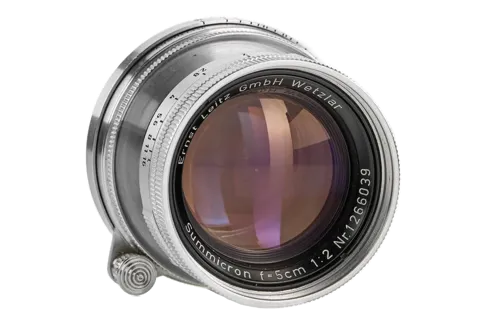
A 1949 Japanese collapsible 50mm f/2 standard lens with six elements in four groups, original coupled Leica M39 focusing and 1.07m close focus.
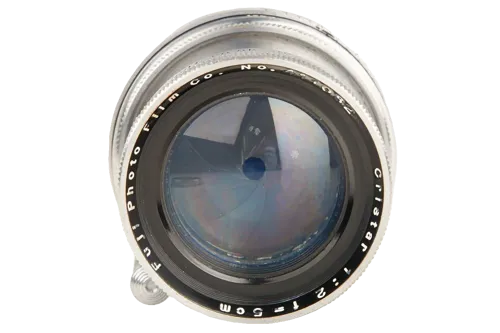
Fujifilm Cristar 50mm f/2
LTM mount
No listings tracked for this lens right now.
The Fujifilm Cristar 50mm f/2 is a LTM-mount lens for Leica rangefinder cameras. Leica price index →
How it compares
Measured against the 108 other 50mm LTM-mount lenses in the catalogue.
Specification
About this lens
Fujifilm Cristar 50mm f/2
The Fujifilm Cristar 50mm f/2 is an early Japanese standard lens in a collapsible, rangefinder-coupled Leica 39mm screw mount. Lens DB dates the model to 1949 and records six elements in four groups with a 3.5-foot minimum focusing distance. Leitz Auction documents an original factory-mounted example from approximately 1950 with an early blue-purple coating.
Its 50mm focal length and f/2 aperture place it in the fast standard-lens class used for general photography on 24 by 36mm rangefinder cameras. The retractable tube reduces storage length, while the helical focusing mount operates a Leica-type rangefinder cam. The tube must be fully extended and locked before exposure.
Cristar predates the better-known Fujinon branding used on many later Fuji lenses. The name alone does not establish that every Cristar shares this optical formula, and the lens should not be treated as a Fujinon variant without model-specific evidence. Reliable sources used here do not provide its filter fitting, diaphragm-blade count, exact dimensions, or a factory production total.
Optical qualities
Rendering
The six-element, four-group layout belongs to the high-speed standard-lens tradition of the period. Leitz Auction describes the visible design as inspired by the Leitz Summitar, but that catalogue observation does not prove identical glass types, curvatures, spacing, or performance. The Cristar should therefore be documented by its own specifications rather than called a Summitar copy as an established fact.
At f/2, the shallow focus zone makes rangefinder accuracy and element alignment important. Stopping down normally increases field evenness and contrast, but no factory performance curves or controlled tests of multiple Cristars have been located. Optical condition can easily dominate the appearance of a lens made around 1950.
Contrast and flare
The auction record explicitly notes an early blue-purple coating on one original example. It is evidence that coated Cristars exist, not proof of a named coating process or identical colour across all production. Haze, cleaning wear, degraded blackening, and separation can reduce contrast. A period-style hood can help in backlight without changing the underlying optical formula.
Out-of-focus rendering
The 50mm focal length and f/2 aperture permit subject separation at closer distances. The source record does not establish a blade count, so highlight shape at different aperture settings remains uncertain. Smoothness, outlining, and any swirl should be evaluated from a known lens and shooting distance rather than presented as universal Cristar traits.
Collapsible handling and digital use
The coupled focusing range extends to approximately 1.07 metres. Before collapsing the barrel on a digital camera or adapter, check the available internal clearance because a retractable tube can approach the shutter or sensor surround. An LTM-to-M adapter permits use on Leica M bodies, while mirrorless live view bypasses the original rangefinder but still requires correct flange registration.
History
Development and Launch
Fujifilm traces its lens-manufacturing foundation to an Odawara optical-glass facility established in 1940. The Cristar appeared after the Second World War, when Japanese manufacturers were expanding camera and lens production for domestic and export markets. Lens DB's 1949 date and the circa-1950 auction example place it at the beginning of Fuji's interchangeable Leica-thread range.
Adopting the M39 screw standard provided compatibility with Leica cameras and Japanese bodies based on the same flange and coupling conventions. The Cristar was not merely an optical cell placed in an anonymous adapter. Its collapsible barrel and mechanical rangefinder cam form part of the original product identity.
Production Evolution
The available evidence is concentrated around the 1949 to 1950 period. It does not establish a precise end date, yearly quantities, or a later optical revision. Fuji subsequently used the Fujinon name widely, but no source located for this audit proves that the Cristar was simply renamed while retaining an unchanged formula.
Minor engraving, aperture-scale, and finish differences may occur among surviving lenses. These require comparison with period documentation before they are treated as chronological generations. Engraved marks noted on a single auction object should not be copied into the generic model profile.
Special Editions/Variants
No formally named Cristar editions have been verified. Early coating colour, barrel wear, caps, or a rear-mount inspection mark describe particular examples rather than distinct commercial models. Other collapsible Japanese 50mm f/2 lenses can resemble the Cristar mechanically, but maker engraving and optical identity remain decisive.
Collector Notes
Identification should include the Cristar 5cm or 50mm f/2 name, Fuji attribution, chrome collapsible barrel, original Leica screw thread, and coupled cam. Check that the tube extends and locks securely, infinity registration is correct, and the rangefinder agrees at closer distances. Play or tilt in the retractable assembly can affect image quality.
Inspect the early coating, cemented groups, aperture mechanism, and internal blackening. Auction rarity language, condition grades, serial numbers, and sale estimates apply only to the catalogued object. The lens should remain separate from later Fujinon-branded LTM standards unless documentary evidence establishes a direct model relationship.
Sources
Where to buy
Related lenses
Similar lenses you might be interested in

![Chiyoda Kogaku Super Rokkor 50mm f/2 [C]](https://assets.leicalenslist.com/images/2063_medium.webp)
Comments