A circa-1955 English collapsible 2-inch f/2 standard lens with six elements in four groups, coupled Leica M39 focusing and 1.07m close focus.
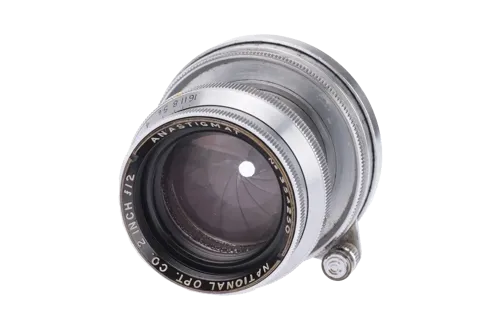
National Optical Company Anastigmat 2-inch 50.8mm f/2 (Collapsible)
LTM mount
No listings tracked for this lens right now.
The National Optical Company Anastigmat 2-inch 50.8mm f/2 (Collapsible) is a LTM-mount lens for Leica rangefinder cameras. Leica price index →
How it compares
Measured against the 108 other 50mm LTM-mount lenses in the catalogue.
Specification
About this lens
National Optical Company Anastigmat 2-inch 50.8mm f/2 (Collapsible)
The National Optical Company Anastigmat 2-inch 50.8mm f/2 (Collapsible) is an English standard lens made for Leica screw-mount rangefinder cameras around 1955. The engraved two-inch focal length is equivalent to 50.8mm and is the most precise way to distinguish the original specification from a rounded 50mm database category. Its native M39 mount is rangefinder coupled, the barrel retracts for carrying, and the recorded minimum focusing distance is 3.5 feet, approximately 1.07 metres. The optical construction is listed as six elements in four groups.
Optical qualities
Rendering
The 50.8mm focal length gives a conventional normal perspective on 35mm film. Framing is close to that of a nominal 50mm lens, and the small difference has little practical effect. At f/2, the lens permits a shallower zone of focus and shorter exposure than slower standard lenses of the period. Image character at that setting depends heavily on focus accuracy and optical condition. A low-contrast result from a hazy sample should not be presented as an inherent design signature.
At wider apertures
Near full aperture, the coupled rangefinder is especially useful because a small focusing error can move the plane of best detail away from the subject. The 1.07m close-focus limit is typical of a rangefinder-era standard lens and does not provide modern close-up magnification. Subjects can still be separated from a distant background, especially at head-and-shoulders distance.
Stopped down
Moving from f/2 toward the middle apertures increases depth of field and normally improves consistency away from the centre. This makes the lens more suitable for architecture, groups and general scenes where subject detail extends across the frame. The improvement should be evaluated on the individual lens, because decentring and previous repair can make one side behave differently from the other. No verified laboratory chart has been found for this exact National Optical Company version, so this profile avoids invented resolution figures or claims of perfectly corrected distortion.
Handling and compatibility
The collapsible tube reduces the stored length, while the focusing mount and rangefinder cam remain part of the fixed assembly. Before photography, the optical unit must be extended and secured in its operating position. The scale on the documented auction example is marked in feet, consistent with its British market context. Its recorded A36 accessory fitting accepts suitable clamp-on or slip-on accessories rather than a conventional modern threaded filter of the same nominal diameter.
History
Development and Launch
Auction and catalogue evidence places this lens in England around 1955. Leitz Auction identifies a coupled Leica M39 example made in England, while Christie's identifies the maker as National Optical Co. of Leicester and describes the fitting as Leica screw mount. Together, those records establish a British third-party contribution to the wider Leica-thread system during the post-war period.
The choice of two inches rather than 50mm reflects British and American photographic conventions that remained visible in mid-century lens engraving. An f/2 maximum aperture made the lens a comparatively fast normal option, and the collapsible barrel kept the camera package compact. The surviving sources do not give a precise announcement date, catalogue price or named optical designer.
Production Evolution
The consulted records document closely numbered surviving lenses and cite period British patents, but they do not provide a factory production ledger. A production total sometimes repeated in collector discussions cannot be verified from the sources used here and is therefore omitted. The safe conclusion is that the model is infrequently documented, not that a specific lifetime quantity is proven.
Special Editions/Variants
The most important comparison is with other British 2-inch f/2 collapsible lenses for Leica-thread or Reid cameras. Similar outward form has led to proposed links with Taylor, Taylor & Hobson products, yet the National Optical Company name and Leicester attribution are explicit in the auction records. This database therefore retains a separate profile. A verified maker's catalogue, patent assignment or optical section would be needed to establish a stronger manufacturing relationship.
No commemorative edition is documented. Differences in caps, cases or accessory fittings do not by themselves define special variants. A lens mounted in a non-original focusing barrel should be catalogued as an adaptation even if the optical unit is authentic.
Collector Notes
Identification should begin with the National Optical Company engraving, the 2-inch f/2 specification and the Leica screw fitting. The presence and operation of the rangefinder cam matter because plain M39 enlarger or camera lenses can share the same thread without supporting coupled focusing. The collapsible tube should extend smoothly and lock securely, and the feet scale should agree with measured focus.
As with any lens of this age, condition can dominate performance. Inspect for haze, fungus, coating marks, separation, oil near the diaphragm and play in the focusing mechanism. Check that the rear structure clears the intended body before collapsing it. Period caps and a correctly sized A36 accessory can add context, but provenance should not be inferred from accessories that could have been exchanged between lenses.
Sources
Where to buy
Related lenses
Similar lenses you might be interested in
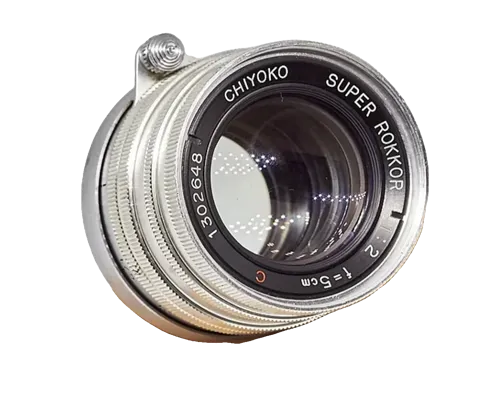
![Chiyoda Kogaku Super Rokkor 50mm f/2 [C]](https://assets.leicalenslist.com/images/2063_medium.webp)
Comments