A 1942 Fujita-made 50mm f/3.5 collapsible triplet in coupled Leica M39 mount, supplied with Showa Kogaku's Leotax Special rangefinder.
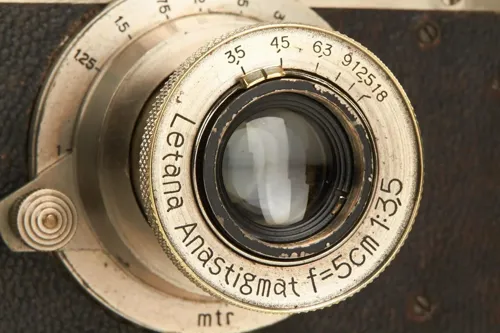
Leotax Letana Anastigmat 50mm f/3.5 (Collapsible)
LTM mount
No listings tracked for this lens right now.
The Leotax Letana Anastigmat 50mm f/3.5 (Collapsible) is a LTM-mount lens for Leica rangefinder cameras. Leica price index →
How it compares
Measured against the 108 other 50mm LTM-mount lenses in the catalogue.
Specification
About this lens
Letana Anastigmat 50mm f/3.5 (Collapsible)
The Letana Anastigmat 50mm f/3.5 is a Japanese collapsible standard lens made for early Showa Kogaku Leotax cameras. A documented example was supplied on the rangefinder-coupled Leotax Special of 1942, placing this version in Japan's small prewar Leica-copy industry. Research published by Japanese Leica Copies identifies Fujita Kogaku Kikai as the lens maker, although the camera itself was produced and sold under the Showa Kogaku name. The lens uses the Leica 39mm screw fitting and, in its Special-camera application, couples to the camera's rangefinder. Its retracting barrel follows the compact working principle familiar from contemporary collapsible 50mm lenses.
The most useful evidence for the optical construction is a report based on an actual dismantled Letana. It identifies three elements in three groups, making the lens a triplet rather than the four-element Tessar or Elmar type sometimes attributed to it in older references. The maximum aperture is f/3.5. Reliable documentation has not established the complete aperture scale, diaphragm-blade count, close-focus limit, filter fitting, or whether all surviving examples have identical coatings. Those details should therefore be checked on the individual lens rather than inferred from a Leitz Elmar or from a later Leotax standard lens.
The lens is intended for 35mm cameras using the Leica screw standard. It gives a normal-angle view and operates a compatible rangefinder when correctly adjusted. Mirrorless adaptation is possible with an L39 adapter, but provides no electronics, and clearance must be checked before the tube is retracted.
Optical qualities
Rendering
The triplet construction is the defining optical fact of the Letana. Three-element standard lenses can give useful central definition with a relatively simple transition toward softer outer zones at wide apertures, but no period test chart or manufacturer performance data for this exact lens has been located. It is therefore safer to describe the design than to promise a particular degree of sharpness, contrast, or correction. At f/3.5 the lens was a practical everyday optic for the film speeds and compact cameras of its period rather than a high-speed lens.
The dismantling evidence matters because a Tessar-type interpretation would imply a cemented rear pair and a different correction strategy. Stopping a triplet down generally improves field evenness, but results from a surviving Letana also depend on centring, surface condition, and correct extension of the tube.
Contrast and flare
No dependable source confirms a standardized coating specification for the 1942 Letana. Uncoated or lightly treated surfaces are susceptible to veiling flare, so a hood may help. Haze, cleaning marks, and internal reflections can affect a surviving copy more than the nominal design.
Out-of-focus rendering
No reliable blade count or controlled rendering study has been found. The 50mm focal length permits some separation at close distances, but does not establish a distinctive bokeh signature. Claims of universal swirl, glow, or softness are unsupported.
History
Development and Launch
Showa Kogaku's first Leotax cameras belonged to the early Japanese effort to produce compact 35mm cameras around the Leica layout. Japanese Leica Copies records the Letana 5cm f/3.5 as the standard collapsible lens on the original Leotax and on the later Special A and Special B. The Special models appeared in 1942 and added coupled rangefinders, which is the context documented by the Leitz Auction example. This gives the coupled M39 Letana a firm place in the wartime Leotax system.
The name on the camera and the maker of the lens should not be conflated. Contemporary corporate documentation is scarce, but the specialist history cites a Japanese government inquiry from April 1943 that identifies Fujita Kogaku Kikai as the manufacturer. Showa Kogaku was responsible for the Leotax camera line, while Fujita supplied the Letana optics. This division of labour is important because the front-ring name alone does not explain who calculated, assembled, or marketed the lens.
Production Evolution
The Letana preceded the better-known postwar Leotax standard lenses. It appears first with the original Leotax, which did not provide the same coupled-rangefinder arrangement, and then with the coupled Special A and B cameras. Consequently, not every Letana installation should automatically be described in identical mechanical terms. The lens profile here concerns the collapsible, rangefinder-coupled Leica M39 version documented with the 1942 Leotax Special.
Earlier summaries called the Letana a four-element Elmar or Tessar type, apparently because its barrel resembles the Leitz pattern. The specialist source instead reports a dismantled three-element example. Mechanical resemblance is not proof of optical identity, so this profile retains the triplet description.
Special Editions/Variants
The Letana name appears on the uncoupled original Leotax and the coupled Special models. No reliable table separates these installations by barrel, coating, diaphragm, or year, so minor engraving differences alone do not establish an optical variant.
Collector Notes
Identification should combine the full engraving, collapsible barrel, Leica screw fitting, rangefinder cam, and infinity position. The tube must extend and lock before use; a lens can fit an L39 body yet remain incorrectly calibrated. Auction condition and accessories describe one object, not the model. Dated Japanese catalogues and measurements from intact examples would improve the incomplete specification record.
Sources
Where to buy
Related lenses
Similar lenses you might be interested in
Comments