A rare Italian collapsible 5cm f/3.5 lens for Sonne Leica-copy cameras, associated with Officine Galileo and the former Koristka optical works.
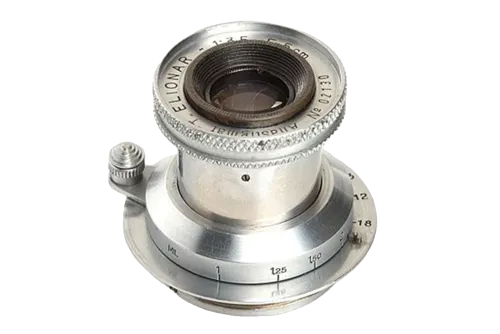
Officine Galileo T Elionar Anastigmat 5cm f/3.5 (Sonne)
LTM mount
No listings tracked for this lens right now.
The Officine Galileo T Elionar Anastigmat 5cm f/3.5 (Sonne) is a LTM-mount lens for Leica rangefinder cameras. Leica price index →
How it compares
Measured against the 108 other 50mm LTM-mount lenses in the catalogue.
Specification
About this lens
T Elionar Anastigmat 5cm f/3.5 (Sonne)
The T Elionar Anastigmat 5cm f/3.5 is a rare Italian collapsible standard lens associated principally with the Gatto Sonne series of Leica-copy rangefinder cameras. The Sonne cameras used an interchangeable 39×1 screw mount compatible with Leica screw-mount lenses, making the Elionar directly relevant to LeicaLensList rather than merely a fixed camera lens.
Historical attribution of the Elionar requires caution. Specialist Italian camera histories state that the standard 50mm f/3.5 lenses supplied with the Sonne were produced for Antonio Gatto by Officine Galileo, Gatto's former employer. Leitz Photographica Auction and CollectiBlend have catalogued surviving examples as Koristka T Elionar lenses. Koristka had itself been acquired by Officine Galileo before the Second World War and formed part of the broader Galileo optical manufacturing structure, which probably explains the differing attribution in collector literature.
The lens is normally encountered in a collapsible chrome barrel and was supplied on several Sonne models. Because detailed surviving technical documentation is scarce, exact optical formula, blade count, dimensions, weight and minimum focusing distance should remain unfilled rather than being inferred from superficially similar Italian 50mm f/3.5 lenses.
Optical qualities
Rendering
Reliable version-specific optical testing of the Elionar is extremely limited. It is a moderate-speed post-war 50mm anastigmat intended as the standard lens for an Italian Leica-compatible rangefinder. More specific statements about sharpness, bokeh, distortion or aberration correction cannot currently be made with collector-grade confidence.
Contrast and color
Later Sonne advertising refers to coated lenses intended for color photography, but coating specifications of individual Elionar production batches are not documented consistently enough to assign a universal coating type to every surviving example.
History
Development and Launch
Antonio Gatto began producing the Sonne series in Pordenone in 1948. The cameras were designed deliberately around the Leica concept and used a 39×1 interchangeable screw mount compatible with Leica lenses.
The Elionar 50mm f/3.5 was one of the standard lenses offered with the Sonne and appears from the earliest period of production. Other standard lenses offered later included Schneider Xenar and Xenon lenses.
Italian historical sources state that Gatto obtained its standard lenses from Officine Galileo. This relationship is historically plausible because Gatto had previously worked for Galileo and established his camera works in a former Galileo facility.
Production Evolution
The Elionar appears on the Sonne IV, V and later Sonne models. Surviving examples span the late 1940s and early-to-mid 1950s.
By the time of the later Sonne C4, Gatto offered several alternative 50mm lenses, including Schneider Xenars and Xenons alongside the Elionar.
Exact production totals for the Elionar itself are uncertain. One Japanese historical compilation proposes serial-number groups and a production total around the low thousands, but these figures have not been confirmed by surviving factory records and should not be treated as definitive.
Special Editions/Variants
No official special edition or separate catalogue number for the Elionar is confirmed.
Related Sonne standard lenses with names such as Adlenar and Eliog are documented. They should not automatically be merged into this profile because the surviving evidence does not prove that all names correspond to an identical optical formula.
Collector literature also attributes some T Elionar examples specifically to Koristka. This is best treated as a manufacturer-attribution issue rather than a separate optical edition until stronger documentation becomes available.
Special Editions/Variants
No major factory special editions with separate model numbers are reliably documented.
Koristka-attributed examples: Surviving T Elionar lenses have been catalogued by major collector sources under Koristka. This is an attribution distinction, not a confirmed separate edition.
Collector Notes
The first point to verify is the genuine original 39×1 Leica-compatible mount. The lens should be collapsible and compatible with the Sonne's interchangeable-lens system.
Collectors should retain photographs of the front engraving and serial number because manufacturer attribution remains historically complicated.
Leitz Auction has catalogued a T Elionar as a Koristka product, while specialist Italian historical literature assigns the Sonne Elionar supply to Officine Galileo. LeicaLensList should preserve this disagreement rather than silently choosing one attribution as unquestionably proven.
The collapsible mechanism, focusing cam, haze, coating and aperture should all be inspected. Original Sonne-matched examples are particularly interesting when the lens serial number and camera provenance can be documented together.
Historical lenses should not be judged from one sample alone. Haze, fungus, separation, cleaning damage, displaced elements and dried lubricant can alter contrast and focus more than modest design differences. Film choice, processing, digital sensor cover glass and adapter tolerances also influence results. A hood may reduce oblique flare but cannot correct internal contamination.
Sources
- Danilo Cecchi / Nadir Magazine. L'Industria Fotografica Italiana 3nadir.it →
- Leitz Photographica Auction. Koristka T Elionar Anastigmat 3.5/5cmleitz-auction.com →
- CollectiBlend. Koristka 50mm f3.5 T Elionar Anastigmat (M39)collectiblend.com →
- Mistermondo Italian Cameras. Gatto Sonne Vmistermondo.com →
- OstLicht Photographica Auction. Gatto Cav. Antonio, Pordenone Sonne Vdownloads.coelncameras.com →
Where to buy
Related lenses
Similar lenses you might be interested in
Comments