Best price Excellent
(865) ライカL用50mmf2.0 レオタックス・レオノン LEOTAX LEONON
Sold by Kikuya Camera & Watch
€151 ≈ $163
A rare 1959 Leotax 5cm f/2 coupled LTM standard lens with six elements in five groups, a ten-blade diaphragm and 40.5mm filters for Leica cameras.
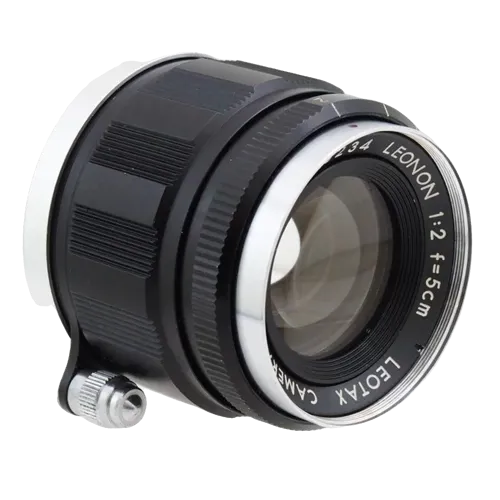
LTM mount
The Leotax Leonon 5cm f/2 is a LTM-mount lens for Leica rangefinder cameras. As of September 2026, it sells from €151 used across 1 listing, with a 30-day median of €151. Leica price index →
Measured against the 108 other 50mm LTM-mount lenses in the catalogue.
The Leotax Leonon 5cm f/2 is a Japanese LTM standard lens introduced in 1959 for the Leotax Elite rangefinder. It appeared near the end of Leotax camera production as a lower-cost alternative to standard lenses supplied by Tokyo Kogaku and Fuji Photo Film. Its Leica screw mount, mechanical rangefinder coupling and 50mm focal length make it fully relevant to LeicaLensList.
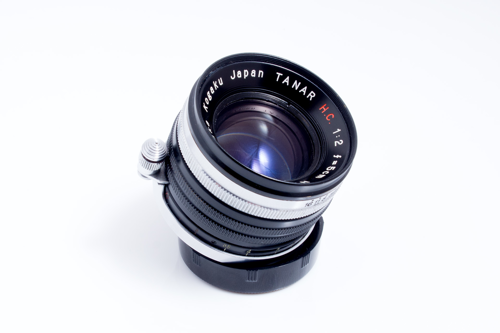
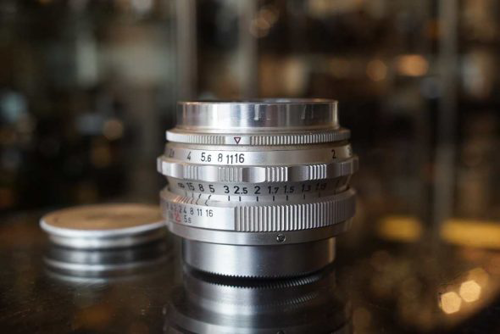
This entry covers the plain Leonon marked “LEONON 1:2 f=5cm” without an “S” suffix. A contemporary Leotax brochure identifies it as a six-element, five-group Gauss-type lens. It focuses to approximately 1 metre, accepts 40.5mm screw-in filters and has a ten-blade aperture closing to f/22. The barrel includes a chrome focusing lever but no infinity lock.
Rendering
Detailed controlled testing is limited, but repeated user comparisons describe the plain Leonon as having good central definition with lower microcontrast and weaker corner performance at wider apertures than the later Leonon-S. Its most consistently documented characteristic is strongly structured out-of-focus rendering rather than uniformly smooth blur.
Sharpness
Comparative testing indicates that the plain Leonon can be slightly sharper in the centre than the later Leonon-S, although the S version provides stronger microcontrast and better corner resolution at f/2. Results depend heavily on optical condition and accurate rangefinder calibration.
Bokeh and transitions
Out-of-focus highlights can show pronounced outlining and asymmetric brightness across the blur disc. Toward the edges, blur shapes become compressed and backgrounds can develop a busy or swirling appearance. The effect varies with subject distance, background structure and illumination, so it should not be expected in every photograph.
Contrast and flare resistance
The lens has coated optics, but no official coating name or specification has been confirmed. Contrast is generally lower than that of the later Leonon-S. Surviving examples with coating damage, haze or cleaning scratches may show substantially reduced contrast and increased flare.
Digital use
The lens can be used on Leica M cameras with an appropriate LTM-to-M adapter. Its mechanical rangefinder coupling should remain functional when the lens and adapter are correctly calibrated. It has no factory six-bit coding. Adaptation to mirrorless cameras is straightforward, but the approximately 1 metre minimum focusing distance remains unchanged unless a helicoid adapter is used.
Development and Launch
The plain Leonon was introduced as the standard lens for the later Leotax Elite, a version of the Leotax T2L rangefinder released in 1959. Earlier T2L cameras were commonly supplied with Topcor-S or Fujinon lenses, while the Elite name became associated with the more economical Leonon-equipped package.
Production Evolution
Leotax entered bankruptcy proceedings in October 1959. Cameras and remaining components continued to be sold afterward, but the final manufacturing date of the plain Leonon is not confirmed. It was followed by Leonon-S lenses associated with the Elite S2 around 1960.
The actual optical manufacturer remains uncertain. Several Japanese sources attribute Leonon lenses to Showa Koki, a separate company from Leotax maker Shōwa Kōgaku, but surviving factory documentation has not conclusively established this attribution. The lens should therefore remain catalogued under its Leotax branding.
Special Editions/Variants
Three visibly distinct 5cm f/2 lenses carry the Leonon name. The plain Leonon covered here has no “S” suffix, normally carries a 23xxxx serial number and closes to f/22.
A scarce early Leonon-S resembles the contemporary aluminum-bodied Topcor-S and is generally found with serial numbers around 59xxxx. A second Leonon-S has a different stepped front bezel, normally carries a 34xxxx serial number and was supplied with the Leotax Elite S2. Both S versions close to f/16 and should receive separate LeicaLensList entries rather than being combined with the plain Leonon.
No commemorative, military or export-only edition of the plain Leonon is confirmed.
Special Editions/Variants
No factory special editions or numerical product codes are confirmed. The two lenses marked Leonon-S are separate successor variants and should not be merged with this plain Leonon entry.
Collector Notes
The most reliable identification points are the absence of an “S” suffix, the “LEOTAX CAMERA CO., LTD.” front engraving, a 23xxxx serial number, f/22 minimum aperture and black barrel with chrome base and focusing lever. The lens accepts 40.5mm filters and does not have an infinity lock.
Some databases list the plain Leonon as a six-element, four-group lens. However, the Leotax brochure documented by specialist research describes the plain version as six elements in five groups. The six-element, four-group specification is more commonly associated with Topcor-S and later related designs.
Collectors should inspect the glass for haze, fungus, coating deterioration, fine scratches and separation. The aperture blades should be checked for oil, scuffing and smooth operation. Rangefinder calibration, focusing resistance and originality of the LTM mount are also important because lenses and camera bodies were frequently separated or exchanged.
About the usual price. The lowest listing is around the 30-day average.
Over the last 8 weeks the median price for the Leotax Leonon 5cm f/2 has risen, ranging from €146 to €152 (now €151).
Weekly price (EUR). Median (Good or better) and lowest (Good or better) across 8 weeks. The full figures follow in the table below.
| Week | Median | Lowest |
|---|---|---|
| Jul 27, 2026 | €146 | Unknown |
| Aug 3, 2026 | €147 | Unknown |
| Aug 10, 2026 | €147 | Unknown |
| Aug 17, 2026 | €148 | €148 |
| Aug 24, 2026 | €147 | €147 |
| Aug 31, 2026 | €150 | €150 |
| Sep 7, 2026 | €152 | €152 |
| Sep 14, 2026 | €151 | €151 |
Every shop grades differently. Leica Classic uses letters, Ffordes uses E++ and E+, German dealers write "Zustand B", Japanese dealers write A−. We map all of them onto the one ladder below. Where a shop states its own grade, we print it under ours.
As of September 2026, the Leotax Leonon 5cm f/2 sells from €151 used, with a 30-day median of €151, across 1 active listing.
As of September 2026, the Leotax Leonon 5cm f/2 is sold by 1 source (1 listing), from €151 used: all compared cheapest-first on this page.
Similar lenses you might be interested in
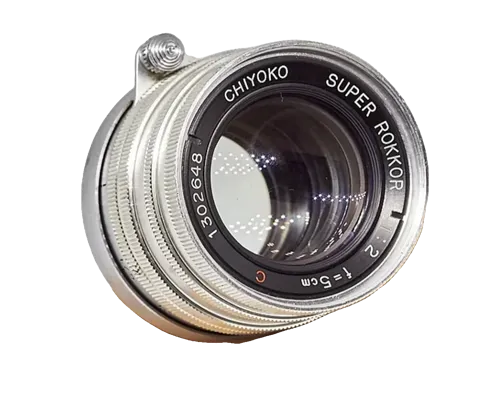
![Chiyoda Kogaku Super Rokkor 50mm f/2 [C]](https://assets.leicalenslist.com/images/2063_medium.webp)
Comments