Best price Good
LEITZ Leica Hektor L39 73mm/F1.9 Lens Yr.1933 LTM Germany #88504
Sold by M&K Kamera
€1,039 ≈ $1,122
Leica’s fast 7.3cm f/1.9 Hektor short telephoto, introduced in 1931 with three cemented doublets and several coupled and uncoupled LTM barrels.
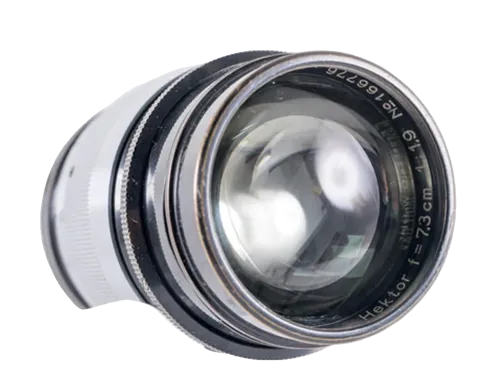
LTM mount
The Leica Hektor 7.3cm f/1.9 is a LTM-mount lens for Leica rangefinder cameras. As of September 2026, it sells from €1,039 used across 1 listing, with a 30-day median of €1,039. Leica price index →
The Leica Hektor 7.3cm f/1.9 is an early fast short-telephoto lens introduced by Ernst Leitz in December 1931. Designed for Leica screw-mount cameras, it was intended for theatre photography, indoor portraiture, reportage and other situations involving low light or greater working distances. Its 73mm focal length and f/1.9 aperture made it an important early high-speed lens within the developing Leica system.
The optical construction consists of six elements arranged as three cemented doublets. This compound-triplet formula provided only six air-to-glass surfaces, helping to limit reflections in an era before anti-reflection coating became standard. The lens has a twelve-blade diaphragm, a substantial brass focusing mount and a removable optical head. Most surviving examples focus to approximately 1.5 metres.
The Hektor was manufactured in several mechanically distinct forms. HEKON versions use a conventional rotating focusing mount, while HEGRA versions use a parallel, non-rotating mount developed for the early Agfacolor lenticular process. Early examples could be uncoupled, but most surviving lenses are mechanically coupled to the Leica rangefinder. Finishes include black and nickel, all-black and black with chrome focusing components.
Rendering
At f/1.9, the Hektor produces very low overall contrast, softly defined fine detail and increasingly blurred detail toward the outer image field. Leitz literature described a slight intentional softness intended to benefit pictorial portraiture. The transition from the focused plane into foreground and background blur is gradual, which contributes to its recognisable early portrait-lens rendering.
Sharpness
Stopping down to f/2.8 improves contrast and the clarity of outlines. Fine detail becomes more visible at smaller apertures, although the lens retains softer edge definition than later short telephoto designs. Optical condition can substantially affect the results obtained from surviving examples.
Contrast and color
Most civilian Hektors were originally uncoated. Consequently, they produce lower contrast than later coated Leica lenses, particularly under strong or scattered light. Some lenses were coated during later factory servicing, while a small number of wartime military examples received coating during production.
Flare resistance
Flare sensitivity is high, especially when direct or oblique light reaches the front element. The dedicated FGHOO reversible hood is useful for practical photography and is also an important original accessory for collectors.
Distortion
Published optical analysis reports no readily visible distortion, making the lens suitable for portraits and general short-telephoto photography when its lower contrast and wide-aperture softness are acceptable.
Digital use
Coupled examples can be mounted on Leica M cameras using an appropriate LTM-to-M adapter. Early uncoupled examples cannot provide mechanical rangefinder focusing. No factory six-bit coding exists. A 75mm viewfinder frame provides a useful approximation on compatible Leica M bodies, while Leica screw-mount cameras generally require a suitable external finder.
Development and Launch
The Hektor 7.3cm f/1.9 was developed at Leitz during 1931 and is generally associated with optical designer Max Berek. It was first offered for sale in December that year. The lens represented Leitz’s first attempt to combine a relatively long focal length with a large aperture for available-light photography.
Production Evolution
The earliest HEKON lenses used a rotating focusing mount and could lack external serial numbers or rangefinder coupling. Coupled HEKONKUP versions appeared with the introduction of Leica cameras equipped with built-in coupled rangefinders.
The HEGRA parallel mount was introduced during the early 1930s for use with the Agfacolor lenticular process. Its front section remained correctly oriented during focusing, allowing the colored filter lines to stay aligned with the film structure. Later lenses returned to the simpler rotating HEKON construction as lenticular color processes lost importance.
Special Editions/Variants
HEKON identifies the conventional rotating focusing mount. HEKONKUP denotes a rangefinder-coupled form, while HEKONCHROM is associated with later chrome-finished focusing components.
HEGRA, HEGRAKUP and HEGRACHROM identify versions of the parallel, non-rotating focusing construction. These variants are historically connected with the Agfacolor lenticular process and can carry a locating stud for the corresponding filter assembly.
Special Editions/Variants
Collector Notes
Collectors should first identify whether the lens has a rotating HEKON mount or a parallel HEGRA mount. The finish, focusing-ring width, infrared index, distance scale and rangefinder cam should then be checked against the serial number and period of production.
About the usual price. The lowest listing is around the 30-day average.
Over the last 8 weeks the median price for the Leica Hektor 7.3cm f/1.9 has fallen, ranging from €1,039 to €1,629 (now €1,039).
Weekly price (EUR). Median (Good or better) and lowest (Good or better) across 8 weeks. The full figures follow in the table below.
| Week | Median | Lowest |
|---|---|---|
| Jul 27, 2026 | €1,696 | €1,696 |
| Aug 3, 2026 | €1,704 | €1,704 |
| Aug 10, 2026 | €1,708 | €1,708 |
| Aug 17, 2026 | €1,630 | €1,039 |
| Aug 24, 2026 | €1,039 | €1,039 |
| Aug 31, 2026 | €1,039 | €1,039 |
| Sep 7, 2026 | €1,039 | €1,039 |
| Sep 14, 2026 | €1,039 | €1,039 |
Every shop grades differently. Leica Classic uses letters, Ffordes uses E++ and E+, German dealers write "Zustand B", Japanese dealers write A−. We map all of them onto the one ladder below. Where a shop states its own grade, we print it under ours.
As of September 2026, the Leica Hektor 7.3cm f/1.9 sells from €1,039 used, with a 30-day median of €1,039, across 1 active listing.
As of September 2026, the Leica Hektor 7.3cm f/1.9 is sold by 1 source (1 listing), from €1,039 used: all compared cheapest-first on this page.
Similar lenses you might be interested in
Comments