Best price New
Zeiss Biotar 75mm f1.5 converted to Leica M with RF coupling
Sold by Camera Obscura Elburg
€3,372 ≈ $3,641
A 1949 German 75mm f/1.5 portrait lens with six elements in four groups, coupled LTM focusing, 18 blades and a 1m close-focus limit.
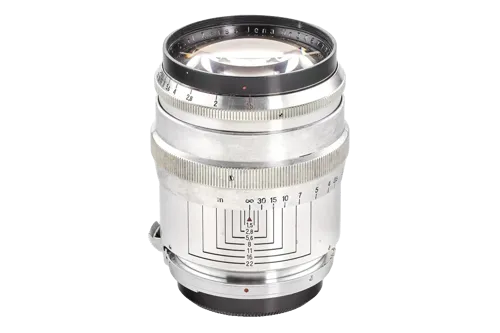
LTM mount
The Carl Zeiss Jena Biotar 75mm f/1.5 is a LTM-mount lens for Leica rangefinder cameras. As of October 2026, it sells from €3,372 used across 1 listing, with a 30-day median of €3,422. Leica price index →
The Carl Zeiss Jena Biotar 75mm f/1.5 is a high-speed German portrait lens documented in a rangefinder-coupled Leica M39 mount. The optical design uses six elements in four groups in a double-Gauss arrangement. The coupled postwar version recorded here has an eighteen-blade diaphragm, a chrome barrel and a minimum focusing distance of approximately 1 metre.
This profile is limited to the factory-style coupled Leica-thread lens documented from 1949. Far more Biotar 75mm lenses exist for Exakta and other SLR mounts. Those barrels, later aperture mechanisms and adaptations must not be merged with the LTM product solely because the optical name is shared.
Rendering
The six-element, four-group Biotar belongs to the double-Gauss family. Its relatively fast f/1.5 aperture and short-telephoto focal length make it suitable for selective-focus portraits and available-light work. At full aperture, the centre can show strong subject definition while residual field curvature, astigmatism and mechanical vignetting influence the outer image and out-of-focus highlights.
The lens is often associated with energetic or rotational background rendering, but that effect is scene dependent. It is strongest with textured backgrounds, particular focus distances and subjects placed near the centre. A plain or distant background can look much calmer. Describing every image as swirled would therefore overstate one possible behaviour.
At f/1.5
Depth of field is narrow at portrait distance, making accurate coupling essential. The 1m near limit permits tight framing without entering an uncoupled extension. The eighteen-blade iris has no effect when the lens is fully open, while at smaller settings it maintains a comparatively rounded opening.
The red T marking on the documented postwar lens denotes coating. A hood remains useful because a large front element and strong off-axis light can produce flare. Haze, cleaning damage and separation can reduce contrast independently of the original optical design.
Stopped down
Closing the aperture increases depth of field and generally improves contrast and edge consistency. The middle apertures provide a more even result for group portraits, landscape details and architecture. Diffraction eventually limits fine detail at the smallest settings. No universal best aperture applies because the intended balance between field coverage and subject separation changes by use.
Handling and compatibility
The substantial metal barrel is heavier than a typical 50mm screw-mount lens. It should be supported when attached to an older camera or adapter. The native coupling cam should be tested at infinity, portrait distance and the 1m limit. A 75mm accessory finder may be necessary for framing on bodies without matching framelines.
Development and Launch
The Biotar 75mm f/1.5 originated before the Second World War. Secondary histories date its introduction to 1939, initially in cinema or SLR-related contexts and soon as a fast lens for the Kine Exakta. Its speed made it suitable for reportage, theatre and sports photography at a time when film sensitivities were limited.
Leitz Auction documents a coated Carl Zeiss Jena example from 1949 in a rangefinder-coupled M39 screw mount. This provides direct evidence for the postwar Leica-thread configuration and its date without relying on a later workshop conversion claim.
Production Evolution
Postwar examples retained the 75mm f/1.5 optical identity while barrels, aperture mechanisms, coating marks and blade counts changed across the wider family. Later SLR versions can focus differently and may use fewer diaphragm blades. Those specifications cannot be transferred to the 1949 coupled LTM lens.
The surviving M39 documentary trail is much smaller than that for Exakta lenses. No complete factory production total has been verified, so market rarity language is not converted into an exact quantity.
Special Editions/Variants
The principal distinctions are mount, barrel generation, coating and diaphragm construction. This profile covers the coupled LTM, red-T, eighteen-blade version. Exakta, M42 and modern reproductions remain separate. A converted SLR lens may produce similar images but is not a native rangefinder version.
Collector Notes
Confirm the Carl Zeiss Jena and Biotar engravings, 1:1.5 f=7.5cm specification, red T, eighteen-blade iris and functioning coupled M39 cam. Compare the barrel with documented 1949 examples and test rangefinder agreement through the full focusing travel.
Inspect the large elements for haze, fungus, cleaning marks, coating loss and separation. The many-bladed diaphragm should move evenly and remain free of oil. Auction price, provenance and included accessories describe the individual sale rather than the model.
About the usual price. The lowest listing is around the 30-day average.
Over the last 4 weeks the median price for the Carl Zeiss Jena Biotar 75mm f/1.5 has fallen, ranging from €3,422 to €3,472 (now €3,422).
Weekly price (EUR). Median (Good or better) and lowest (Good or better) across 4 weeks. The full figures follow in the table below.
| Week | Median | Lowest |
|---|---|---|
| Sep 14, 2026 | €3,449 | €3,449 |
| Sep 21, 2026 | €3,431 | €3,431 |
| Sep 28, 2026 | €3,378 | €3,378 |
| Oct 5, 2026 | €3,372 | €3,372 |
Every shop grades differently. Leica Classic uses letters, Ffordes uses E++ and E+, German dealers write "Zustand B", Japanese dealers write A−. We map all of them onto the one ladder below. Where a shop states its own grade, we print it under ours.
As of October 2026, the Carl Zeiss Jena Biotar 75mm f/1.5 sells from €3,372 used, with a 30-day median of €3,422, across 1 active listing.
As of October 2026, the Carl Zeiss Jena Biotar 75mm f/1.5 is sold by 1 source (1 listing), from €3,372 used: all compared cheapest-first on this page.
Similar lenses you might be interested in
Comments