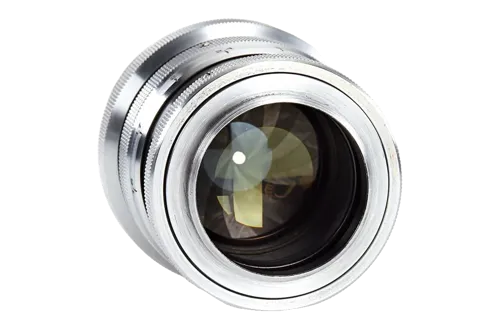
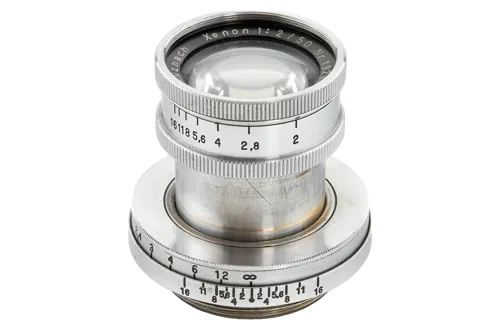
A factory uncoupled Leica-thread 80mm f/2 portrait lens documented in the mid-1940s, with its own rigid focusing barrel but no mechanical rangefinder cam.
Schneider-Kreuznach Xenon 80mm f/2 (Uncoupled)
LTM mount
No listings tracked for this lens right now.
The Schneider-Kreuznach Xenon 80mm f/2 (Uncoupled) is a LTM-mount lens for Leica rangefinder cameras. Leica price index →
How it compares
Measured against the 4 other 80mm LTM-mount lenses in the catalogue.
Specification
About this lens
Schneider-Kreuznach Xenon 80mm f/2 (Uncoupled)
The Schneider-Kreuznach Xenon 80mm f/2 is a fast short-telephoto lens documented in an original, factory-made Leica M39 mount during the mid-1940s. This profile is specifically for the uncoupled rangefinder version. It has its own focusing barrel and distance scale, but no mechanical cam to transfer the focused distance to a Leica-type rangefinder.
The native screw mount distinguishes it from projection, enlarging and cine Xenon cells that may also appear with 39mm threads or later custom adaptations. Original Leica-mount examples are documented in an all-black coated finish and in another factory M39 form from the following year. The barrel is rigid, not collapsible. Aperture setting and focusing are fully manual.
Accessible exact-version sources do not provide a dependable element and group count, aperture-blade count, minimum focus distance or filter specification. The wider Xenon family is historically associated with high-speed double-Gauss development, but a formula from another focal length, mount or production period cannot be assigned automatically to this 80mm M39 lens. Those fields should remain unknown until mount-specific factory documentation is located.
On a screw-mount Leica or compatible body, the lens must be focused by scale, external rangefinding or a separate focusing aid. An 80mm or suitable telephoto finder is also needed for framing on cameras without matching framelines. A Leica M adapter changes the mount interface but does not add rangefinder coupling. Mirrorless live view is therefore the most direct way to focus it accurately at f/2.
Optical qualities
Rendering
Dependable performance information for the exact uncoupled 80mm f/2 M39 version is limited. The auction records establish original mount, period, finish and coupling status, but they do not supply controlled image tests. Rendering descriptions from later Xenons, projection lenses or other focal lengths should not be transferred to this profile.
The f/2 aperture gives shallow depth of field at portrait distances, but that geometric fact is not evidence for a specific bokeh signature, contrast level or sharpness pattern. Coating is documented for the all-black 1946 form, while a universal coating specification for every factory M39 example is not established by the sources reviewed.
Digital use
Mirrorless cameras allow direct sensor-plane focusing through magnified live view and avoid the uncoupled rangefinder limitation. Adapter register accuracy remains important for reaching infinity. On a Leica M body, the lens remains scale focused because no passive adapter can create the missing cam movement.
No claim is made here that digital results represent the original factory specification. Internal haze, coating wear, element alignment and previous conversion work can substantially affect a lens of this age, especially when examples with other original applications have sometimes been remounted.
History
Development and Launch
Schneider-Kreuznach developed the Xenon name around its high-speed lens work, beginning in the interwar period. The exact Leica-thread 80mm f/2 form documented here belongs to the immediate post-war continuation of that line. Leitz Photographica Auction records original uncoupled M39 examples from 1946 and 1947, while Schneider's own manufacturing-date archive independently places the relevant production period within the company's post-war chronology.
The 80mm focal length and f/2 aperture made it a short telephoto suited to portrait framing, but the absence of a rangefinder cam limited normal handheld focusing compared with coupled Leica-mount portrait lenses. Its factory M39 construction nevertheless places it within LeicaLensList scope as an original uncoupled LTM application.
Production Evolution
At least two documented factory examples establish that the lens existed across consecutive post-war years. One auction record describes a coated all-black original M39 version, while another describes an original uncoupled M39 lens from 1947. These records confirm finish and production variation, but they do not establish a complete chronological sequence or a change in optical formula.
No broader production period should be inferred from these two records alone. Likewise, later 80mm Xenons in enlarger, projection, medium-format or other camera mounts cannot be merged into this profile without proof that they share both the same optical unit and the same collector-relevant mechanical identity.
Special Editions/Variants
The coated all-black factory version is documented as part of the original M39 production. A second period example confirms another original M39 form. These are recorded as factory variants within the uncoupled profile, not as evidence for separate optical generations. No commemorative edition has been documented.
Collector Notes
The essential identification points are the Schneider Xenon 2/8cm engraving, an original Leica-standard rear mount, a complete focusing barrel and the absence of a rangefinder cam. Collectors should be cautious with lenses described only as M39. Projection and enlarging mounts may share the nominal diameter while using a different register, and later conversions can resemble a factory photographic mount.
The uncoupled construction must remain explicit in the title and description because it materially changes use. It should not be merged with any coupled conversion or another factory version unless reliable evidence shows that the mechanical identities are equivalent. Individual lens numbers are unnecessary for defining this generic profile.
Sources
Where to buy
Related lenses
Similar lenses you might be interested in
Comments