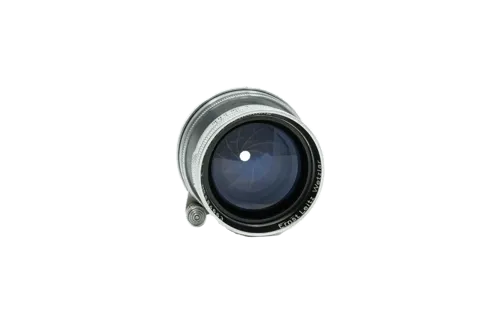
A 1948 German collapsible 50mm f/2 standard lens with a six-element, four-group design, coupled Leica M39 focusing and 1.2m close focus.
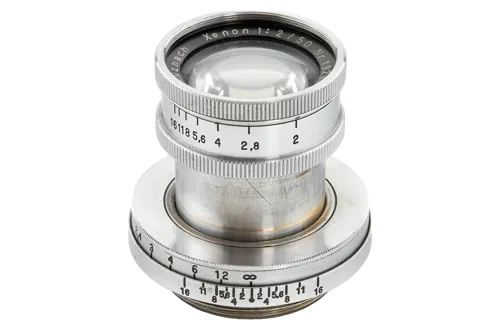
Schneider-Kreuznach Xenon 50mm f/2 (Collapsible)
LTM mount
No listings tracked for this lens right now.
The Schneider-Kreuznach Xenon 50mm f/2 (Collapsible) is a LTM-mount lens for Leica rangefinder cameras. Leica price index →
How it compares
Measured against the 108 other 50mm LTM-mount lenses in the catalogue.
Specification
About this lens
Schneider-Kreuznach Xenon 50mm f/2 (Collapsible)
The Schneider-Kreuznach Xenon 50mm f/2 (Collapsible) is a German standard lens made in 1948 for Leica screw-mount rangefinder cameras. Its combination of a 50mm focal length, f/2 maximum aperture and retractable barrel places it among the compact, relatively fast normal lenses offered to photographers in the early post-war period. This version is an original rangefinder-coupled M39 lens rather than a later adaptation. The recorded optical specification is six elements in four groups, and the focusing mount reaches 1.2 metres.
Optical qualities
Rendering
At 50mm on 35mm film, the angle of view is conventional and does not impose a strong wide-angle or telephoto perspective. The f/2 aperture allows selective focus at moderate distances and gives the lens practical scope in lower light. At full aperture, a period six-element standard lens can show lower edge contrast and more visible aberration away from the central subject than it does when stopped down. These are sensible expectations from the specification and era, not a substitute for a controlled test of this exact model.
At wider apertures
Used near f/2, focus accuracy matters because depth of field is limited at portrait and close working distances. The coupled focusing cam lets a compatible rangefinder body indicate distance, while the 1.2m minimum focus sets a clear mechanical limit. Out-of-focus areas depend on subject distance, background structure and diaphragm position; the available records do not establish a blade count, so this profile does not claim a particular highlight shape.
Stopped down
Handling and compatibility
The retractable barrel shortens the lens for carrying. It must be drawn out and locked in its taking position before an exposure; trying to use it while collapsed places the optics at the wrong extension. On an original Leica-thread body, focusing and rangefinder coupling should be checked together because wear, previous servicing or a non-standard cam can affect agreement. On a digital camera, an appropriate M39 adapter preserves infinity registration, but it does not guarantee safe clearance when the barrel is retracted. Users should confirm clearance for the particular camera rather than assume that every collapsible lens can be pushed fully inward.
History
Development and Launch
Schneider-Kreuznach traces its origins to the optical workshop founded in Bad Kreuznach in 1913. Its company history records continued work in photographic and cinema optics through the 1940s. The official manufacturing-date table and the dated Leitz Auction record both place this Xenon in 1948, when German optical production was being re-established after the Second World War.
The 50mm f/2 specification answered a familiar rangefinder requirement: a normal lens faster than the common f/2.8 and f/3.5 alternatives, but in a barrel compact enough for a small camera. The M39 mount widened its practical relevance beyond lenses made by Leitz itself. Surviving documentation is much thinner than it is for Schneider's later mass-market lenses, so the exact catalogue introduction and discontinuation dates remain unconfirmed.
Production Evolution
Leitz Auction describes a documented group made in 1948 and identifies its example as an original, collapsible, rangefinder-coupled M39 lens. That evidence supports the date and mechanical configuration. The auction house also assigns a very small batch size, but no factory ledger covering the complete production run has been located here. It is therefore safer to describe production as very limited in the documented record than to treat one stated batch as proof of the absolute lifetime total.
The available records do not demonstrate a sequence of revised optical formulas. Likewise, no reliable evidence has been found for a later change in minimum focus, filter fitting or diaphragm construction within this exact collapsible version. Differences between surviving examples should first be assessed as normal production details, servicing changes or replacement parts rather than assumed to be official generations.
Special Editions/Variants
The important variant distinction is mechanical. Schneider used the Xenon name widely, and 50mm Xenons exist in other apertures, mounts and barrel types. A collapsible 50mm f/2 made for another camera, a rigid M39 lens, or an adapted lens may resemble this model without being the same commercial product. Identification should combine the front-ring inscription, focal length and aperture with evidence of an original Leica-thread focusing mount and its coupling cam.
Collector Notes
For cataloguing, the most consequential checks are originality of the collapsible M39 assembly, operation of the locking mechanism and agreement between the focusing scale and rangefinder cam. A lens head installed in a later barrel should be described as a conversion, even if it can form images correctly. Engravings should be compared as a group rather than judged from one number or one cosmetic detail.
Sources
Where to buy
Related lenses
Similar lenses you might be interested in
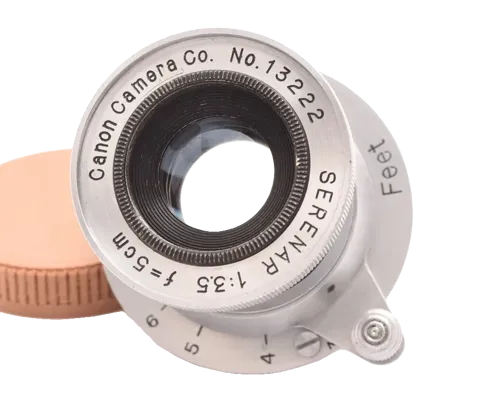
![Chiyoda Kogaku Super Rokkor 50mm f/2 [C]](https://assets.leicalenslist.com/images/2063_medium.webp)
Comments