A 1947 German 50mm f/1.5 standard lens with seven elements in five groups, original coupled LTM focusing and a rigid black-painted barrel.
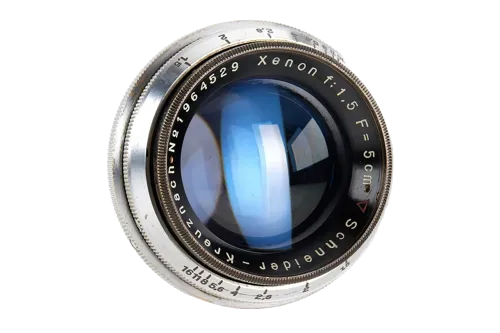
Schneider-Kreuznach Xenon 50mm f/1.5 (Rigid)
LTM mount
No listings tracked for this lens right now.
The Schneider-Kreuznach Xenon 50mm f/1.5 (Rigid) is a LTM-mount lens for Leica rangefinder cameras. Leica price index →
How it compares
Measured against the 108 other 50mm LTM-mount lenses in the catalogue.
Specification
About this lens
Schneider-Kreuznach Xenon 50mm f/1.5 (Rigid)
The Schneider-Kreuznach Xenon 50mm f/1.5 (Rigid) is a postwar German high-speed standard lens in an original rangefinder-coupled Leica screw mount. The recorded optical construction uses seven elements in five groups. A documented 1947 version has a rigid black-painted focusing barrel, distinguishing it mechanically and commercially from the more familiar collapsible Leitz-branded Xenon 5cm f/1.5.
This profile is limited to the Schneider-branded rigid 50mm lens. It does not combine the specifications of the Leitz Xenon, the later Summarit, Schneider Xenons made for other cameras, or collapsible Schneider-branded Leica-thread lenses. The diaphragm blade count, filter fitting and minimum focusing distance of this exact rigid version remain undocumented.
Optical qualities
Rendering
The database records a seven-element, five-group construction for this 50mm f/1.5 version. A verified factory section for the precise rigid 1947 barrel has not been located. It would therefore be misleading to transfer a diagram from a Retina, Exakta, Leitz Xenon or later Summarit.
Controlled testing of the exact Schneider-branded LTM version is scarce. The 50mm focal length gives a standard field on 35mm film, while f/1.5 permits selective focus and shorter exposures than slower contemporary lenses. Haze, separation, cleaning wear and previous servicing can affect surviving examples.
At f/1.5
Maximum aperture gives the shallowest depth of field and places the greatest demand on rangefinder and helicoid calibration. The coupled cam should be tested at infinity, at an intermediate distance and close to the lens's actual near limit. A camera and lens that agree at only one point may still produce displaced focus elsewhere.
No exact laboratory record supports fixed claims about wide-open corner resolution, bokeh, flare or colour. Those characteristics and the coating status should be assessed from the individual lens rather than inferred from its date or finish.
Stopped down
Closing the diaphragm increases depth of field and generally reduces residual wide-aperture aberrations. Middle settings suit subjects requiring more even detail. The smallest setting and highlight shape remain unknown until the aperture scale and blade construction are confirmed.
Handling and compatibility
The rigid barrel does not retract into the camera. Its native Leica M39 thread and coupling cam should work on a correctly adjusted LTM rangefinder, subject to the usual framing limits of the camera body. A 50mm finder is built into many later Leica screw-mount bodies; earlier bodies may require an accessory finder.
On a Leica M camera, a correctly indexed LTM-to-M adapter provides the bayonet interface and frame selection where supported, but cannot repair an inaccurate cam. Mirrorless adaptation permits direct sensor focusing. The unknown filter fitting should be measured rather than assumed.
History
Development and Launch
Schneider traces its foundation in Bad Kreuznach to 1913 and records an early emphasis on photographic and cinema optics. The Xenon name predates the Second World War. This rigid Leica-thread version belongs to Schneider's immediate postwar rangefinder production.
Leitz Auction documents an original rangefinder-coupled M39 example in black paint from 1947 and attributes a recorded issue of these lenses to November of that year. That evidence supports the 1947 date and factory-coupled identity. It does not by itself establish a complete lifetime production total, so no total is given here.
Production Evolution
The rigid black-painted Schneider barrel is the defining mechanical form in this profile. Other 50mm and 5cm Xenons appeared with different branding, finishes, mounts and focusing constructions. In particular, a collapsible barrel changes handling, storage and camera-clearance considerations enough to require separate treatment even when there is related optical lineage.
The records do not establish a sequence of diaphragm, coating or engraving revisions within this rigid product. An altered scale or replacement optical unit should be documented on the individual lens rather than presented as a factory generation.
Special Editions/Variants
No commemorative edition or separately catalogued special version of the rigid Schneider-branded 50mm f/1.5 has been reliably documented. Factory Leitz branding, a collapsible mount, a different focal-length engraving or a later workshop conversion should not be treated as a cosmetic variant of this entry.
Collector Notes
Identification should combine Schneider-Kreuznach and Xenon engraving, the 1:1.5 50mm or 5cm specification, a rigid black-painted barrel, Leica-standard M39 thread and a functioning rangefinder cam. A screw thread alone is insufficient because other 39mm standards use different registers. Compare the complete mount and cam with documented auction photographs.
Check rangefinder agreement, aperture movement, helicoid play and infinity position. Inspect for haze, fungus, separation, coating damage and incorrect reassembly. Serial numbers, auction condition, accessories and prices are not generic model data.
Sources
Where to buy
Related lenses
Similar lenses you might be interested in
Comments