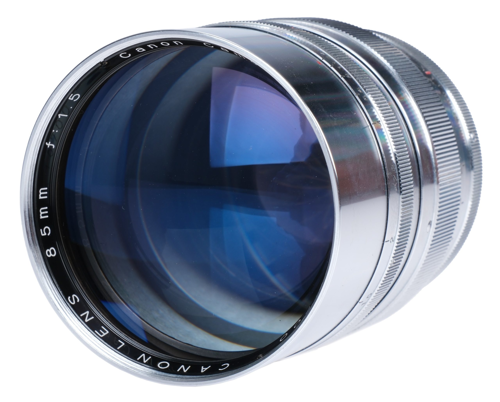
The Canon Serenar 85mm f/2 I is an early 1948 LTM portrait lens with six elements in four groups, rangefinder coupling and a heavy chrome barrel.
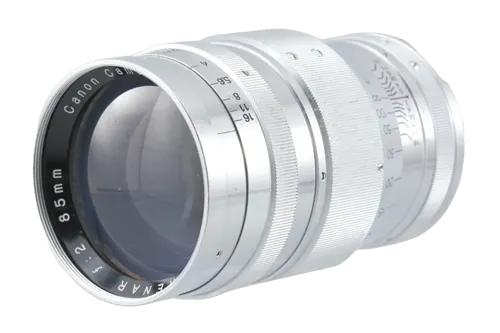
Canon Serenar 85mm f/2 I
LTM / M39 mount
No listings tracked for this lens right now.
The Canon Serenar 85mm f/2 I is a LTM / M39-mount lens for Leica rangefinder cameras. Leica price index →
How it compares
Measured against the 15 other 85mm lenses in the catalogue.
Specification
About this lens
Canon Serenar 85mm f/2 I
The Canon Serenar 85mm f/2 I is an early Japanese short-telephoto lens produced for Leica screw-mount rangefinder cameras. Introduced in January 1948, it was among Canon’s first dedicated portrait lenses and predates the better-known Serenar 85mm f/1.9, 85mm f/1.5 and later Canon-branded 85mm lenses. Canon records a six-element, four-group optical construction, a closest focusing distance of 1.07 metres, a 48mm filter fitting and a substantial weight of 556 grams .
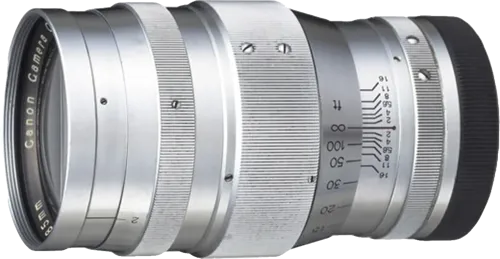
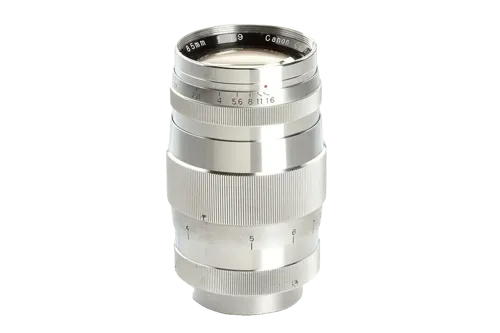
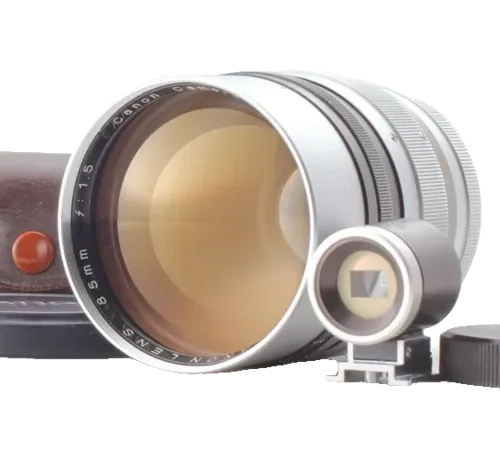
The original lens is built around a heavy chrome-plated brass focusing mount. Its comparatively compact diameter disguises its considerable weight, making it feel more substantial than many later aluminum-bodied rangefinder telephotos. The dedicated 85mm optical finder frequently supplied with the lens is an accessory and does not identify a separate optical version.
This entry covers the original Type I lens in Leica L39 / LTM / M39 screw mount. It should not be combined with the Serenar 85mm f/2 II, Serenar 85mm f/1.9, Canon 85mm f/1.8, Serenar 85mm f/1.5 or similarly specified Nikon and Soviet 85mm rangefinder lenses.
Optical qualities
Rendering
The Serenar 85mm f/2 I produces a distinctly early postwar rangefinder rendering. At full aperture it combines moderate contrast, visible light falloff and relatively gentle detail reproduction with useful subject separation. Contemporary digital-camera testing of a 1948 example describes the full-aperture image as slightly low in contrast, with neutral background rendering and considerable corner falloff .
The lens becomes more structured when stopped down. Around f/2.8, contrast and subject definition improve, while medium apertures provide a more even balance of sharpness and tonal separation. Its appeal is not modern clinical correction, but the combination of portrait-friendly focal length, smooth transitions and vintage tonal character.
Sharpness
Central sharpness can be useful at f/2, although spherical aberration, haze and focusing accuracy may soften fine detail. The image generally becomes clearer after stopping down, with improved contrast and more consistent detail across the frame.
Performance varies significantly between surviving examples. Internal haze, cleaning marks, element separation, previous disassembly and inaccurate rangefinder adjustment can all have a greater effect than the nominal optical formula.
Contrast and color
The lens was produced during the early coated-lens period, but coating condition varies between copies. A clean example can provide pleasing tonal separation, while haze or coating damage can produce noticeably reduced contrast and veiling flare.
A suitable hood is recommended, especially when shooting towards strong light. The relatively large front element and early coatings make physical condition particularly important.
Bokeh and transitions
The combination of an 85mm focal length and f/2 maximum aperture gives the lens substantial portrait separation. User reports commonly describe smooth backgrounds and rounded highlights, although the precise appearance depends on subject distance and aperture.
Published reports disagree about the diaphragm-blade count, with examples described as having either 15 or 20 blades . Because this may reflect production differences or incorrect counting, the blade count should remain unconfirmed until checked on a documented Type I example.
Distortion and vignetting
No reliable measured distortion data was found. Visible vignetting can occur at full aperture, particularly on digital full-frame sensors, and decreases after stopping down. Geometric distortion is not generally the principal concern for portrait use.
Handling
The lens is rangefinder-coupled and focuses to approximately 1.07 metres. Its long focusing movement supports precise adjustment, although the heavy brass barrel can feel slow compared with later Canon lenses.
An external 85mm finder is useful on screw-mount bodies without a matching frame. The finder, leather case, caps and any L39-to-M adapter should be recorded as accessories rather than incorporated into the lens name.
Digital use
The lens can be mounted on Leica M bodies using an L39-to-M adapter and on mirrorless cameras with suitable adapters. It has no six-bit coding or electronic communication.
Accurate rangefinder calibration is particularly important at f/2. On mirrorless bodies, magnified live view avoids coupling errors and makes it easier to assess the lens’s wide-open rendering.
History
Development and Launch
Canon marketed the first Serenar 85mm f/2 in January 1948. It was part of the company’s rapidly expanding postwar rangefinder system and provided Canon users with a faster portrait option than the slower 100mm and 135mm telephotos commonly available at the time.
The Serenar name was used by Canon before the company gradually transitioned towards simpler Canon Lens branding. These early lenses helped establish Canon as a serious Japanese competitor to Leica, Zeiss and Nippon Kogaku in the international rangefinder market.
Production Evolution
Canon recognizes two separate versions of the Serenar 85mm f/2. Version I was introduced in January 1948 and weighed 556 grams. Version II followed in September 1951 and retained the six-element, four-group formula, 1.07m minimum focusing distance and 48mm filter fitting, but increased in weight to 615 grams .
The later Type II should remain a separate database entry when version-level price tracking is desired. The two versions share core optical specifications, but differ in production period, barrel details and weight.
Special Editions/Variants
No commemorative factory special edition is documented. Collector-relevant variations include:
- Early and later front-ring engraving styles
- Canon Camera Co. and related manufacturer wording
- Minor barrel and focusing-mount differences
- Different focusing scales
- Original 85mm optical finder
- Dedicated hood, leather case and caps
These details should be recorded from the individual copy and should not automatically be treated as separate optical models.
Collector Notes
Collectors should verify the Serenar engraving, 85mm f/2 specification, serial number, Leica screw mount and rangefinder cam. Serial numbers in the early 50xxx range are consistent with the original production sequence, while later copies require closer comparison with the Type II barrel.
Condition checks should include haze, fungus, coating damage, element separation, scratches, oily diaphragm blades and stiff focusing grease. The brass construction makes the lens durable, but also places considerable load on the camera mount.
Sources
- Canon Camera Museum. *Serenar 85mm f/2 I*global.canon →
- Canon Camera Museum. *Serenar 85mm f/2 II*global.canon →
- Australian Photographic Collectors Society. *Back Focus No. 120, Canon early serial-number research*apcsociety.com.au →
- Five Star Camera. *Canon Serenar 85mm f/2 L39 LTM Leica Thread Mount + 85mm Viewfinder, serial 52096*five-star-camera.com →
- Mark O’Russa. *Canon Serenar 85mm f/2.0 Clean, Lubricate, Adjust*markorussa.wordpress.com →
- DPReview Forums. *1948 Canon Serenar 85mm f/2 Lens on the Sony A7*dpreview.com →
- Fotohandel Delfshaven. *Canon Serenar 85mm f/2 lens LTM / M39*fotohandeldelfshaven.nl →
Where to buy
Canon Serenar 85mm f/2 I: frequently asked
What filter size does the Canon Serenar 85mm f/2 I take?
The Canon Serenar 85mm f/2 I takes 48 mm screw-in filters (E48).
How close does the Canon Serenar 85mm f/2 I focus?
The Canon Serenar 85mm f/2 I focuses down to 1.07 m, and the rangefinder stays coupled over the whole range.
How heavy is the Canon Serenar 85mm f/2 I?
The Canon Serenar 85mm f/2 I weighs 556 g, lighter than 44% of the 9 other 85mm lenses in the catalogue.
Which cameras does the Canon Serenar 85mm f/2 I fit?
The Canon Serenar 85mm f/2 I is a Leica screw-mount (M39/LTM) lens. It fits Leica M bodies with a screw-to-M adapter, which keeps rangefinder coupling, and mirrorless cameras with an M39 adapter. It carries no 6-bit code, so select the lens profile by hand on a digital M.
When was the Canon Serenar 85mm f/2 I made?
The Canon Serenar 85mm f/2 I was produced from 1948 to 1951.
Related lenses
Similar lenses you might be interested in
Comments