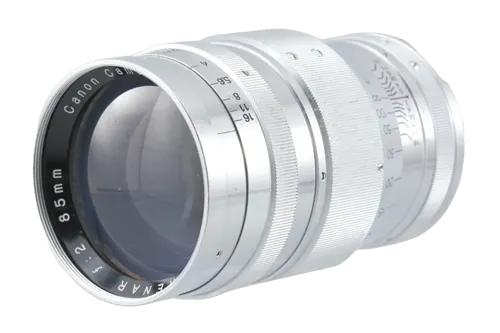
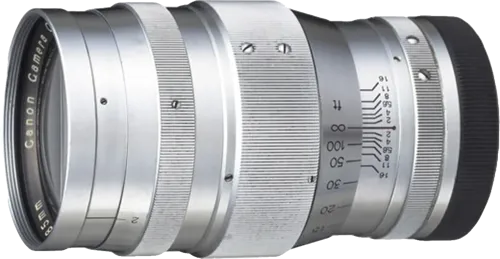
The Canon 85mm f/1.5 I is a fast Gauss-type LTM portrait lens of 1952, prized by Leica screw-mount collectors for its chrome build and rare optics.</parameter> <parameter name="long_description">## Canon 85mm f/1.5 I Among the fastest medium telephotos offered for Leica thread-mount cameras in the early 1950s, the Canon 85mm f/1.5 I was Canon's attempt to push the short-telephoto rangefinder lens to a wider aperture than most competitors of its day. Marketed in June 1952 under the Serenar name, it used a seven-element, four-group Gauss-type design and was developed from the earlier Serenar 85mm f/1.9 I of 1951, gaining a roughly one-stop wider maximum aperture in the process [1]. The same lens was sold both as a Serenar and later under the Canon brand name, reflecting the company's transition away from the Serenar label during the 1950s. The lens is a relatively heavy, chrome-finished optic built around a brass barrel, which accounts for its substantial weight in this first version. It carries a high blade count diaphragm for a smooth, near-circular aperture, focuses to one meter, and accepts screw-in filters on its front thread. As an early Canon screw-mount telephoto it mounts on Leica thread-mount (LTM/M39) bodies and the contemporary Canon rangefinders, and like most lenses of this type it relies on the camera body's rangefinder for focusing rather than on any electronic coupling. According to Canon's own records, the first version was subsequently improved into the Serenar 85mm f/1.5 II, which substituted a lighter aluminum-alloy barrel to reduce weight while retaining the same basic optical concept. The chrome first version is the heavier of the two and is the one most associated with the original Serenar branding. Collectors should be aware that 85mm f/1.5 lenses in the Canon line appear under both Serenar and Canon markings, and finish and engraving details are the main way to distinguish early from later barrels. --- ## Optical qualities **Rendering** Documented information on this specific lens is limited, so claims about its rendering should be treated cautiously. As a fast Gauss-type design from the early 1950s it would be expected to show the wide-open character typical of large-aperture lenses of its era, with best sharpness and contrast reached on stopping down. Its 20-blade diaphragm produces a nearly round aperture opening, which favors smooth out-of-focus highlights when the lens is closed down slightly. Beyond these design-based observations, there is little consistently sourced reviewer consensus on its rendering, and specific performance figures are not well documented. --- ## History **Development and Launch** Canon introduced the Serenar 85mm f/1.5 I in June 1952 as a large-aperture middle telephoto for its rangefinder system. It was based on the Serenar 85mm f/1.9 I of 1951 and represented a faster development of that earlier portrait-length lens, retaining a Gauss-type layout of seven elements in four groups. **Production Evolution** Canon records indicate the design was carried forward into the Serenar 85mm f/1.5 II, which replaced the original barrel with a lighter aluminum-alloy construction; the lens was also offered under the Canon brand name as the company phased out the Serenar designation. **Special editions** No major factory special editions, military variants, or unusual finishes of the 85mm f/1.5 I are widely documented; the principal distinction within the family is between the chrome first version and the lighter aluminum-barrel second version. **Collector Notes** This is a relatively uncommon early Canon fast telephoto, and auction and dealer records place values that rise sharply with condition, with clean examples commanding a considerable premium over average ones [2]. Buyers should confirm whether a given lens is the chrome first version or the later aluminum-barrel II, check the front element and internal glass for the haze and coating degradation common to early-1950s lenses, and verify that the diaphragm operates smoothly given the high blade count. Because the design was sold under both Serenar and Canon markings, name engraving alone does not always indicate version, so barrel material and finish should be checked as well. --- ## Sources * [1] Canon Camera Museum. *Serenar 85mm f/1.5 I*. https://global.canon/en/c-museum/product/s23.html * [2] CollectiBlend. *Canon 85mm (8.5cm) f1.5 Serenar (SM, chrome) price guide*. https://collectiblend.com/Lenses/Canon/85mm-f1.5-Serenar-(SM,-chrome).html
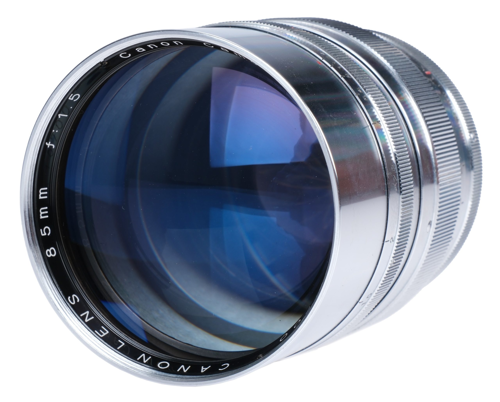
Canon 85mm f/1.5 I
LTM mount
No listings tracked for this lens right now.
The Canon 85mm f/1.5 I is a LTM-mount lens for Leica rangefinder cameras. Leica price index →
How it compares
Measured against the 14 other 85mm LTM-mount lenses in the catalogue.
Specification
About this lens
Canon 85mm f/1.5 I
Among the fastest screw-mount short telephotos of the early 1950s, the Canon 85mm f/1.5 was Canon's answer to the large-aperture portrait lenses offered by Leitz and others for the Leica thread mount. It was designed by Itō Hiroshi and reached the market in June 1952, developed from the earlier and slower Serenar 85mm f/1.9 of 1951 [1][2]. The first version, designated "I," is the heavy chrome-barrelled original; Canon later reworked the design into the 85mm f/1.5 II with a lighter aluminium alloy barrel. Production of the 85mm f/1.5 line ran into 1960, and surviving figures suggest it was made in modest numbers despite frequent appearances in Canon catalogues and advertising.
Optically the lens is a Gauss-type design with seven elements arranged in four groups, a relatively complex formula for a fast medium telephoto of the period. It uses a 20-blade diaphragm that closes to f/16 and focuses to one metre. The lens is supplied in the 39mm Leica thread mount and mounts on Leica M bodies through a screw-to-bayonet adapter, where it brings up the 90mm framelines on most cameras; like other Canon rangefinder lenses of the era, it is rangefinder coupled through the standard LTM cam, though originality of any individual sample should be confirmed before purchase. Build quality is solid, and the early chrome version is notably dense and heavy compared with later black-finished Canon telephotos.
Identification rests largely on finish and version: the "I" is the chrome original, while the later II adopted a lighter alloy barrel, and the family went through several iterations before production ended. Collectors should note that published specifications for the early chrome lens vary, and some sources record a larger filter thread and a heavier weight than those listed here, so it is worth measuring an actual lens rather than relying on a single catalogue figure.
Optical qualities
Rendering Documented impressions of the Canon 85mm f/1.5 come mainly from collector and user accounts rather than formal testing. The general consensus is that it can render with a soft, glowing quality wide open that firms up as it is stopped down, with smooth out-of-focus areas typical of a fast Gauss-type portrait lens. Reports of a slightly swirly background character appear among users, though such accounts are anecdotal and vary between samples and bodies. As with most uncoated-era or early-coated fast lenses, results depend heavily on the condition of the glass and coatings.
History
Development and Launch The 85mm f/1.5 was introduced in June 1952 as a fast complement to Canon's slower 85mm offerings for the Leica thread mount. It was designed by Itō Hiroshi and grew out of the Serenar 85mm f/1.9 of 1951, adopting a larger maximum aperture while retaining the Gauss-type layout. The lens carried the Serenar name in its earliest form and was also sold under the Canon brand as the company moved away from the Serenar designation in the early 1950s.
Production Evolution After the chrome "I" version, Canon revised the lens into the 85mm f/1.5 II, switching to a lighter aluminium alloy barrel while keeping the seven-element optical formula. The design continued through further iterations until production of the f/1.5 ended around 1960. Collector references indicate the lens sold in relatively small numbers across its run.
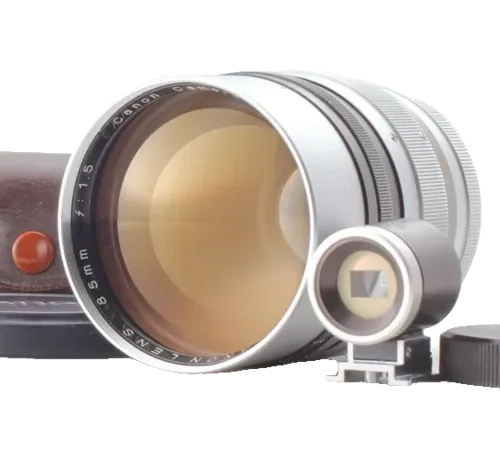
Collector Notes Buyers should verify which version they are handling, since the chrome "I" differs in weight and barrel material from the lighter later examples. Because it is a fast vintage lens, internal haze and coating condition are common concerns and have a direct effect on contrast and on the lens's tendency to glow wide open. Period accessories such as the correct clamp-on hood are sometimes substituted with later or incorrect types, so accessory originality is worth checking before buying.
Sources
Where to buy
Related lenses
Similar lenses you might be interested in
Comments