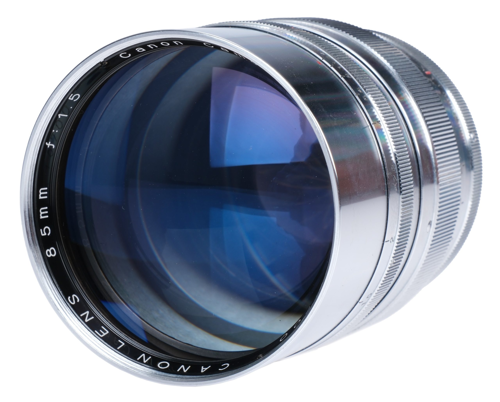
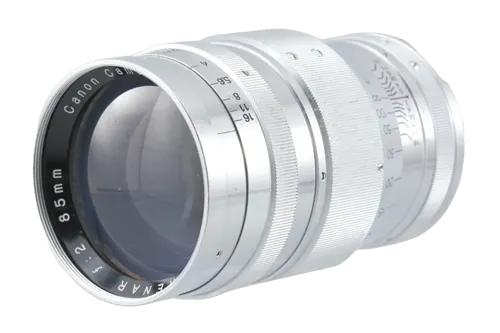
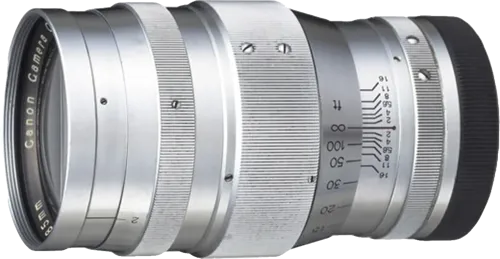
The Canon 85mm f/1.5 II is a fast Gauss-type LTM screw-mount portrait telephoto, the lighter alloy-barrel evolution of Canon's super-speed 85 prized by collectors.
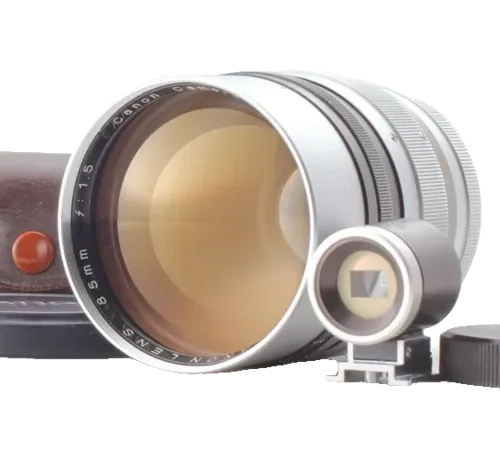
Canon 85mm f/1.5 II
LTM mount
No listings tracked for this lens right now.
The Canon 85mm f/1.5 II is a LTM-mount lens for Leica rangefinder cameras. Leica price index →
How it compares
Measured against the 14 other 85mm LTM-mount lenses in the catalogue.
Specification
About this lens
Canon 85mm f/1.5 II
Canon built this 85mm to compete at the top of the fast-telephoto class, answering the Leitz Summarex 8.5cm f/1.5 and the Nikkor 8.5cm f/1.5, the other "super-speed" portrait lenses available to rangefinder users in the early 1950s [4]. The optical design is a Gauss-type large-aperture medium telephoto with seven elements in four groups, attributed to designer Itō Hiroshi, and it was developed from the earlier Serenar 85mm f/1.9 [1][2]. The f/1.5 maximum aperture made it one of the fastest 85mm lenses of its day, and surviving examples are comparatively scarce: production of the f/1.5 ran from 1952 into 1960, with one collector source citing only 1,336 units sold despite frequent appearances in Canon catalogues and advertising, and Peter Kitchingman's figures placing total output in the low thousands.
In use the lens carries the standard Leica thread mount (M39) and focuses to one metre, with a 20-blade diaphragm that gives a near-circular aperture even when stopped down. It is a substantial optic at roughly 730 grams, reflecting its large fast glass and metal barrel. As an LTM lens it mounts on Leica screw bodies and, by adapter, on M bodies and mirrorless cameras; an external 85mm finder is needed on most rangefinders since the focal length falls outside many viewfinders' built-in frame lines.
The "II" designation refers to the barrel revision rather than an optical redesign. Canon's own records describe the original Serenar 85mm f/1.5 as being improved into the f/1.5 II by adopting a lighter aluminium-alloy lens barrel in place of the earlier heavier construction, while keeping the same Gauss optical formula. Early examples carry the Serenar engraving, with later production marketed under the Canon name; the type-1 Serenar version was a short first run, with one dealer reporting roughly 500 made in 1952[3].
Optical qualities
Rendering Documented impressions of this lens come mainly from collector and user reports rather than formal test data. Users describe it as a strong portrait lens, noting sharpness, pleasing colour and smooth out-of-focus rendering at and near full aperture. As a fast Gauss telephoto of its era it is generally used for portraiture and available-light work, where its shallow depth of field at f/1.5 is the main attraction. Detailed, independent measurements of distortion, vignetting and flare are not widely published, so claims beyond the general portrait character above should be treated with caution.
History
Development and Launch The f/1.5 grew out of Canon's Serenar telephoto line of the late 1940s and early 1950s. Canon first offered slower 85mm Serenars at f/2 and f/1.9, and the f/1.5 was developed on the basis of the Serenar 85mm f/1.9 to reach a faster aperture, using a Gauss-type configuration of seven elements in four groups. It was marketed from 1952, placing it among the fast portrait lenses that Japanese makers produced to rival European super-speed optics.
Production Evolution Production of the f/1.5 continued through the 1950s, with sources giving an end around 1960. The most significant change in the lens family was the move to the lighter aluminium-alloy barrel that defines the II, made without altering the optical design. The earliest Serenar-branded examples were produced in small numbers before the lens settled into longer production under the Canon name.
Collector Notes Buyers should distinguish the f/1.5 from the slower and more common 85mm f/1.9 and f/2 Serenars, which share the same focal length and similar barrels but are different lenses. Early Serenar-marked f/1.5 examples are scarcer than later Canon-marked ones. Because these are large fast lenses now around seventy years old, internal haze and coating condition are worth checking, as is the smoothness of the focus and the 20-blade aperture. The lens needs a dedicated 85mm viewfinder for accurate framing on most rangefinder bodies, and period caps, the correct screw-in filter and the matching finder add to collector value. Note that one collector listing cites a 58mm filter thread for the closely related f/1.5 type, which differs from the value recorded here; confirm the filter size on the specific example before buying.
Sources
Where to buy
Related lenses
Similar lenses you might be interested in
Comments