The Canon Serenar 85mm f/2 II is the heavier 1951 LTM portrait-lens revision, with six elements in four groups and a substantial 615g barrel.
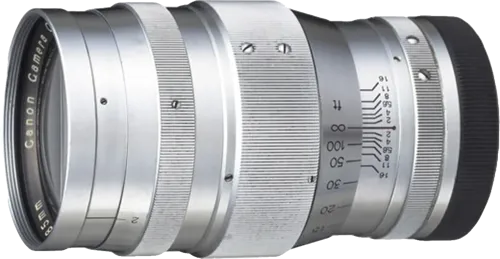
Canon Serenar 85mm f/2 II
LTM / M39 mount
No listings tracked for this lens right now.
The Canon Serenar 85mm f/2 II is a LTM / M39-mount lens for Leica rangefinder cameras. Leica price index →
How it compares
Measured against the 15 other 85mm lenses in the catalogue.
Specification
About this lens
Canon Serenar 85mm f/2 II
The Canon Serenar 85mm f/2 II is the second documented version of Canon’s early fast portrait lens for Leica screw-mount rangefinder cameras. Canon introduced Version II in September 1951, replacing the original Serenar 85mm f/2 I that had appeared in January 1948 .
Version II retains the six-element, four-group optical construction, 1.07-metre minimum focusing distance, f/16 minimum aperture and 48mm filter fitting of the earlier lens. Its most clearly documented specification difference is weight. Canon records 615 grams for Version II, compared with 556 grams for Version I. This makes the revised lens one of the heavier 85mm rangefinder lenses of its period.
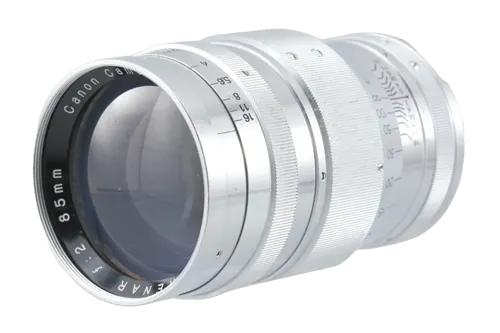
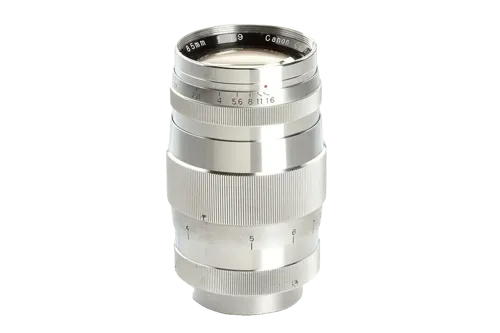
The lens was produced in Leica L39 / LTM / M39 screw mount and is rangefinder-coupled. Its substantial chrome-finished barrel, long focusing movement and f/2 maximum aperture place it among Canon’s early premium telephoto lenses. An external 85mm finder was commonly used for accurate framing on screw-mount cameras without suitable built-in framelines.
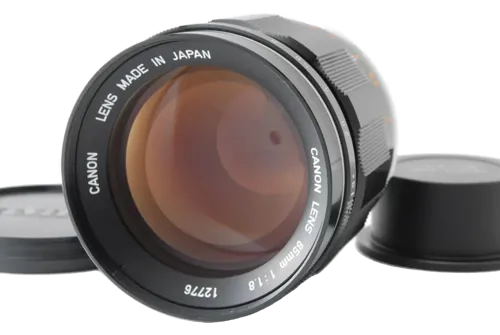
This entry covers the officially designated Serenar 85mm f/2 II. It should remain separate from the Serenar 85mm f/2 I, Serenar 85mm f/1.9, Serenar 85mm f/1.5 and later Canon 85mm f/1.8 lenses. Finders, hoods, cases, caps and L39-to-M adapters are accessories and do not constitute separate lens versions.
Optical qualities
Rendering
The Serenar 85mm f/2 II combines a portrait-oriented focal length with a relatively fast f/2 maximum aperture. Its six-element, four-group design provides meaningful subject separation and a rendering style associated with early postwar Japanese rangefinder optics.
At full aperture, surviving examples can show gentler contrast and softer transitions than later Canon telephoto lenses. Stopping down generally improves contrast, definition and consistency across the image. The precise result depends strongly on the condition and calibration of the individual lens.
Sharpness
No standardized modern test specific to Version II was found. The optical formula is officially listed as six elements in four groups, matching Version I. A clean and correctly adjusted example should provide useful central detail at f/2, with improved clarity after stopping down.
Performance differences between surviving copies may be caused by haze, cleaning marks, element separation, coating wear, optical misalignment or inaccurate rangefinder coupling. These factors should be considered before drawing conclusions about the design itself.
Contrast and color
The Serenar belongs to Canon’s coated postwar lens generation, although Canon’s specification page does not document the exact coating process. Contrast remains strongly dependent on optical cleanliness and coating condition.
A suitable hood is recommended. Strong side light or backlight may produce veiling flare, particularly when internal haze or front-element cleaning marks are present.
Bokeh and transitions
An 85mm focal length combined with an f/2 maximum aperture provides substantial background separation at portrait distances. The lens can produce smooth transitions between focused and defocused areas, although the exact appearance of highlights depends on aperture setting, subject distance and diaphragm construction.
Distortion and vignetting
No reliable measured distortion figures were found specifically for Version II. Visible corner falloff can be expected at maximum aperture and should reduce as the lens is stopped down. For portrait use, distortion is generally less significant than focus accuracy, flare and optical condition.
Handling
The lens focuses to approximately 1.07 metres and uses a 48mm filter fitting. Its 615-gram weight gives it a notably substantial feel on compact screw-mount cameras.
Accurate rangefinder calibration is important at f/2. The long focusing movement can support precise adjustment, but the combination of focal length and aperture places greater demands on the camera’s rangefinder than a slower normal lens.
Digital use
The lens can be mounted on Leica M bodies with an L39-to-M adapter and on mirrorless cameras with suitable adapters. It has no six-bit coding or electronic communication.
On a digital rangefinder, the lens and adapter should be checked for accurate infinity focus and rangefinder coupling. Mirrorless live-view focusing avoids coupling errors and provides a practical way to assess wide-open performance.
History
Development and Launch
Canon introduced the first Serenar 85mm f/2 in January 1948 as an early fast short-telephoto lens for its postwar rangefinder system. Version II followed in September 1951.
The revised lens appeared during a period in which Canon was rapidly expanding its screw-mount lens range. Fast 85mm lenses were important prestige products because they combined portrait capability, low-light performance and demanding optical design.
Production Evolution
Canon officially distinguishes the two generations as:
- Serenar 85mm f/2 I, marketed January 1948 and weighing 556 grams.
- Serenar 85mm f/2 II, marketed September 1951 and weighing 615 grams.
Both versions use six elements in four groups, focus to 1.07 metres and accept 48mm filters. The increased weight indicates a revised mechanical construction, although Canon does not publish detailed barrel dimensions or a complete explanation of the mechanical changes.
Version II was followed by other fast Canon 85mm lenses, including the Serenar 85mm f/1.9 and the premium 85mm f/1.5. These later lenses should not be treated as further versions of the 85mm f/2 because they have different apertures, model identities and collector markets.
Special Editions/Variants
No commemorative factory special edition is documented.
Collector-relevant variations may include:
- Different Canon Camera Co. front-ring engravings
- Minor focusing-scale and barrel-marking differences
- Feet-only or combined distance scales
- Original 85mm finder sets
- Matching hood, leather case and caps
- Sets later supplied with an L39-to-M adapter
These differences should be recorded per copy but do not automatically require separate lens entries.
Collector Notes
Collectors should first distinguish Version II from Version I. Canon’s official specifications establish Version II as the September 1951 revision weighing 615 grams. Barrel appearance, serial number and measured weight can all assist with identification.
Condition checks should include internal haze, fungus, coating damage, element separation, cleaning marks, oily diaphragm blades, stiff focusing grease and damage to the screw mount. The heavy barrel should also be checked for impact damage or looseness.
Sources
Where to buy
Canon Serenar 85mm f/2 II: frequently asked
What filter size does the Canon Serenar 85mm f/2 II take?
The Canon Serenar 85mm f/2 II takes 48 mm screw-in filters (E48).
How close does the Canon Serenar 85mm f/2 II focus?
The Canon Serenar 85mm f/2 II focuses down to 1.07 m, and the rangefinder stays coupled over the whole range.
How heavy is the Canon Serenar 85mm f/2 II?
The Canon Serenar 85mm f/2 II weighs 615 g, lighter than 33% of the 9 other 85mm lenses in the catalogue.
Which cameras does the Canon Serenar 85mm f/2 II fit?
The Canon Serenar 85mm f/2 II is a Leica screw-mount (M39/LTM) lens. It fits Leica M bodies with a screw-to-M adapter, which keeps rangefinder coupling, and mirrorless cameras with an M39 adapter. It carries no 6-bit code, so select the lens profile by hand on a digital M.
When was the Canon Serenar 85mm f/2 II made?
The Canon Serenar 85mm f/2 II was produced from 1951.
Related lenses
Similar lenses you might be interested in
Comments