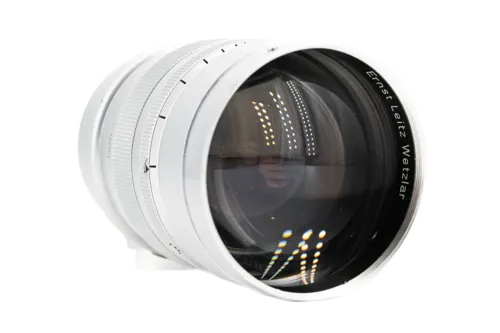
The Leica Thambar 9cm f/2.2 is Leitz's only dedicated soft-focus portrait lens, a prewar LTM rangefinder classic prized by collectors today.
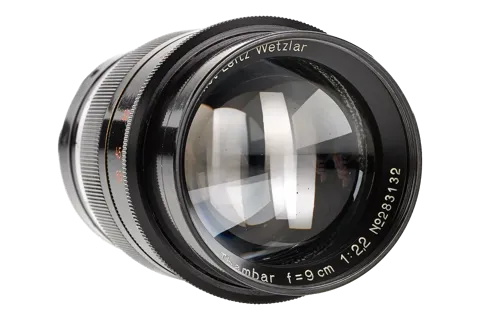
Leica Thambar 9cm f/2.2
LTM mount
No listings tracked for this lens right now.
The Leica Thambar 9cm f/2.2 is a LTM-mount lens for Leica rangefinder cameras. Leica price index →
How it compares
Measured against the 14 other 90mm LTM-mount lenses in the catalogue.
Specification
About this lens
Leica Thambar 9cm f/2.2
Among Leica lenses, the Thambar is an outlier: it was the only Leitz optic ever officially marketed as a soft-focus lens, a deliberate departure for a company whose reputation rested on resolution and sharpness [3]. The design grew out of recurring criticism that Leica lenses were too crisp for flattering portraiture, which prompted Max Berek to develop a portrait optic in the early 1930s [2]. The name derives from a Greek root meaning something that inspires wonder. Rather than failing to resolve detail, the Thambar produced its dreamy glow on purpose, through a carefully controlled amount of residual spherical aberration that increases toward the periphery of the optical system.
The lens uses a simple arrangement of four elements in three groups, with the two central elements cemented together. It was supplied with a removable center-spot filter, a clear glass disc carrying a small silvered spot in the middle that blocks the central, sharpest rays so that only the softer marginal rays form the image. With the spot filter fitted, the effective maximum aperture is reduced slightly, so the barrel carries two diaphragm scales, one for use without the filter and a second, in red, for use with it that runs only to the point beyond which the soft effect disappears. The strongest softening occurs wide open and diminishes as the lens is stopped down, giving the photographer continuous control over the degree of diffusion. A notable feature is the 20-blade diaphragm, which keeps the aperture nearly circular and renders point light sources as round highlights even when stopped down [1]. The lens is rangefinder coupled in Leica screw mount, though in practice the rangefinder cannot show the soft-focus effect, so effective use depended on experience and on understanding how subject distance, aperture, and lighting interact.
Identification and accessory matching are common points of confusion because Leica reissued the design in 2017 as the Thambar-M, which retains the original four-element, three-group formula and the 20-blade iris but adds a single coating and uses a different front filter size. The original prewar Thambar is uncoated and takes the older Leitz E48 filters and matching clamp-on hoods rather than the modern lens's fittings, a difference worth checking before buying filters or shades.
Optical qualities
Rendering The Thambar's defining trait is a soft, glowing image produced by intentionally undercorrected spherical aberration that is strongest wide open and at the edges of the field, and that is progressively tamed by stopping down. With the center-spot filter removed and the lens not used at full aperture, users report that the central image can be surprisingly sharp, while the characteristic bloom becomes most visible away from the center. The lens is highly prone to flare and veiling against the light, which tends to lower contrast and can further intensify the soft effect, so a hood is effectively essential. The 20-blade diaphragm yields rounded, even out-of-focus highlights that retain a wide-open look even when the lens is stopped down.
History
Development and Launch Leitz had been faulted for the lack of a dedicated portrait lens, since many photographers found its standard optics too sharp for flattering results, and this prompted Max Berek to design the Thambar at the start of the 1930s. The lens reached production in 1935 as a specialized soft-focus portrait optic for the screw-mount Leica system, an unusual move for a maker that otherwise advertised optical resolution above all. It was designed not to blur the image outright but to deliver a controllable veil of spherical aberration that could be modulated with the aperture and the supplied center-spot filter.
Production Evolution Total production was small, generally cited at fewer than about 3,000 units. Published sources do not fully agree on the production span: some collector references place manufacture across roughly 1935 to 1949, while others describe a span of only about six years in the 1930s. The original lens was supplied uncoated.
Collector Notes The Thambar is regarded as one of the great collectible Leica lenses and one of the most sought-after items of its prewar era, in part because complete examples are hard to find. The center-spot filter is integral to the lens's intended use, and sets that are complete with the original filter, and especially those that also retain the original red boxes, command a premium. Because the prewar lens takes E48 filters while the modern Thambar-M uses a different size, buyers should confirm that any filters or hoods actually fit the original optic. As an early uncoated lens, copies should be checked for internal haze, dust, and the soundness of the focusing helicoid and rangefinder coupling, which can be damaged or missing on hard-used examples.
Sources
Where to buy
Related lenses
Similar lenses you might be interested in

Comments