Best price Good
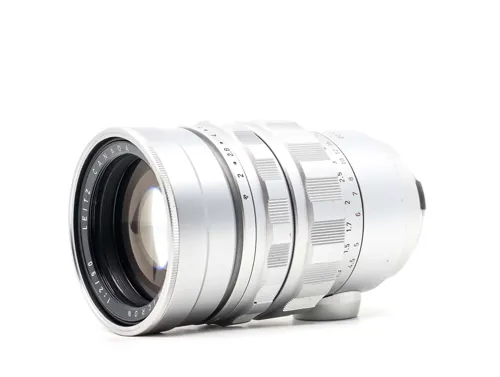
Leica Leitz Tele-Elmarit 2.8 / 90mm + 12575 hood, M
Sold by Fotohandel Delfshaven
€415 ≈ $448
The Leica Tele-Elmarit 90mm f/2.8 "Fat" is a Canadian-made M and LTM short telephoto from the 1960s, prized by collectors for its compact true-tele design.
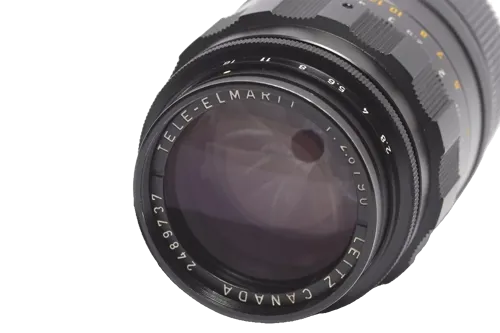
M / LTM mount
The Leica Tele-Elmarit 90mm f/2.8 "Fat" is a M / LTM-mount lens for Leica rangefinder cameras. As of October 2026, it sells from €427 used across 16 listings, with a 30-day median of €787. Leica price index →
Measured against the 36 other 90mm lenses in the catalogue.
When Leitz wanted a 90mm lens that could ride inside an ordinary case rather than protruding from the camera, the answer was a genuine telephoto computation rather than a long symmetrical design. The Tele-Elmarit 90mm f/2.8, introduced in 1964 and sold alongside the larger and longer Elmarit 90mm f/2.8 of the period, used a true telephoto layout so that the physical barrel is shorter than the focal length [1]. Leitz marketing leaned into this compactness, and the lens was pitched as a small companion to the standard 90mm Elmarit at the same price, intended above all to keep the kit portable. The nickname "Fat" is retrospective collector shorthand, used only to distinguish this first version from the much slimmer Tele-Elmarit-M ("thin") that replaced it in 1974.
Optically the lens is a five-element design in five groups, credited to Walter Mandler and produced at the Leitz facility in Midland, Canada[2]. It is single-coated, with the characteristic magenta cast of coatings from that era. The aperture uses ten blades and runs from f/2.8 to f/16 with half-stop detents, and minimum focus is one meter. Focus travel from infinity to one meter covers roughly 180 degrees, which suits the rangefinder coupling well. The lens takes E39 screw-in filters and the snap-on 12575 hood (also catalogued as IUFOO). Unlike the contemporaneous Elmarit, the head of this Tele-Elmarit does not unscrew for Visoflex reflex use. It mounts on Leica M bodies and is reported to function on the full range of M cameras, with screw-mount examples existing for LTM bodies as well.
The first-version Tele-Elmarit was offered primarily in black, and the Leica Wiki also notes silver and titanium finishes among the variants recorded under order number 11800 and related catalogue numbers. Production ran from 1964 to 1974, and serial-number records compiled by collectors indicate a relatively limited output of fewer than about 14,400 lenses across that decade. Because the later "thin" Tele-Elmarit-M shares the same name, focal length, aperture, and order number 11800, buyers should identify this version by its noticeably larger barrel diameter and overall heft relative to the slimmer successor.
Rendering Documented impressions describe a classic single-coated short telephoto that is gentle wide open and tightens up on stopping down. At f/2.8 the center is somewhat soft and lower in contrast, with softer edges; by f/4 the center reaches its optimum and overall contrast improves markedly, though far corners remain a little soft through f/5.6. Out-of-focus rendering is regarded as pleasant, with smooth, round blur circles from roughly f/4 to f/8. Distortion is described as effectively absent, and corner falloff is reported as negligible on a full-frame digital body. As a single-coated optic, it has fewer anti-reflection layers than modern multicoated lenses, which is a factor to weigh against strong light sources.
Development and Launch The Tele-Elmarit appeared in 1964 as the compact alternative within Leica's 90mm f/2.8 offering, joining rather than immediately replacing the standard Elmarit 90mm f/2.8 that had been introduced a few years earlier. The two were sold concurrently at the same price, with the Tele-Elmarit positioned for photographers who valued a smaller package, while Leitz suggested the larger Elmarit for the most demanding work. Both designs persisted until 1974.
Production Evolution This first-version lens was built in Canada throughout its run. In 1974 it was superseded by the redesigned Tele-Elmarit-M, the so-called "thin" version, which was lighter and more compact and which absorbed the role of both earlier 90mm f/2.8 lenses; that successor was made mostly in Canada with later production in Germany.
Collector Notes The most common point of confusion is the shared name and order number 11800 between this "Fat" first version and the later "thin" Tele-Elmarit-M; the two are most reliably told apart by size and weight, since the first version is the bulkier of the two. Sources differ slightly on a few figures: the Leica Wiki lists the optical layout as five elements in three groups and a rated weight of 355 g, whereas measured and cross-section data describe five elements in five groups and roughly 340 g, so prospective buyers may encounter conflicting published numbers. As with any single-coated lens of this age, internal haze and coating condition are worth checking, along with the correct snap-on 12575 hood and E39 filters when completeness matters.
Good time to buy. The lowest listing is 46% below the 30-day average.
Lowest price Click a mark to open that listing · arrow keys to step, Enter to open
Price against condition for 16 listings of Leica Tele-Elmarit 90mm f/2.8 "Fat", €415 to €1,392, median €723. Mint: 1 at €833. Excellent: 6 at €682, €765, €802, €802, €802, €1,392. Good: 8 at €415, €580, €626, €649, €649, €682, €867, €948. Fair: 1 at €628. The full table follows.
| Condition | Lowest | Median |
|---|---|---|
| Mint | €833 | €833 |
| Excellent | €682 | €802 |
| Good | €415 | €649 |
| Fair | €628 | €628 |
Over the last 16 weeks the median price for the Leica Tele-Elmarit 90mm f/2.8 "Fat" has risen, ranging from €657 to €787 (now €787).
Weekly price (EUR). Median (Good or better) and lowest (Good or better) across 16 weeks. The full figures follow in the table below.
| Week | Median | Lowest |
|---|---|---|
| Jun 1, 2026 | €697 | €652 |
| Jun 8, 2026 | €697 | €652 |
| Jun 15, 2026 | €697 | €583 |
| Jun 22, 2026 | €697 | €583 |
| Jun 29, 2026 | €765 | €583 |
| Jul 6, 2026 | €697 | €423 |
| Jul 13, 2026 | €697 | €423 |
| Jul 20, 2026 | €679 | €423 |
| Jul 27, 2026 | €697 | €423 |
| Aug 3, 2026 | €765 | €423 |
| Aug 10, 2026 | €784 | €423 |
| Aug 17, 2026 | €784 | €423 |
| Aug 24, 2026 | €765 | €423 |
| Aug 31, 2026 | €765 | €423 |
| Sep 7, 2026 | €765 | €423 |
| Sep 14, 2026 | €765 | €427 |
Every shop grades differently. Leica Classic uses letters, Ffordes uses E++ and E+, German dealers write "Zustand B", Japanese dealers write A−. We map all of them onto the one ladder below. Where a shop states its own grade, we print it under ours.
As of October 2026, the Leica Tele-Elmarit 90mm f/2.8 "Fat" sells from €427 used, with a 30-day median of €787, across 16 active listings.
As of October 2026, the Leica Tele-Elmarit 90mm f/2.8 "Fat" is sold by 2 sources (16 listings), from €427 used: all compared cheapest-first on this page.
Similar lenses you might be interested in


Comments