Best price Excellent
Kamerastockholm Leica Summicron-m 90mm f2
Sold by Kamera Stockholm
€670 ≈ $724
The Leica Summicron-M 90mm f/2 II Type 2 is a Canadian-made M-mount portrait lens (11136/11137), the E55 pre-ASPH prized for its classic rendering.
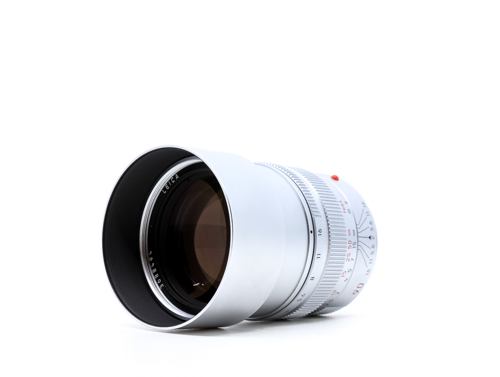
M mount
The Leica Summicron-M 90mm f/2 II Type 2 is a M-mount lens for Leica rangefinder cameras. As of October 2026, it sells from €670 used across 17 listings, with a 30-day median of €1,653. Leica price index →
Measured against the 25 other 90mm M-mount lenses in the catalogue.
For eighteen years this was the fastest and most ambitious 90mm Leica offered for the M system, sitting at the top of the rangefinder telephoto range from 1980 until the APO-Summicron-M 90mm f/2 ASPH replaced it in 1998 [1][2]. Collectors usually call it the "pre-ASPH" Summicron, and the Type 2 here is the more common E55 form introduced in 1982, distinct from the short-lived earlier E49 variant. Built in Canada, it uses a compact five-element design in four groups and is a slightly telephoto layout, with a small amount of pincushion distortion. It carries the part numbers 11136 for the black anodized aluminum version and 11137 for the chromed-brass version.
Construction is classic Leica, with aluminum and brass barrels, engraved and paint-filled markings, and a built-in retractable hood. The eleven-blade diaphragm is unusual for its high count and produces strong sunstars on bright points of light; it stops down in half-stop clicks, and the blades curve inward at wide apertures, becoming round only at the smallest setting. Focusing runs to a one meter minimum, and the lens couples to the rangefinder on every Leica M body. Handling is conventional for an M lens, with the aperture ring at the front and the focus ring in the middle, though the aperture detents are noted as subtle. The optics are single-coated, mostly in blue and amber tints.
The same optical formula was sold in more than one cosmetic form. The 1980 to 1981 version took 49mm filters, was made only in black, and used a slip-over front cap; from 1982 the barrel was restyled to take 55mm filters and to resemble the later APO-ASPH closely. Within the E55 run, the black version is by far the most common, while the silver chromed-brass version is much heavier and is sometimes described as the heaviest 90mm Leica ever made for the M. Each sample is also marked with its measured focal length to a tenth of a millimeter, engraved as two small digits on the focus ring.
Rendering The lens is associated with the rendering of Leica's Walter Mandler era, combining high central contrast at full aperture with a generally smooth but not flawless out-of-focus character. Because the design predates affordable aspherical elements and floating groups, performance wide open shows higher spherical aberration and softer corners, improving on stopping down.
Sharpness Central sharpness and contrast are strong from f/2, while the corners are soft at wider apertures and improve as the lens is stopped down; on high-resolution sensors the planes of best contrast and resolution do not fully coincide, which can make precise focusing harder. Ken Rockwell likewise reports it as very sharp, optimal across the frame by around f/5.6.
Bokeh and transitions The f/2 aperture gives clear subject separation at 90mm, and the background blur is mostly pleasing, though reviewers note less smooth, somewhat ring-shaped highlights in the middle apertures between roughly f/2.8 and f/8.
Flare resistance With the sun directly in the frame the lens can hold up well, but at certain angles it can lose contrast and show small artifacts, behavior typical of its single-coated era.
Distortion and vignetting Distortion is low, a minor pincushion that needs only slight correction for critical work. Light falloff at f/2 is modest and largely gone by f/4.
Aberrations Coma is well controlled, and spherochromatism is minimal for a fast telephoto, though some lateral color can be seen on digital sensors at high magnification.
Development and Launch Introduced in 1980, this Summicron-M replaced the earlier 90mm f/2 Summicron of 1958 to 1980 and served as Leica's premium short telephoto for the M mount, ranking above the slower 90mm f/2.8 Elmarit-M options. It remained Leica's top 90mm until the APO-Summicron-M 90mm f/2 ASPH arrived in 1998.
Production Evolution The first 1980 to 1981 lenses used a 49mm filter thread and a black-only finish; from 1982 the restyled E55 barrel appeared, the version represented here. Across the production run Leica also changed engraving styles, with older samples using a rounded font and later ones the squared current font, while the black and silver chromed-brass finishes were offered in parallel.
Special editions No widely documented factory special editions are associated with this model beyond the standard black anodized and silver chromed-brass finishes; the principal collector distinction remains the early E49 barrel versus the more common E55 Type 2.
Collector Notes Buyers should distinguish this E55 pre-ASPH from the rarer early E49 version and from the later APO-ASPH, which looks similar but engraves its identity on a non-rotating hood rather than on a ring inside the filter thread. The lenses were made in Canada. Both 11136 and 11137 share the same optical design, so the practical choice between them is largely about weight and finish, the brass silver version being substantially heavier. As with any older single-coated Leica telephoto, the usual checks apply for internal haze, smooth focus, and clean aperture action, and rangefinder focus accuracy at 90mm is best confirmed against the intended body.
Good time to buy. The lowest listing is 59% below the 30-day average.
Lowest price Click a mark to open that listing · arrow keys to step, Enter to open
Price against condition for 17 listings of Leica Summicron-M 90mm f/2 II Type 2, €670 to €2,722, median €1,039. Excellent: 9 at €670, €833, €1,039, €1,243, €1,395, €1,511, €1,670, €1,670, €2,722. Good: 3 at €694, €1,014, €1,062. Unknown: 5 at €724, €933, €933, €985, €1,449. The full table follows.
| Condition | Lowest | Median |
|---|---|---|
| Excellent | €670 | €1,395 |
| Good | €694 | €1,014 |
| Other | €724 | €933 |
Over the last 21 weeks the median price for the Leica Summicron-M 90mm f/2 II Type 2 has risen, ranging from €966 to €1,653 (now €1,653).
Weekly price (EUR). Median (Good or better) and lowest (Good or better) across 21 weeks. The full figures follow in the table below.
| Week | Median | Lowest |
|---|---|---|
| Jun 1, 2026 | €1,142 | €927 |
| Jun 8, 2026 | €1,026 | €833 |
| Jun 15, 2026 | €1,095 | €921 |
| Jun 22, 2026 | €1,047 | €921 |
| Jun 29, 2026 | €1,047 | €921 |
| Jul 6, 2026 | €1,057 | €691 |
| Jul 13, 2026 | €1,057 | €691 |
| Jul 20, 2026 | €1,020 | €691 |
| Jul 27, 2026 | €1,020 | €691 |
| Aug 3, 2026 | €1,020 | €691 |
| Aug 10, 2026 | €1,020 | €691 |
| Aug 17, 2026 | €1,014 | €691 |
| Aug 24, 2026 | €1,004 | €691 |
| Aug 31, 2026 | €997 | €691 |
| Sep 7, 2026 | €997 | €691 |
| Sep 14, 2026 | €1,014 | €691 |
| Sep 21, 2026 | €1,014 | €691 |
| Sep 28, 2026 | €1,060 | €691 |
| Oct 5, 2026 | €1,057 | €691 |
| Oct 12, 2026 | €1,114 | €673 |
| Oct 19, 2026 | €1,152 | €670 |
Every shop grades differently. Leica Classic uses letters, Ffordes uses E++ and E+, German dealers write "Zustand B", Japanese dealers write A−. We map all of them onto the one ladder below. Where a shop states its own grade, we print it under ours.
As of October 2026, the Leica Summicron-M 90mm f/2 II Type 2 sells from €670 used, with a 30-day median of €1,653, across 17 active listings.
As of October 2026, the Leica Summicron-M 90mm f/2 II Type 2 is sold by 5 sources (17 listings), from €670 used: all compared cheapest-first on this page.
The Leica Summicron-M 90mm f/2 II Type 2 takes 55 mm screw-in filters (E55).
The Leica Summicron-M 90mm f/2 II Type 2 focuses down to 1 m, and the rangefinder stays coupled over the whole range.
The Leica Summicron-M 90mm f/2 II Type 2 weighs 484 g, lighter than 20% of the 25 other 90mm M-mount lenses in the catalogue.
The Leica Summicron-M 90mm f/2 II Type 2 has a Leica M mount, so it fits every Leica M body natively and mirrorless cameras with an M adapter. It carries no 6-bit code, so select the lens profile by hand on a digital M.
The Leica Summicron-M 90mm f/2 II Type 2 was produced from 1982.
No reviews yet. Own this lens? Be the first.
Write a review of the Leica Summicron-M 90mm f/2 II Type 2Similar lenses you might be interested in
Comments