The early broad-barrel Leica Elmar 9cm f/4, introduced in 1931 with a four-element design, fifteen-blade diaphragm and varied LTM coupling.
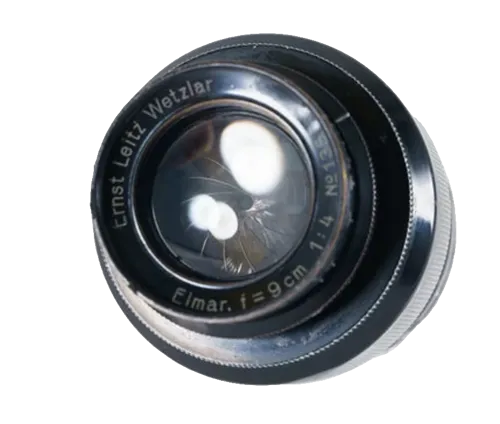
Leica Elmar 9cm f/4 “Fat”
LTM mount
No listings tracked for this lens right now.
The Leica Elmar 9cm f/4 “Fat” is a LTM-mount lens for Leica rangefinder cameras. Leica price index →
How it compares
Measured against the 14 other 90mm LTM-mount lenses in the catalogue.
Specification
About this lens
Leica Elmar 9cm f/4 “Fat”
The Leica Elmar 9cm f/4 “Fat” is the first large-barrel version of Leitz’s 90mm Elmar telephoto lens for Leica screw-mount cameras. Introduced in 1931, it is distinguished by its broad black-enamel barrel, nickel-plated fittings and substantially heavier construction than the slimmer Elmar 9cm lenses that followed. The terms “Fat Elmar” and “Thick Elmar” are later collector descriptions rather than official Leitz model names.
The lens uses a four-element, three-group Elmar optical design, with the rear elements cemented together. Its brass construction, fifteen-blade diaphragm and long focusing movement reflect early Leitz manufacturing practice. Depending on the version, focusing may be uncoupled or mechanically coupled to the camera rangefinder. The front accepts 36mm clamp-on accessories rather than the E39 screw-in filters associated with later Elmar 9cm versions.
Several mechanical forms appeared during the lens’s short production period. Documented examples include uncoupled and rangefinder-coupled lenses, barrels with different knurling patterns, lenses without external serial numbers and later numbered examples. The order codes ELANG and ELANGKUP identify uncoupled and coupled configurations, although the code alone is not always sufficient to distinguish the Fat version from early slimmer Elmar variants.
Optical qualities
Rendering
Controlled modern testing of the Fat Elmar is limited. Surviving reports generally describe moderate contrast at wider apertures, with useful central detail and a distinctly early uncoated-lens character. Optical condition can strongly influence performance, particularly when haze, cleaning marks, internal contamination or coating alterations are present. Strong claims concerning bokeh, distortion or edge performance are therefore difficult to apply consistently across surviving examples.
Contrast and flare resistance
Original examples were produced before coated Leica lenses became standard. Uncoated specimens can show reduced contrast and increased flare when used against strong light. Some surviving lenses have coated elements, but these may reflect later factory or service treatment rather than the original production specification.
History
Development and Launch
Leitz introduced the Elmar 9cm f/4 in 1931 as a compact telephoto option for the expanding Leica interchangeable-lens system. The first version used the broad barrel now known among collectors as the Fat Elmar. Its 90mm focal length offered a longer perspective for portraiture, travel and distant subjects while retaining the established Elmar optical concept.
Production Evolution
The Fat Elmar was produced only briefly before Leitz introduced a slimmer and lighter barrel design around late 1932 or early 1933. Early Fat lenses could be uncoupled and were sometimes supplied without externally engraved serial numbers. Rangefinder-coupled versions followed, including both unnumbered and serial-numbered examples. Differences in barrel knurling, depth-of-field markings and focusing construction help distinguish the known mechanical variations.
Published specifications do not always agree on weight. Variant-specific collector documentation gives approximately 314 g, while some compiled lens databases list approximately 340 g. Differences may reflect the exact mechanical version or whether caps and accessories were included during measurement.
Special Editions/Variants
No commemorative or formally named special edition of the Fat Elmar is widely documented. Its important variants are mechanical production forms rather than special editions. These include early uncoupled examples, rangefinder-coupled examples, lenses without external serial numbers and later numbered lenses. Coated surviving examples should be examined carefully because the coating may have been applied after initial production.
Special Editions/Variants
No official commemorative special editions are confirmed. The principal collectible variants are the uncoupled ELANG, coupled ELANGKUP, unnumbered examples and later serial-numbered examples.
Collector Notes
Collectors should verify the broad barrel shape because the ELANGKUP order code was also associated with early slimmer Elmar 9cm lenses. Originality checks should include the engraving style, nickel finish, knurling pattern, serial-number placement and rangefinder-coupling mechanism.
The optical unit should be inspected for haze, fungus, separation, cleaning marks and scratches. Repainted barrels, replacement screws, later-applied coatings and converted focusing mounts may affect collector value. Original caps, the FIKUS adjustable hood and appropriate A36 accessories add interest, but should not be treated as proof that the lens itself is fully original.
Historical lenses should not be judged from one sample alone. Haze, fungus, separation, cleaning damage, displaced elements and dried lubricant can alter contrast and focus more than modest design differences. Film choice, processing, digital sensor cover glass and adapter tolerances also influence results. A hood may reduce oblique flare but cannot correct internal contamination.
Sources
- Summichronica, Leica Screw Mount Lenses, 90mmsummichronica.com →
- Atelier Leica, Elmar 90mmat-leica.com →
- Leica Society International, Leica Lenses Without Serial Numbersleicasocietyinternational.org →
- Leitz Photographica Auction, Elmar 4/9cm Black/Nickel, WEISO, FIKUSleitz-auction.com →
- Leica Camera Forum, 90mm f/4 Fat Elmarl-camera-forum.com →
Where to buy
Related lenses
Similar lenses you might be interested in

Comments