Best price Used
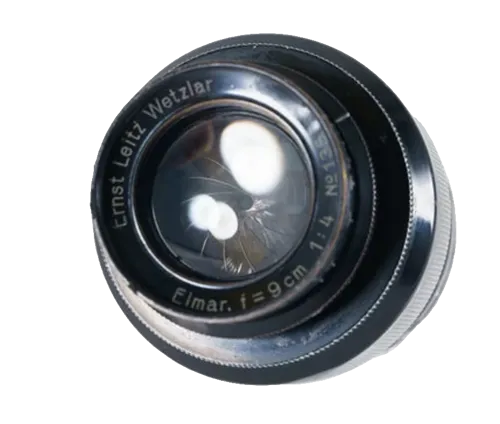
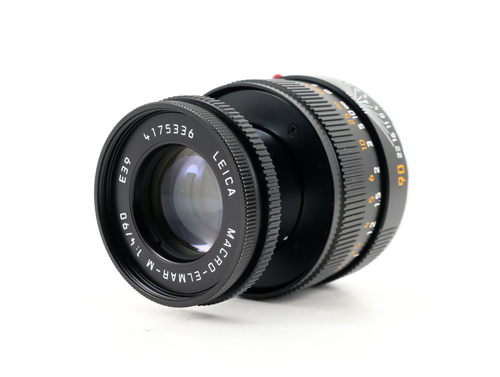
Leica 9cm f4 Elmar Black Paint L39 ALC173804
Sold by Aperture UK
€136 ≈ $147
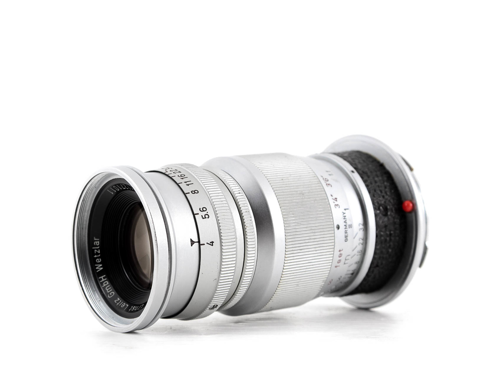
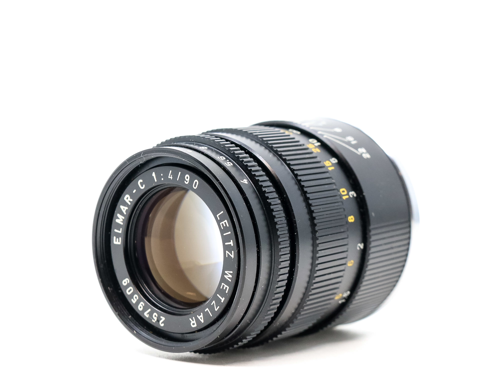
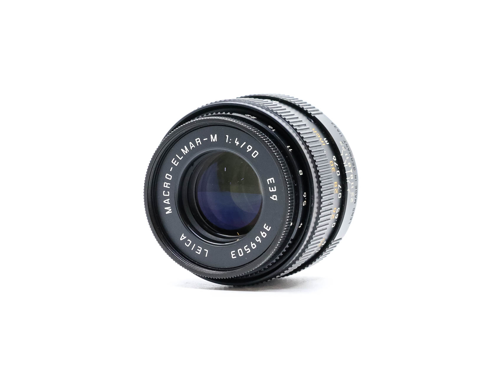
The Leica Elmar 9cm f/4 four-element rigid lens is a coupled LTM and M-mount telephoto, valued for compact build and classic rendering.

M / LTM mount
The Leica Elmar 9cm f/4 (4-Element Rigid) is a M / LTM-mount lens for Leica rangefinder cameras. As of October 2026, it sells from €136 used across 4 listings, with a 30-day median of €210. Leica price index →
Measured against the 36 other 90mm lenses in the catalogue.
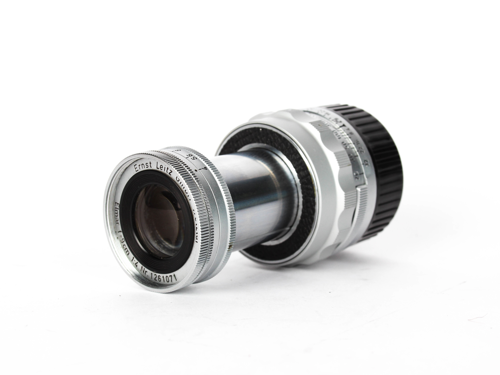
The four-element rigid Elmar 9cm f/4 is the long-running slim telephoto that followed the short-lived large-barrel “Fat Elmar.” This profile covers the rigid Leica screw-mount lens introduced in 1933 and its Leica M-bayonet counterpart introduced in 1954. It excludes the Fat Elmar, the collapsible 9cm Elmar and the later three-element Elmar 90mm f/4.
The lens uses the classic four-element, three-group Elmar construction. Its modest f/4 aperture kept the optical unit compact, while the 90mm focal length provided portrait and distant-detail coverage without the bulk of faster Leica telephotos. Most examples are rangefinder coupled. Later rigid versions focus to 1m, while some earlier barrels and scales differ, so the engraved close-focus limit should be checked on an individual lens.
Production evolved substantially without changing the basic optical identity. Early screw-mount examples may have black-painted barrels with nickel or chrome fittings, older non-standard aperture scales and A36 clamp-on accessories. Post-war lenses gained coating, and later chrome screw-mount and M-mount examples commonly accept E39 filters. Several versions rotate the front section during focusing, which affects the use of polarizing filters and explains duplicated aperture markings on some barrels.
The bayonet version was sold under the codewords ELANG-M and ELGAM, with catalogue numbers including 11130 and 11830. ELANG also appears on screw-mount lenses, and Leitz reused or overlapped codes and catalogue numbers across production transitions. A codeword alone is therefore not sufficient identification. Optical construction, barrel form, mount and serial-number period should be considered together.
Rendering
At f/4, a sound coated example gives good central definition with gentler contrast and less uniform corners than later 90mm designs. Fine detail and field consistency improve on stopping down, while the fifteen-blade diaphragm preserves a rounded aperture and smooth tonal transitions. Earlier uncoated lenses are more susceptible to flare and veiling contrast. Haze, cleaning marks and coating condition can influence results more strongly than small production differences.
The rigid barrel balances well on both Barnack and M bodies, although screw-mount cameras require a separate 90mm finder unless an appropriate accessory finder is fitted. On an M camera, the bayonet version or a correctly indexed LTM adapter brings up the 90mm framelines. Collectors should verify that the lens is neither the wide Fat version nor the collapsible or three-element successor before assigning it to this profile.
Good time to buy. The lowest listing is 35% below the 30-day average.
Lowest price Click a mark to open that listing · arrow keys to step, Enter to open
Price against condition for 4 listings of Leica Elmar 9cm f/4 (4-Element Rigid), €136 to €313, median €178. Good: 1 at €313. Used: 3 at €136, €145, €210. The full table follows.
| Condition | Lowest | Median |
|---|---|---|
| Good | €313 | €313 |
| Other | €136 | €145 |
Over the last 10 weeks the median price for the Leica Elmar 9cm f/4 (4-Element Rigid) has fallen, ranging from €119 to €10,684 (now €210).
Weekly price (EUR). Median (Good or better) and lowest (Good or better) across 10 weeks. The full figures follow in the table below.
| Week | Median | Lowest |
|---|---|---|
| Aug 10, 2026 | €10,684 | Unknown |
| Aug 17, 2026 | €119 | Unknown |
| Aug 24, 2026 | €151 | Unknown |
| Aug 31, 2026 | €151 | Unknown |
| Sep 7, 2026 | €273 | €273 |
| Sep 14, 2026 | €273 | €273 |
| Sep 21, 2026 | €178 | Unknown |
| Sep 28, 2026 | €177 | Unknown |
| Oct 5, 2026 | €311 | €311 |
| Oct 12, 2026 | €313 | €313 |
Every shop grades differently. Leica Classic uses letters, Ffordes uses E++ and E+, German dealers write "Zustand B", Japanese dealers write A−. We map all of them onto the one ladder below. Where a shop states its own grade, we print it under ours.
As of October 2026, the Leica Elmar 9cm f/4 (4-Element Rigid) sells from €136 used, with a 30-day median of €210, across 4 active listings.
As of October 2026, the Leica Elmar 9cm f/4 (4-Element Rigid) is sold by 3 sources (4 listings), from €136 used: all compared cheapest-first on this page.
The Leica Elmar 9cm f/4 (4-Element Rigid) takes 39 mm screw-in filters (E39).
The Leica Elmar 9cm f/4 (4-Element Rigid) focuses down to 1 m, and the rangefinder stays coupled over the whole range.
The Leica Elmar 9cm f/4 (4-Element Rigid) weighs 270 g, lighter than 67% of the 30 other 90mm lenses in the catalogue.
The Leica Elmar 9cm f/4 (4-Element Rigid) exists in both Leica M and M39 screw mounts, so it fits every Leica M body (the screw-mount version with an M adapter) and mirrorless cameras with an M adapter. It carries no 6-bit code, so select the lens profile by hand on a digital M.
The Leica Elmar 9cm f/4 (4-Element Rigid) was produced from 1933 to 1963.
Similar lenses you might be interested in
Comments
I would love to add that pictured first-batch nickel-finish Elmar to my collection for your median price of €168 :-)