Best price Used
Ernst Leitz Wetzlar Leitz Wetzlar ELMAR 90mm f/4 [I], ELANG-M
Sold by Foto Ottica Cavour
€146 ≈ $158
The Leica Elmar 90mm f/4 Collapsible is a compact M-mount telephoto whose locking collapsible barrel and modest, dependable rendering make it a collector favorite.
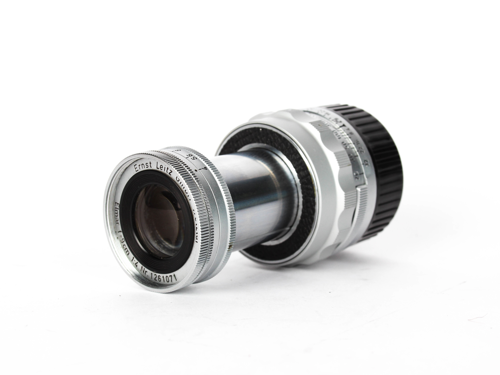
M mount
The Leica Elmar 90mm f/4 Collapsible is a M-mount lens for Leica rangefinder cameras. As of October 2026, it sells from €146 used across 8 listings, with a 30-day median of €293. Leica price index →
Measured against the 25 other 90mm M-mount lenses in the catalogue.
Among the production 90mm Elmars Leica made, this was the only collapsible model until the much later Macro-Elmar-M. Earlier 9cm Elmars and the subsequent three-element Elmar and Elmar-C were supplied in rigid focusing mounts. Although experimental collapsible screw-mount examples are known, the production collapsible lens was made for the Leica M bayonet. The collapsing barrel is therefore its defining feature and the principal distinction between it and the otherwise numerous rigid 90mm Elmars.
Typical examples are engraved Ernst Leitz GmbH Wetzlar Elmar f=9cm 1:4. The lens was initially catalogued under the letter code ILNOO and numerical code 11631, and was later listed as 11131. As an inexpensive entry point into genuine Leitz glass, it remains popular with users looking for a compact, all-mechanical telephoto for film and digital M cameras.
The lens uses four optical elements arranged in three groups. Contemporary Leitz literature sometimes called this a “triplet” or “triplet-type” construction, but that terminology describes the design family rather than the literal number of pieces of glass: the rear group contains a cemented pair, producing four elements in total. It should not be confused with the scarce, genuinely three-element 90mm f/4 Elmar introduced later in the early 1960s. That lens was a separate rigid-mounted redesign produced in M and limited screw-mount versions.
The barrel is built largely of metal and finished in satin chrome, with gloss chrome on the collapsing section and the portion that extends during close focusing, giving it a heavy, solid feel without play or wobble. The lens focuses only when fully extended and locked with a quarter turn, and it must be returned to infinity before it can be collapsed; a small infinity lock holds the focus there and a leather bumper quiets the barrel when it is pushed home. The large scalloped focusing ring sits at the base and is marked in metres, with a depth-of-field scale and an infrared index, while the aperture ring at the front clicks at full stops from f/4 to f/32 over ten mostly straight blades.
The lens takes 39mm screw-in filters and has a notably thick filter rim that resists denting. It should not be collapsed while mounted on a digital M body because the projecting tube may interfere with internal camera components. Similar care is required with the Leica M5 and CL because of their moving metering arms; on compatible film M bodies, normal collapsing is possible.
Identification is straightforward. Regular-production collapsible examples are M-mount lenses with E39 filter threads and a conventional aperture scale. Earlier rigid screw-mount 9cm Elmars commonly use A36 clamp-on filters and may carry the older aperture sequence of 4, 4.5, 6.3, 9 and so forth, but these should not be described as screw-mount versions of the production collapsible lens. Collapsible M39 examples exist principally as rare prototypes and experimental lenses. The reversible metal hood carries the code IUFOO, later numbered 12575, and was shared with several other Leitz telephoto lenses.
Development and launch
The Elmar name reaches back to Leica’s early lenses and the work of Max Berek. The original 9cm Elmar belonged to the triplet-derived, four-element and three-group tradition that remained associated with the lens for decades. The collapsible M-mount version appeared with the new Leica M system in 1954 and retained this established four-element optical arrangement. Standard references list the model through 1968, although that date range should not be interpreted as evidence of continuous annual production in equal quantities.
Production evolution
The chronology is not an evolution from three elements to four elements. The longstanding 9cm Elmar formula used four elements in three groups, including the collapsible M-mount lens described here. In the early 1960s Leitz introduced a separate rigid 90mm f/4 Elmar containing only three elements in three groups. Screw-mount examples are documented from 1962, while M-mount examples are documented in 1965. This later three-element lens was made in comparatively small numbers, particularly in screw mount, and was never the optical formula of the production collapsible Elmar.
The Elmar-C introduced for the Leica CL in the 1970s was another distinct lens and used four separate elements in four groups. It should therefore be presented as a later member of the broader 90mm Elmar family rather than as the immediate replacement optical formula of the collapsible model.
Special editions and prototypes
No major commemorative or special-production editions of the collapsible Elmar are generally documented. Factory prototypes and experimental versions do exist, however. These include pre-production M-mount lenses with detail differences and extremely rare collapsible screw-mount prototypes. Leitz Auction notes that, apart from such prototypes, Leica did not issue the collapsible Elmar as a regular screw-mount product.
Collector notes
Published production figures of approximately 79,600 lenses refer to the broader 1954–1968 90mm f/4 Elmar category, combining multiple rigid and collapsible configurations; they should not be quoted as the production total for the collapsible lens alone. The surviving serial-number allocations do show that several thousand collapsible lenses were produced during the 1950s, so ordinary chrome examples are not exceptionally rare, but a dependable collapsible-only total is not established by the sources cited here.
This distinction is important because the later three-element rigid Elmar had much more limited production. The screw-mount version is particularly scarce: Leica Camera Classic reports only 543 examples, while Leitz Auction describes the total as approximately 500.
The lens’s all-mechanical construction makes servicing possible, and copies that have sat unused may benefit from cleaning, lubrication and adjustment. Buyers should verify smooth operation of the collapsing barrel, locking mechanism and infinity catch, and should check for original accessories such as the IUFOO/12575 hood and appropriate caps. Owners of digital M cameras should leave the lens extended rather than risk contact between its collapsing tube and the camera’s internal components.
Good time to buy. The lowest listing is 50% below the 30-day average.
Lowest price Click a mark to open that listing · arrow keys to step, Enter to open
Price against condition for 8 listings of Leica Elmar 90mm f/4 Collapsible, €146 to €671, median €228. Excellent: 2 at €316, €671. Good: 2 at €158, €293. Fair: 1 at €162. Used: 3 at €146, €157, €366. The full table follows.
| Condition | Lowest | Median |
|---|---|---|
| Excellent | €316 | €494 |
| Good | €158 | €226 |
| Fair | €162 | €162 |
| Other | €146 | €157 |
Over the last 18 weeks the median price for the Leica Elmar 90mm f/4 Collapsible has fallen, ranging from €159 to €678 (now €293).
Weekly price (EUR). Median (Good or better) and lowest (Good or better) across 18 weeks. The full figures follow in the table below.
| Week | Median | Lowest |
|---|---|---|
| Jun 1, 2026 | €319 | €319 |
| Jun 8, 2026 | €239 | €159 |
| Jun 15, 2026 | €418 | €159 |
| Jun 22, 2026 | €418 | €159 |
| Jun 29, 2026 | €678 | €678 |
| Jul 6, 2026 | €577 | €476 |
| Jul 13, 2026 | €476 | €476 |
| Jul 20, 2026 | €231 | €101 |
| Jul 27, 2026 | €231 | €231 |
| Aug 3, 2026 | €274 | €116 |
| Aug 10, 2026 | €276 | €231 |
| Aug 17, 2026 | €311 | €302 |
| Aug 24, 2026 | €302 | €159 |
| Aug 31, 2026 | €230 | €159 |
| Sep 7, 2026 | €230 | €159 |
| Sep 14, 2026 | €230 | €159 |
| Sep 21, 2026 | €230 | €159 |
| Sep 28, 2026 | €305 | €158 |
Every shop grades differently. Leica Classic uses letters, Ffordes uses E++ and E+, German dealers write "Zustand B", Japanese dealers write A−. We map all of them onto the one ladder below. Where a shop states its own grade, we print it under ours.
As of October 2026, the Leica Elmar 90mm f/4 Collapsible sells from €146 used, with a 30-day median of €293, across 8 active listings.
As of October 2026, the Leica Elmar 90mm f/4 Collapsible is sold by 3 sources (8 listings), from €146 used: all compared cheapest-first on this page.
Similar lenses you might be interested in

Comments
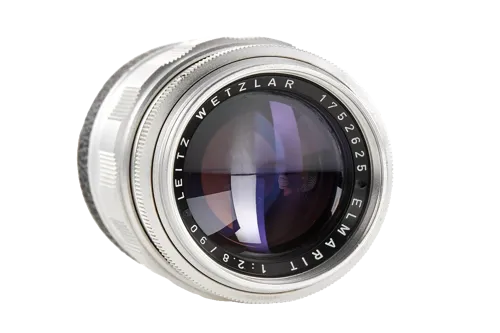
The ‘three element’ 90 mm Elmar had limited production and was actually a later variant and not an early variant of this lense as stated. The illustration shown of the ‘fat’ 90mm 2.8 elmarit is not correct.
Thank you for the comment. Appreciate the correction, this is indeed true. Was looking at a 35mmc source that also mentioned this, but this was also wrong. Corrected it! Also fixed the 'Fat' Elmarit 90mm f2.8 photo. This was an oversight. Again, many thanks!