A late-1940s coated Dallmeyer 2-inch f/1.9 standard lens in an original rigid, rangefinder-coupled Leica M39 mount, equal to approximately 50.8mm.
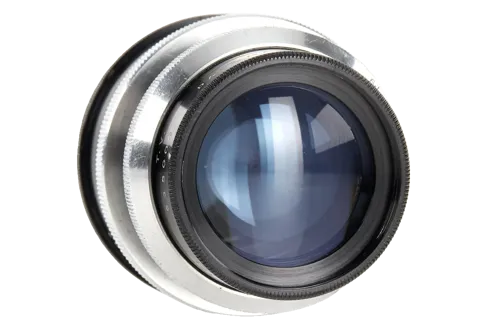
Dallmeyer Super-Six 2-inch 50.8mm f/1.9 (Rigid)
LTM mount
No listings tracked for this lens right now.
The Dallmeyer Super-Six 2-inch 50.8mm f/1.9 (Rigid) is a LTM-mount lens for Leica rangefinder cameras. Leica price index →
How it compares
Measured against the 108 other 50mm LTM-mount lenses in the catalogue.
Specification
About this lens
Dallmeyer Super-Six 2-inch 50.8mm f/1.9 (Rigid)
The Dallmeyer Super-Six 2-inch 50.8mm f/1.9 (Rigid) is a British high-speed standard lens documented in an original, rangefinder-coupled Leica M39 focusing mount. Auction records place coated coupled examples in the late 1940s and 1950s, including one specifically dated 1948. The “Rigid” qualifier distinguishes this fixed-length barrel from a separate collapsible entry; it does not refer to the recent lens that borrows the word for a modern mechanical design.
The Super-Six family uses a six-element, four-group double-Gauss construction. A 1953 Dallmeyer Super-Six supplied for the Ilford Witness is independently documented with that formula and the same 2-inch f/1.9 specification. That Witness barrel is not identical to the Leica rigid mount, so its 18-inch close-focus extension, diaphragm range and hybrid mounting details are not transferred here. For the exact Leica version, blade count, minimum focusing distance, filter fitting, weight and complete aperture scale remain unspecified unless established from a particular lens.
Two inches converts to 50.8mm, functionally a normal focal length on 35mm film. The lens focuses manually and couples mechanically to the Leica rangefinder. Aperture operation is manual, without automatic diaphragm or electronic communication. It can be used on a Leica screw-mount body directly or on many Leica M bodies with an appropriate M39-to-M adapter. A 50mm finder view is suitable for composition, while live view can help verify focus and reveal any mismatch between an old lens cam and a modern camera body.
Optical qualities
Rendering
The double-Gauss formula and f/1.9 maximum aperture place the Super-Six among the fast standard lenses of its period. A contemporary-style use report for the same focal-length formula on the Ilford Witness describes a balance of strong detail and some corner softness, but that evidence belongs to a different focusing mount and one individual lens. It supports the broader optical identity, not a guarantee that every rigid M39 example will render identically. Coating condition, centering, haze and prior repair can materially change results.
Sharpness and contrast
At full aperture, focus accuracy is critical and the outer field may differ from the center. Stopping down increases depth of field, but there is no controlled aperture series for the exact rigid M39 variant. A healthy coated example should be assessed separately from an uncoated cine lens or a later conversion. Rangefinder calibration and optical alignment are part of practical image quality.
Bokeh and aberrations
The f/1.9 aperture allows shallow depth of field at close and medium subject distances. The six-element double-Gauss layout can produce changing blur toward the edges as residual aberrations interact with focus distance, yet a fixed label such as “swirly” or “smooth” would overstate the evidence. Highlight shape also depends on the diaphragm in the specific barrel, whose blade count is not established here. Sample images should therefore be matched to an original 2-inch coupled M39 lens before they are used to characterize this entry.
Color, flare and coating
Documented Leica M39 examples from the late 1940s and 1950s are coated. Surviving coating can improve transmission and resistance to flare compared with an untreated surface, but early coatings are often softer and may show cleaning damage. A hood remains useful with bright light near the frame. Color and contrast claims from the Ilford Witness provide limited comparison only, because even lenses sharing the optical formula can differ in coating age, internal finish and present condition.
History
Development and Launch
For the rigid 2-inch M39 version, the most direct evidence is a group of Leitz Auction records documenting original coupled lenses. One is dated 1948 and explicitly described as coated; another is assigned to the 1940s; and a later example is dated to the 1950s. Together they support a late-1940s introduction or availability window and continued production into the following decade, but they do not establish a precise first-production date or total quantity.
Production Evolution
The 2-inch f/1.9 optical specification was used beyond the Leica system. Dallmeyer supplied a coated six-element, four-group Super-Six for the Ilford Witness, a British rangefinder sold in the early 1950s. Its focusing unit looks superficially collapsible but is fixed, and its special interrupted-thread and bayonet arrangement allowed use within the Witness system. That version is historically relevant but mechanically separate from the original Leica rigid barrel described here.
Special Editions/Variants
The principal variants for Leica collectors are the rigid and collapsible focusing forms, together with later conversions that may use either Leica screw or bayonet mounts. They should remain separate database entries because their mechanics, dimensions and provenance differ. Coated and potentially earlier untreated optics may also exist across the broader Super-Six family, but the exact coating should be inspected rather than inferred from the name.
Collector Notes
Originality depends on more than an M39 rear thread. Inspect the rangefinder cam, focusing barrel, engravings and flange construction, and compare them with a documented original Leica example. Confirm that the lens reaches infinity and that measured focus agrees with the rangefinder at several distances. At f/1.9, small calibration or centering errors become visible quickly.
Sources
- Leitz Auction: Dallmeyer Super-Six 2-inch M39, dated 1948leitz-auction.com →
- Leitz Auction: Dallmeyer Super-Six 2-inch M39, 1940s exampleleitz-auction.com →
- Leitz Auction: Dallmeyer Super-Six 2-inch M39, 1950s exampleleitz-auction.com →
- Mike Eckman: Ilford Witness and its 2-inch Super-Sixmikeeckman.com →
Where to buy
Related lenses
Similar lenses you might be interested in
Comments