The classic fast 50mm f/1.5 Sonnar for Contax RF, using seven elements in three groups and body-driven focusing through the internal bayonet.
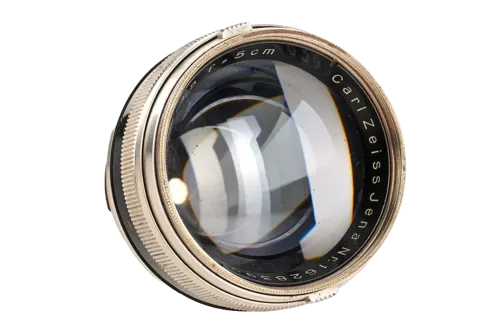
Carl Zeiss Jena Sonnar 50mm f/1.5
Contax RF mount
No listings tracked for this lens right now.
The Carl Zeiss Jena Sonnar 50mm f/1.5 is a Contax RF-mount lens for Leica rangefinder cameras. Leica price index →
How it compares
Measured against the 15 other 50mm Contax RF-mount lenses in the catalogue.
Specification
About this lens
Carl Zeiss Jena Sonnar 50mm f/1.5
The Carl Zeiss Jena Sonnar 50mm f/1.5 was the fastest standard lens offered with the original Contax rangefinder system. Introduced in 1932, it combined an unusually large aperture with a compact seven-element, three-group optical construction developed by Ludwig Bertele.
The lens uses the internal Contax bayonet. It does not contain an independent focusing helicoid. Focusing is performed by the helicoid built into the Contax camera body, operated with the camera's focusing wheel or the knurled focusing ring surrounding the mount. Rangefinder coupling is therefore provided through the camera rather than through a separate mechanism inside the lens.
Unlike the slower collapsible 50mm lenses, the f/1.5 Sonnar was supplied in a rigid barrel. It must consequently remain a separate collector profile from collapsible Sonnar and Tessar designs even though they share the same internal Contax mounting principle.
Early examples have black and nickel finishes, an aperture control positioned farther back on the barrel and no threaded filter mount. Later pre-war lenses moved the aperture control to the front, added small finger grips and adopted a 40.5mm filter thread. Chrome bodies became common with the Contax II and III. Coated lenses appeared during the late 1930s, initially alongside uncoated production, while wartime examples may use mixed metals or aluminum components.
The stated dimensions, weight and blade count represent a documented late pre-war configuration. Mechanical specifications vary across the numerous early, late and wartime barrel types.
Optical qualities
Rendering
The seven-element, three-group Sonnar was designed to achieve high speed while limiting the number of air-to-glass surfaces. This was particularly important before anti-reflection coating became widely available.
At f/1.5, a well-adjusted example can provide strong central definition with lower overall contrast, visible spherical aberration, field curvature and softer outer areas. These characteristics can produce gentle transitions and pronounced subject separation, but performance depends heavily on optical condition and accurate rangefinder calibration.
Stopping down improves contrast and extends the area of useful sharpness. Uncoated examples are particularly sensitive to direct light and benefit from a suitable hood. Later coated examples generally retain better contrast in difficult lighting.
The exact rendering also varies with optical revision, coating status, element spacing and previous servicing. Haze, separation and cleaning damage can affect results more strongly than the nominal production version.
History
Development and Launch
The f/1.5 Sonnar appeared with the original Contax system in 1932. Its speed was exceptional for a production 35mm camera lens of the period and made the Contax system particularly attractive for available-light, press and theatre photography.
The design used seven elements in three cemented groups. This reduced reflective surfaces compared with contemporary fast double-Gauss lenses and helped preserve transmission and contrast before effective lens coating became standard.
Production Evolution
The earliest lenses were finished in black and nickel and lacked a threaded filter rim. Successive versions changed the position of the aperture control and the smallest available aperture.
A revised front section with finger grips and a 40.5mm filter thread appeared during the mid-1930s, followed by chrome-finished bodies. Coating was introduced gradually during the late 1930s. Wartime production produced additional material and finish variations.
This profile ends with the original Jena pre-war and wartime generation. Zeiss-Opton and later West German Carl Zeiss Sonnars belong to separate postwar profiles.
Special Editions/Variants
No commemorative edition is known. Black-and-nickel, chrome, coated, uncoated and mixed-material wartime lenses are production variants within this profile.
Special-purpose R-Sonnar and X-ray versions are not included because their intended use and optical characteristics differ from the standard photographic lens.
Collector Notes
Identify the version through the aperture-control position, front rim, filter provision, finish and coating mark. Early unthreaded and later 40.5mm versions should not be assumed to share identical dimensions or aperture limits.
Check for internal haze, cemented-group separation, cleaning marks, damaged filter threads, oily diaphragm blades and previous optical reassembly. Accurate spacing and correct calibration are especially important when the lens is used at f/1.5.
Modern mirrorless use requires an adapter with an integrated Contax/Kiev focusing helicoid. A simple passive bayonet ring cannot focus this internal-bayonet lens.
Collectors should verify the engraved maker and model, native mount, focusing mechanism and rangefinder cam instead of relying on a seller title. A later conversion is not evidence of a factory variant, while cosmetic engraving changes do not automatically prove a new optical version. Serial numbers can support comparison when used with specialist records, but an isolated number does not establish a production date.
Check focusing travel, aperture action, glass condition and signs of incorrect reassembly. Rangefinder agreement should be tested at close, middle and distant settings. Caps and cases add context but do not change the identity of the lens.
Sources
- Zeiss Ikon, The Contax Camera System, 1938pacificrimcamera.com →
- Pacific Rim Camera, 50/1.5 Zeiss Sonnar for Contaxpacificrimcamera.com →
- JAPB, Carl Zeiss Jena Sonnar 50mm f/1.5 Contax/Kiev data sheetjapb.net →
- 35mmc, Zeiss Jena 5cm Sonnars: The Magic of the Prewar Uncoated Sonnar35mmc.com →
- Leitz Photographica Auction, Carl Zeiss Jena f. Contax Sonnar 1.5/5cmleitz-auction.com →
Where to buy
Related lenses
Similar lenses you might be interested in
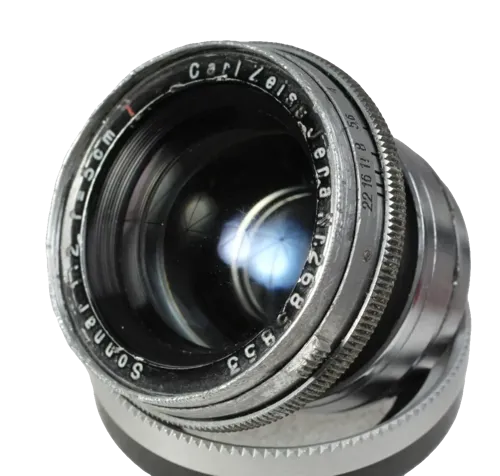
Sonnar 5cm f/2 (Collapsible)
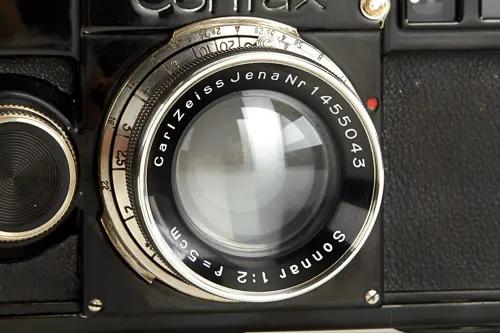
Sonnar 50mm f/2 (Rigid)
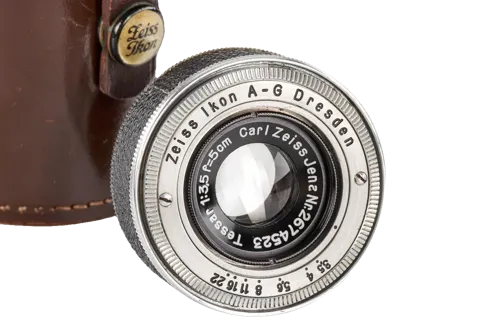
Tessar 50mm f/3.5 (Rigid)
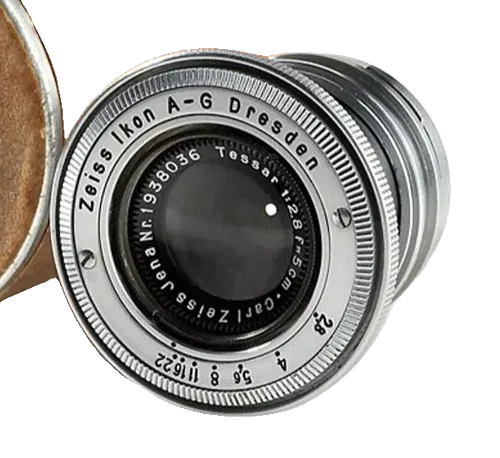
Tessar 50mm f/3.5 (Collapsible)
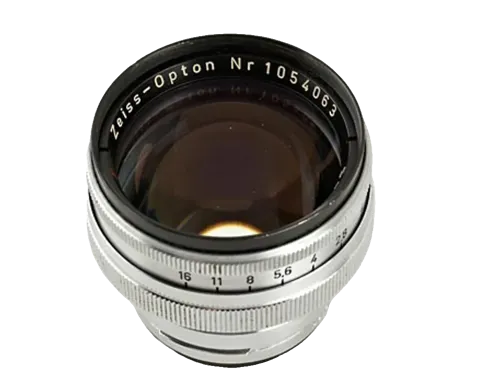
Opton Sonnar 50mm f/1.5
Comments