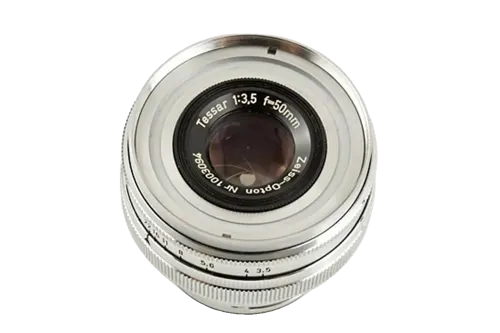
A collapsible 50mm f/3.5 Tessar for early Contax RF cameras, using four elements, internal-bayonet body focusing and a compact retractable barrel.
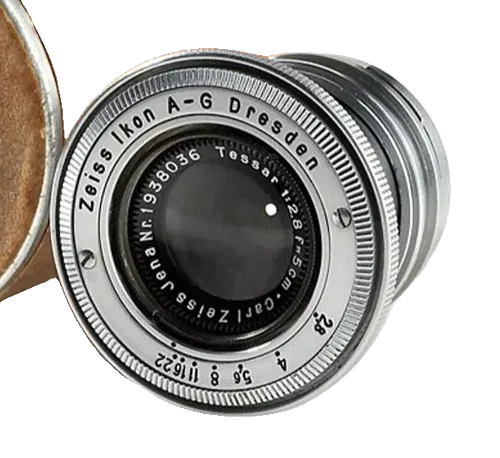
Carl Zeiss Jena Tessar 50mm f/3.5 (Collapsible)
Contax RF mount
No listings tracked for this lens right now.
The Carl Zeiss Jena Tessar 50mm f/3.5 (Collapsible) is a Contax RF-mount lens for Leica rangefinder cameras. Leica price index →
How it compares
Measured against the 15 other 50mm Contax RF-mount lenses in the catalogue.
Specification
About this lens
Carl Zeiss Jena Tessar 50mm f/3.5 (Collapsible)
The Carl Zeiss Jena Tessar 50mm f/3.5 Collapsible was one of the original standard lenses for the Contax rangefinder system. It combines the classic four-element, three-group Tessar formula with a retracting barrel designed to reduce the camera's carrying depth.
The lens uses the internal Contax bayonet and relies on the focusing helicoid built into the camera. The lens itself contains no independent focusing mount. Rangefinder coupling is provided through the camera's internal focusing mechanism.
For photography, the optical tube must be extended fully into its working position. The collapsed position is intended for transport and storage. This operating requirement makes it a separate mechanical identity from the fixed rigid prototype.
The compact body was produced in several finishes. Early lenses have black and nickel or bright nickel construction. Chrome versions followed with the Contax II and III. Immediate postwar Jena examples may use lighter aluminum bodies and can be found with or without coating.
The quoted dimensions and weight describe a documented pre-war barrel. Other finishes and postwar bodies can differ.
Optical qualities
Rendering
The Tessar uses four elements in three groups, making it simpler and slower than the contemporary Sonnar lenses. At f/3.5 it is intended as a compact general-purpose standard lens rather than a low-light optic.
A clean example can provide useful central definition at full aperture, with lower contrast and weaker outer-field performance than a modern 50mm lens. Stopping down improves contrast, field consistency and edge definition.
Uncoated versions are vulnerable to veiling flare and loss of contrast when strong light reaches the front element. A hood is useful. Coated postwar examples generally handle difficult illumination better, although internal haze can negate that benefit.
The lens offers less subject isolation than the f/2 and f/1.5 Sonnars. Its attraction is its compactness, restrained rendering and small collapsed package.
History
Development and Launch
The first Contax Tessar 50mm f/3.5 lenses were built in 1931, shortly before the commercial introduction of the Contax I. The design provided a compact and less expensive alternative to the fast Sonnars.
Zeiss's 1938 Contax catalogue describes the Tessar as an all-purpose lens suitable for landscapes, portraits, street scenes and enlarging. It explicitly states that the lens was made in a collapsible mount.
Production Evolution
Early production used a black-faced nickel body. An all-nickel version followed, with chrome construction introduced later to match the Contax II and III.
Production resumed in Jena after the war using aluminum barrels. Coated and uncoated immediate postwar examples are documented. Public sources do not establish a sufficiently precise final production year, so the database end date remains unknown.
Special Editions/Variants
Black-faced nickel, bright nickel, chrome and immediate postwar aluminum lenses are normal production variants within this profile.
The dedicated Tessar optical head made for the Contaprox close-focus system is excluded. Its specialised mounting and use belong to the separate Macro profile.
The 1940 rigid prototype is also excluded because its fixed barrel is a materially different mechanical construction.
Collector Notes
Check that the tube extends completely and locks securely. A partially extended lens will not focus correctly. On modern adapters, verify that the collapsible tube has adequate internal clearance.
Inspect the sliding surfaces for dents and uneven movement. Other common concerns include haze, cleaning marks, oily diaphragm blades, damaged filter threads and loose optical cells.
Early accessory fittings can accept 25.5mm screw-in filters as well as suitable 27mm or 42mm slip-on accessories. Confirm the actual front fitting before ordering filters or a hood.
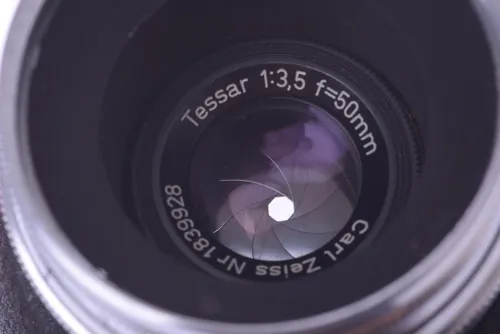
Collectors should verify the engraved maker and model, native mount, focusing mechanism and rangefinder cam instead of relying on a seller title. A later conversion is not evidence of a factory variant, while cosmetic engraving changes do not automatically prove a new optical version. Serial numbers can support comparison when used with specialist records, but an isolated number does not establish a production date.
Check focusing travel, aperture action, glass condition and signs of incorrect reassembly. Rangefinder agreement should be tested at close, middle and distant settings. Caps and cases add context but do not change the identity of the lens.
Historical lenses should not be judged from one sample alone. Haze, fungus, separation, cleaning damage, displaced elements and dried lubricant can alter contrast and focus more than modest design differences. Film choice, processing, digital sensor cover glass and adapter tolerances also influence results. A hood may reduce oblique flare but cannot correct internal contamination.
Sources
- Zeiss Ikon, The Contax Camera System, 1938pacificrimcamera.com →
- Pacific Rim Camera, 50/3.5 Zeiss Tessar for Contaxpacificrimcamera.com →
- Kamerastore, Carl Zeiss 5cm f/3.5 Jena Tessar Collapsiblekamerastore.com →
- Leitz Photographica Auction, Carl Zeiss Jena Tessar 3.5/5cm collapsibleleitz-auction.com →
Where to buy
Related lenses
Similar lenses you might be interested in
Comments