A rigid 50mm f/2 Sonnar for Contax RF, with six elements in three groups and internal-bayonet focusing driven and coupled by the camera body.
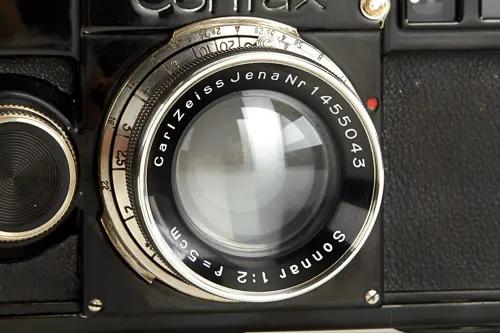
Carl Zeiss Jena Sonnar 50mm f/2 (Rigid)
Contax RF mount
No listings tracked for this lens right now.
The Carl Zeiss Jena Sonnar 50mm f/2 (Rigid) is a Contax RF-mount lens for Leica rangefinder cameras. Leica price index →
How it compares
Measured against the 15 other 50mm Contax RF-mount lenses in the catalogue.
Specification
About this lens
Carl Zeiss Jena Sonnar 50mm f/2 (Rigid)
The Carl Zeiss Jena Sonnar 50mm f/2 Rigid is the fixed-barrel form of Ludwig Bertele's classic six-element, three-group standard lens for the Contax rangefinder system.
Although its optical construction is closely related to the collapsible Sonnar 50mm f/2, the rigid barrel is a material mechanical difference. It cannot retract into the camera, has different handling and storage characteristics and exists in several barrel forms that are not represented accurately by the collapsible profile.
The lens uses the internal Contax bayonet and has no independent focusing helicoid. Focusing is performed by the helicoid built into the camera body. Rangefinder coupling is transmitted through that same mechanism. On a modern mirrorless camera, an adapter with a Contax/Kiev internal-bayonet focusing helicoid is therefore required.
Early rigid versions were made for the Contax I in black, nickel and mixed finishes. Their aperture controls and accessory fittings differ from later examples. Mid-1930s rigid lenses introduced front-mounted aperture controls, 40.5mm filter threads and chrome or mixed black, nickel and chrome finishes.
The rigid lens was produced alongside the collapsible Sonnar for a period. Immediate postwar Jena production returned to a rigid alloy body. These postwar Carl Zeiss Jena lenses remain distinct from the later West German Zeiss-Opton Sonnar, which introduced a different barrel and double-diaphragm construction.
Because the rigid Jena lens exists in widely differing early and postwar barrels, no single reliable length, diameter or weight should be transferred across the complete profile.
Optical qualities
Rendering
The six-element, three-group Sonnar construction limits the number of air-to-glass surfaces. In an uncoated lens this helps preserve transmission and contrast compared with more complex contemporary designs.
A properly assembled example can produce good central detail at f/2 with moderate contrast and softer outer areas. Residual spherical aberration and field curvature can give wide-open images smooth transitions and a recognisable vintage character. Stopping down increases contrast and extends sharpness across the frame.
Uncoated examples are vulnerable to veiling flare and generally benefit from a hood. Coated postwar Jena examples retain more contrast in backlight, although haze or damaged coating can remove that advantage.
The rigid and collapsible versions should not automatically be assumed to render identically. Optical recalculations, coating status, glass batches, mechanical alignment and condition can all affect the result.
History
Development and Launch
The Sonnar 50mm f/2 was developed for the first Contax system and entered production during the early 1930s. Its six elements are arranged in three groups, minimising reflective surfaces at a time when photographic lenses were normally uncoated.
The early rigid barrel matched the construction and appearance of the Contax I. It was later supplemented by a collapsible version intended to make the Contax II and III more compact when carried.
Production Evolution
Early lenses used black and nickel finishes and slip-on accessories. Later rigid barrels introduced revised rear elements, front-mounted aperture controls and eventually a 40.5mm threaded filter rim.
Chrome rigid lenses appeared during the mid-1930s. The collapsible form became the normal catalogue version, but rigid lenses continued to exist in smaller quantities.
After the war, Carl Zeiss Jena resumed production in a rigid aluminum body. These immediate postwar Jena lenses belong here mechanically but should not be confused with the later Zeiss-Opton Sonnar 50mm f/2.
Special Editions/Variants
Documented variants include early black-and-nickel barrels, nickel bodies, chrome bodies, coated examples, wartime mixed-material construction and immediate postwar aluminum bodies.
A very small ivory-finished Jena test series is also documented. It is a factory finish variation rather than a separate optical profile.
Collector Notes
Rigid and collapsible lenses can share the same basic optical designation, so identification must be based on the fixed barrel itself. A rigid lens does not have a sliding inner tube or a storage position.
Check the front accessory fitting before purchasing filters. Early rigid lenses may require slip-on accessories, while later examples accept a 40.5mm threaded filter.
Common condition concerns include haze, separation, oily diaphragm blades, damaged front rims and incorrect optical reassembly. The lens should also seat correctly in the camera's internal bayonet and focus smoothly through the body helicoid.
Collectors should verify the engraved maker and model, native mount, focusing mechanism and rangefinder cam instead of relying on a seller title. A later conversion is not evidence of a factory variant, while cosmetic engraving changes do not automatically prove a new optical version. Serial numbers can support comparison when used with specialist records, but an isolated number does not establish a production date.
Check focusing travel, aperture action, glass condition and signs of incorrect reassembly. Rangefinder agreement should be tested at close, middle and distant settings. Caps and cases add context but do not change the identity of the lens.
Sources
- Zeiss Ikon, The Contax Camera System, 1938pacificrimcamera.com →
- Pacific Rim Camera, 50/2 Zeiss Sonnar for Contaxpacificrimcamera.com →
- 35mmc, Zeiss Jena 5cm Sonnars: The Magic of the Prewar Uncoated Sonnar35mmc.com →
- Leitz Photographica Auction, Contax I with rigid Sonnar 2/5cmleitz-auction.com →
- Pacific Rim Camera, Carl Zeiss Jena Contax lens inventory referencesigorcamera.com →
Where to buy
Related lenses
Similar lenses you might be interested in
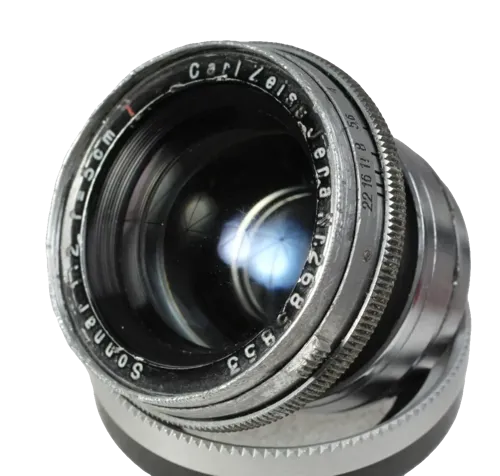
Sonnar 5cm f/2 (Collapsible)
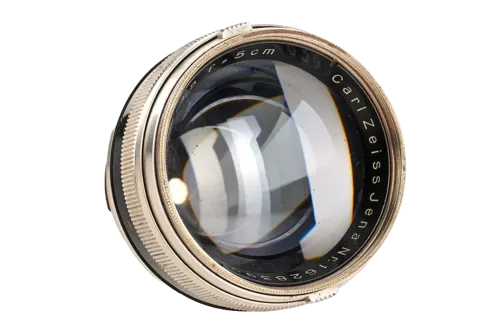
Sonnar 50mm f/1.5
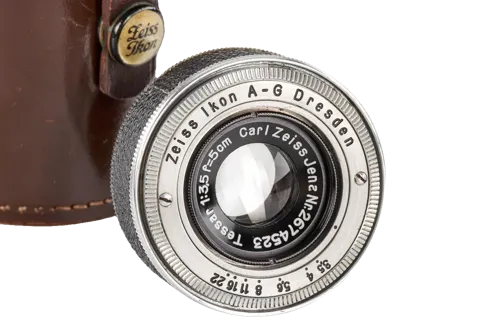
Tessar 50mm f/3.5 (Rigid)
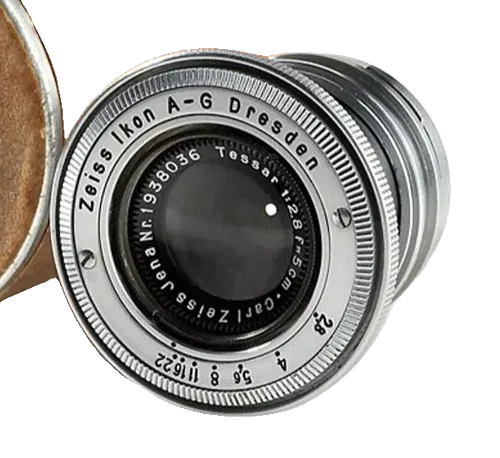
Tessar 50mm f/3.5 (Collapsible)
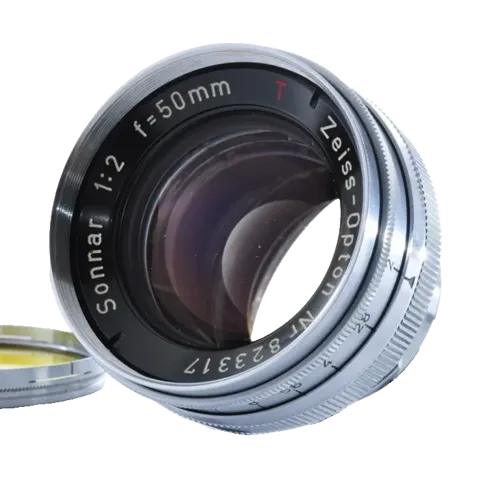
Opton Sonnar 50mm f/2
Comments