The flat-rear Zunow 5cm f/1.1 Type II, a rare 1950s ultra-fast rangefinder lens made in both coupled Leica M39 and Contax RF versions.
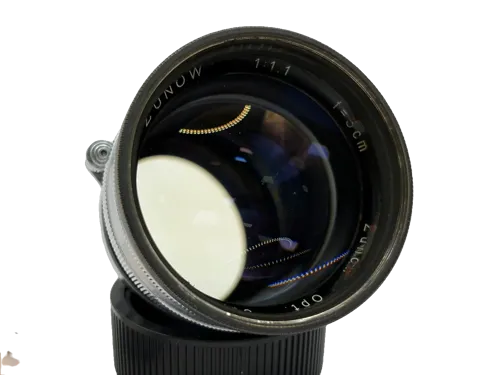
Zunow 5cm f/1.1 Type II
LTM / Contax RF mount
No listings tracked for this lens right now.
The Zunow 5cm f/1.1 Type II is a LTM / Contax RF-mount lens for Leica rangefinder cameras. Leica price index →
How it compares
Measured against the 121 other 50mm lenses in the catalogue.
Specification
About this lens
Zunow 5cm f/1.1 Type II
The Zunow 5cm f/1.1 Type II is a rare Japanese ultra-fast standard lens produced by Teikoku Kogaku during the 1950s. This profile distinguishes the later flat-rear form from the earlier rounded-rear version commonly nicknamed the Ping-Pong Ball. Leitz Auction documents a rangefinder-coupled Leica M39 example with a flat rear element, while specialist records also identify factory Contax rangefinder production.
The database records an eight-element, five-group construction for this version, a 54.5mm filter fitting, twelve diaphragm blades and a minimum focusing distance of approximately one metre. Published accounts do not always separate Zunow types consistently, and some describe a nine-element configuration associated with other examples. The optical count in this profile must therefore remain tied specifically to Type II evidence rather than applied to every 5cm f/1.1 Zunow.
Optical qualities
Rendering
The f/1.1 aperture was exceptional for a full-frame rangefinder lens of its era. Wide-open images can combine shallow depth of field with visible residual aberrations, lower contrast and pronounced sensitivity to oblique light. The many-bladed diaphragm helps maintain a rounded opening after modest stopping down, although highlight shape still depends on the exact aperture and optical geometry. Colour and contrast also vary with coating condition and internal cleanliness.
A historical lens should not be judged from one sample alone. Haze, separation, cleaning damage, displaced elements and inaccurate rangefinder adjustment can alter contrast and focus. This profile therefore addresses the design rather than promising identical results from every surviving copy.
Film choice, processing, digital sensor cover glass and adapter accuracy also affect the final image. A hood can reduce oblique flare, but cannot correct internal contamination or damaged coatings.
At maximum aperture
At f/1.1 the focus zone is extremely narrow at close range. Small errors in the camera's rangefinder, the lens cam or the adapter can move the sharp plane away from the intended subject. Bright edges and point light sources may show glow, flare or coloured fringes. These characteristics should be treated as conditions of ultra-fast period design, not as proof that every sample has the same signature.
Maximum-aperture use demands accurate focusing. A coupled rangefinder measures distance rather than inspecting the image plane, so calibration errors and subject movement can be mistaken for softness.
Stopped down
Stopping down reduces the burden on focus calibration and normally strengthens contrast and definition. It also changes the balance between a sharply defined subject and the smoother transitions sought by photographers who use the lens primarily at f/1.1. Middle apertures make the lens more practical for general standard-lens work.
The smallest aperture is not automatically the sharpest. Extra depth of field can help, while diffraction gradually reduces fine contrast. Mid apertures are usually the practical choice for even detail.
Handling and compatibility
The large front barrel and unusual rear construction require care. Original Leica M39 and Contax RF mounts use different mechanical interfaces even where the optical identity is related. The rear element must be checked for clearance before use on adapted digital bodies. Heavy filters or accessories should not be forced onto the uncommon 54.5mm fitting.
Similar-looking rangefinder mounts are not universally interchangeable. A suitable adapter must preserve the correct register and keep the rear assembly clear of internal parts.
History
Development and Launch
Teikoku Kogaku developed the Zunow name around unusually fast postwar optics. The 5cm f/1.1 became its best-known rangefinder lens and was offered for several systems. Its specification placed it among the fastest commercially available normal lenses of the period, when f/1.4 and f/1.5 were already considered high-speed designs.
Production Evolution
Early and later Zunow 5cm f/1.1 lenses differ visibly at the rear. The rounded protruding form is generally identified as the earlier type, while the flat-rear coupled M39 lens documented by Leitz Auction supports the Type II distinction used here. Conflicting element counts in secondary literature make visual and mechanical identification preferable to relying on a seller's type label alone.
Special Editions/Variants
Factory mounts are reported for Leica screw, Contax and Nikon rangefinder systems. This profile covers the flat-rear Type II in Leica M39 and Contax RF form. Nikon-mount examples remain mechanically separate. Cosmetic finish, scale engraving and minor barrel details may differ without proving a new optical formula.
Collector Notes
Collectors should verify the engraving, native mount, rangefinder cam and mechanical construction instead of relying on a seller's title. A later conversion is not evidence of a factory variant, and an isolated serial number does not establish a production year.
Check the aperture, focusing travel, haze, fungus, separation and signs of incorrect reassembly. Test rangefinder agreement at several distances. Accessories add context but do not change the lens's identity.
A Type II candidate should show the expected flat rear and a coherent factory mount with functioning rangefinder coupling. The rear glass deserves careful inspection because its location makes damage, cleaning marks and interference especially relevant. Claims of rarity should never replace verification of the exact type.
Sources
Where to buy
Related lenses
Similar lenses you might be interested in
Comments