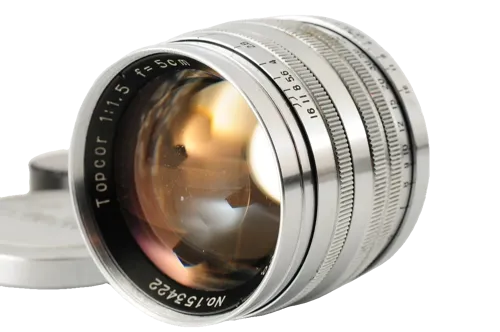
A rigid, coupled 50mm f/1.5 standard lens introduced for the Leotax D IV around 1950, with seven elements, twelve blades and a substantial chrome barrel.

Tokyo Kogaku Simlar 50mm f/1.5
LTM mount
No listings tracked for this lens right now.
The Tokyo Kogaku Simlar 50mm f/1.5 is a LTM-mount lens for Leica rangefinder cameras. Leica price index →
How it compares
Measured against the 108 other 50mm LTM-mount lenses in the catalogue.
Specification
About this lens
Tokyo Kogaku Simlar 50mm f/1.5
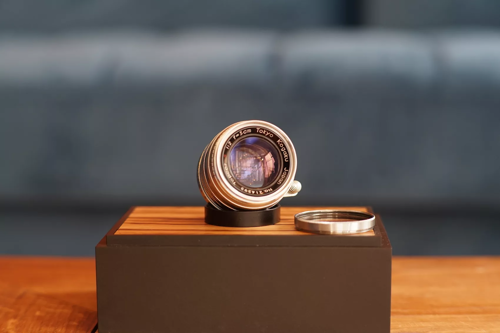
The Tokyo Kogaku Simlar 50mm f/1.5 is a fast, rigid standard lens introduced for the Leotax rangefinder system around 1950. It was produced by Tokyo Optical before the company adopted the Topcor name for this lens family. The Simlar is a native Leica-standard screw-mount lens with its own focusing helicoid and mechanical rangefinder coupling, suitable for Leotax and other correctly calibrated LTM bodies.
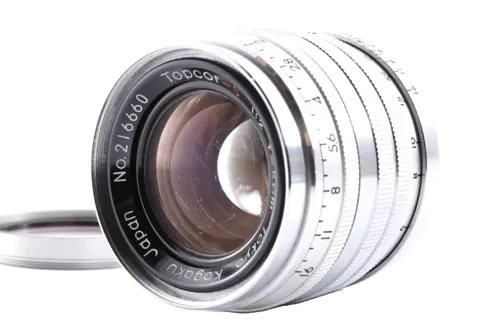
Its optical construction is documented as seven elements in four groups. A twelve-blade diaphragm controls the f/1.5 maximum aperture, giving the lens a more complex optical and mechanical identity than the collapsible f/3.5 Simlar offered alongside it. The substantial rigid chrome barrel cannot be collapsed and should not be merged with the smaller collapsible Simlar profiles merely because they share a name and focal length.
Specialist documentation gives a minimum focus of approximately 3.5 feet and records an unusual 40mm filter fitting for the early Simlar. Tokyo Optical revised the lens during production, but surviving documentation does not establish whether every published mechanical specification applies to both Simlar forms. A 40.5mm fitting is associated with the later revised lens or the renamed Topcor, so filter size should be checked on the actual generation rather than inferred from the family name.
The lens provides normal 50mm coverage. It can be mounted on Leica M cameras with a suitable 50mm LTM-to-M adapter, while retaining manual aperture control and rangefinder focusing. Its fast aperture places greater demands on body and lens calibration than the slower collapsible standard lenses.
Optical qualities
Rendering
Dependable controlled testing for the exact Simlar-marked 50mm f/1.5 is limited. Later Topcor-marked f/1.5 lenses should not be used as automatic evidence because specialist research documents a revision and a name change. The seven-element, four-group count is supported, but informal labels such as Sonnar, Gauss or hybrid do not by themselves establish how this exact generation renders.
Published user discussion suggests that the Simlar and revised Topcor do not behave identically, but the available observations are too limited and copy-dependent for universal claims about glow, swirl or colour. Optical condition is especially important in a fast early-1950s lens. Haze, coating damage, element separation, decentring and rangefinder miscalibration can each dominate the result.
Bokeh and transitions
The twelve-blade diaphragm supports a rounded aperture shape when stopped down, which is a documented mechanical characteristic. It does not guarantee smooth backgrounds in every scene. Reliable exact-generation comparisons across focus distances and apertures have not been found, so stronger claims about transition quality are omitted.
Digital use
Live-view magnification can separate optical behaviour from rangefinder calibration error, making mirrorless testing useful. On coupled film or digital rangefinders, calibration should be checked at f/1.5 and at the lens's closer distances before drawing conclusions about sharpness. A standard LTM adapter is sufficient mechanically; no collapsing-tube clearance issue applies to this rigid version.
History
Development and Launch
Tokyo Optical supplied lenses to Showa Kogaku for the Leotax camera line during the post-war period. By at least 1950, the rigid Simlar 50mm f/1.5 was offered with the Leotax D IV as the fast alternative to the collapsible f/3.5 standard lens. A 1951 Leotax advertisement reproduced in specialist research shows both aperture classes within the system.
The f/1.5 Simlar belongs to a separate optical and mechanical identity from the earlier State, C.Simlar and Simlar 50mm f/3.5 collapsible lenses. The shared Simlar name reflects Tokyo Optical branding, not a shared optical formula or barrel construction.
Production Evolution
The rigid f/1.5 lens was revised during its production life. Collector research records an early 40mm filter fitting and indicates that the revised form may have moved to 40.5mm. The precise point at which that change occurred is not securely established in accessible factory documentation. In 1955 the f/1.5 lens was renamed Topcor, and early Leotax F documentation identifies the Simlar before the Topcor name became standard.
The later name should not erase the earlier Simlar identity. At the same time, a cosmetic engraving change alone does not prove a new optical formula. The documented revision should be described within the production history unless stronger factory evidence supports a formal split.
Special Editions/Variants
Early and revised Simlar forms are documented, chiefly through barrel details and filter fitting. No commemorative or separate special-edition version has been reliably established. The later Topcor engraving is a production successor and alias within the broader lens family, but it should remain distinguishable in collector notes because exact mechanical specifications can differ.
Collector Notes
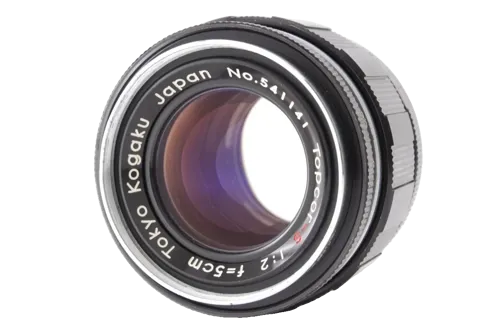
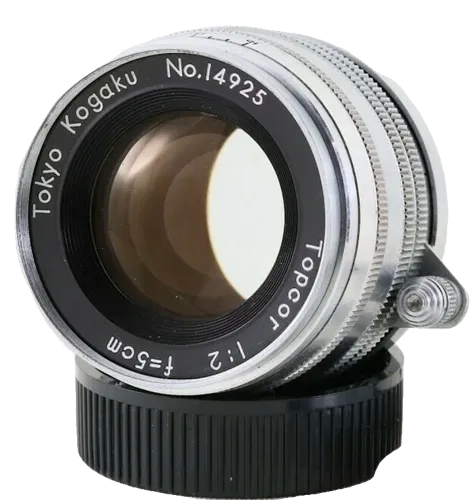
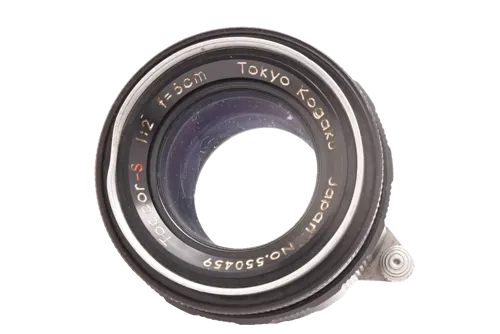
The rigid chrome construction, Simlar name, f/1.5 aperture and twelve-blade diaphragm are the main identification points. The lens must not be confused with the collapsible f/3.5 Simlar, with the later 50mm f/2 Topcor and Topcor-S designs, or with similarly named lenses in unrelated mounts. Filter accessories require particular care because the early 40mm fitting is uncommon and should not be forced to accept a 40.5mm accessory.
For use on a coupled rangefinder, check focus accuracy at full aperture, helicoid smoothness and diaphragm cleanliness. Catalogue descriptions should remain generic and should not use an individual lens number to define a production generation.
Sources
Where to buy
Related lenses
Similar lenses you might be interested in
Comments