Best price Good
Leica Summicron-M M3 2/35mm Silver V1 (11308)
Sold by classic.leica-camera.com
€2,380 ≈ $2,571
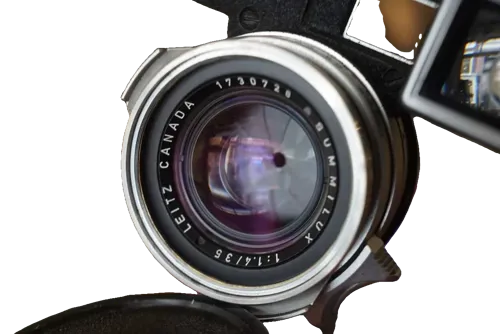
Leica Summicron-M 35mm f/2 I 8-element 11308 SAWOM, the classic non-goggled M-mount version with 16-blade aperture and collector appeal.
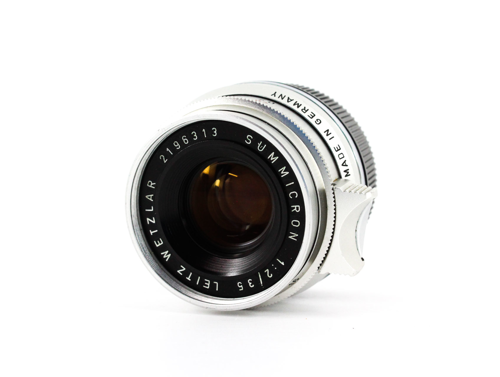
M mount
The Leica Summicron-M 35mm f/2 I 8-element is a M-mount lens for Leica rangefinder cameras. As of October 2026, it sells from €2,380 used across 18 listings, with a 30-day median of €4,062. Leica price index →
Measured against the 76 other 35mm M-mount lenses in the catalogue.
The Leica Summicron-M 35mm f/2 I 8-element is the non-goggled M-mount version of Leica's first 35mm Summicron, introduced at Photokina in 1958. Developed by Walter Mandler and the optical department at Leitz Canada in Midland, the lens combined an unusually compact barrel with an eight-element, six-group optical design. The standard non-goggled version was intended primarily for cameras such as the Leica M2 and M1, whose viewfinder systems accommodated the 35mm focal length without the optical viewing attachment required by the M3 version. The production version became catalogue number 11308 and carried the Leitz code SAWOM, following the earlier SAWOO-M designation.
The lens has an E39 filter thread, a 16-blade diaphragm and rangefinder-coupled focusing to 0.7 metres. Its chrome-plated brass construction is compact, with the lens measuring approximately 28.4 mm in length and 51 mm in diameter. The scalloped focusing ring, infinity lock and small aperture-control lever are characteristic features of the first-generation 35mm Summicron. Production took place in both Wetzlar and Midland, Canada.
The 11308 must be separated from two closely related first-generation Summicron versions. The 11108/SAMWO was designed for the Leica M3 and incorporates an optical viewing attachment, commonly called goggles, while the 11008/SAWOO is the much rarer Leica Thread Mount version. These versions share the basic eight-element optical formula but differ mechanically, including their minimum focusing distances and diaphragm construction. For LeicaLensList, they are best treated as separate lens profiles rather than variations within a single listing.
Rendering
The first-generation 35mm Summicron uses a largely symmetrical eight-element, six-group optical design. At f/2, published optical analysis describes moderate overall contrast with stronger resolution and fine-detail definition around the centre than toward the outer image field. Stopping down increases contrast and produces progressively more even definition across the frame.
Sharpness
At maximum aperture, the central image area is better corrected than the edges and corners. Definition improves substantially at f/2.8 and through the middle apertures. The design becomes considerably more uniform when stopped down, although the extreme image field remains less strongly corrected than the central area.
Flare resistance
The eight-element design can show flare and reduced contrast when strong light enters the lens, particularly at wider apertures. Present-day performance also depends heavily on optical condition. Haze, cleaning marks and coating deterioration can make an individual lens perform noticeably differently from a clean example.
Distortion and vignetting
Distortion is very low and is one of the notable characteristics of the largely symmetrical optical construction. Vignetting is significantly more apparent at maximum aperture and decreases progressively as the lens is stopped down.
Development and Launch
Leitz introduced the 35mm f/2 Summicron at Photokina in 1958. Its optical design was developed under Walter Mandler at Leitz Canada in Midland, Ontario. The new lens provided Leica photographers with a substantially faster 35mm option while remaining compact enough for normal rangefinder use.
Several versions were required because of differences between Leica M camera finders. The Leica M2, introduced in 1957, incorporated 35mm framelines and could use the standard lens directly. This non-goggled version was initially known as SAWOO-M and subsequently received the code SAWOM and catalogue number 11308.
A separate goggled version was produced for the Leica M3, whose viewfinder did not contain 35mm framelines. Leica also produced a much rarer screw-mount SAWOO for users of older Leica Thread Mount cameras.
Production Evolution
The 11308 retained the original eight-element, six-group optical construction throughout its production life. Both Wetzlar and Midland production examples are documented, with minor differences in engraving, coatings and external details.
Early examples commonly use red lettering on parts of the distance scale, while later lenses can be found with yellow scale markings. Collector references associate the transition toward yellow lettering with later serial-number production.
Some genuine M-bayonet examples were assembled using a screw-mount-derived chassis fitted at the factory with a Leica bayonet adapter secured by a small screw. This construction is original to certain production lenses and should not automatically be interpreted as a later conversion.
The first-generation bayonet Summicron remained in production through 1969. Surviving 11308 examples from the first 1958 production batches through late 1969 production are documented by specialist auction records.
Special Editions/Variants
The principal factory variant of the non-goggled lens is the rare black-finish 11307. It was intended for the same M2/M1-type application as the chrome 11308 but was produced in substantially smaller quantities.
Several versions of the 11307 are documented, with differences including Germany or Canada engraving, bayonet finish, infinity-lock construction and red or yellow distance-scale lettering. Original black lenses are highly collectible and should be distinguished carefully from later repainted chrome examples.
Prototype and pre-series non-goggled lenses are also known. Documented examples include very low prototype serial numbers from the development period. A special chrome-finish aluminium prototype is also recorded in specialist collector literature. These were not normal commercial production lenses.
Collector Notes
The primary identifiers of the standard lens are the absence of goggles, Leica M bayonet, 0.7 metre focusing scale and 11308/SAWOM identity. Collectors should not identify the version solely from the eight-element optical formula, since the goggled M3 and LTM versions use the same fundamental optical construction.
Factory-fitted bayonet adapters deserve particular attention. Some genuine M lenses were built on screw-mount-derived chassis, so the presence of an adapter-style construction does not necessarily mean that a lens began life as a separately sold LTM lens.
Original black 11307 examples require particularly careful authentication because of their high collector value. Finish wear, engraving style, serial number, scale colors, mount construction and infinity-lock details should be considered together when assessing originality.
Optical condition is also important. Haze, separation, cleaning marks, fungus and coating deterioration can affect both collector value and photographic performance. The focusing mechanism, infinity lock, aperture lever and 16-blade diaphragm should operate correctly. Period accessories include E39 filters and Leica hoods such as the IROOA/12571 and 12585.
11307, black finish: Rare factory black version of the non-goggled first-generation M-mount Summicron. Multiple mechanical and engraving subvariants are documented.
Prototype and pre-series lenses: Very low serial-number development examples and an aluminium prototype are documented, but these were not regular commercial models.
Good time to buy. The lowest listing is 41% below the 30-day average.
Lowest price Click a mark to open that listing · arrow keys to step, Enter to open
Price against condition for 18 listings of Leica Summicron-M 35mm f/2 I 8-element, €2,380 to €14,024, median €3,619. Mint: 3 at €3,953, €5,556, €6,288. Excellent: 4 at €2,598, €2,858, €4,172, €5,093. Good: 6 at €2,380, €2,754, €2,926, €3,477, €5,563, €14,024. 15_Day_Approval: 5 at €2,688, €3,113, €3,495, €3,742, €4,728. The full table follows.
| Condition | Lowest | Median |
|---|---|---|
| Mint | €3,953 | €5,556 |
| Excellent | €2,598 | €3,515 |
| Good | €2,380 | €3,201 |
| Other | €2,688 | €3,495 |
Over the last 19 weeks the median price for the Leica Summicron-M 35mm f/2 I 8-element has risen, ranging from €3,564 to €4,062 (now €4,062).
Weekly price (EUR). Median (Good or better) and lowest (Good or better) across 19 weeks. The full figures follow in the table below.
| Week | Median | Lowest |
|---|---|---|
| Jun 1, 2026 | €3,957 | €2,615 |
| Jun 8, 2026 | €3,957 | €2,615 |
| Jun 15, 2026 | €3,672 | €2,615 |
| Jun 22, 2026 | €3,672 | €2,615 |
| Jun 29, 2026 | €3,594 | €2,615 |
| Jul 6, 2026 | €3,692 | €2,615 |
| Jul 13, 2026 | €3,594 | €2,615 |
| Jul 20, 2026 | €3,594 | €2,615 |
| Jul 27, 2026 | €3,594 | €2,615 |
| Aug 3, 2026 | €3,594 | €2,615 |
| Aug 10, 2026 | €3,753 | €2,615 |
| Aug 17, 2026 | €3,674 | €2,615 |
| Aug 24, 2026 | €3,889 | €2,615 |
| Aug 31, 2026 | €3,825 | €2,615 |
| Sep 7, 2026 | €4,242 | €2,615 |
| Sep 14, 2026 | €3,889 | €2,615 |
| Sep 21, 2026 | €3,953 | €2,615 |
| Sep 28, 2026 | €3,953 | €2,380 |
| Oct 5, 2026 | €3,953 | €2,380 |
Every shop grades differently. Leica Classic uses letters, Ffordes uses E++ and E+, German dealers write "Zustand B", Japanese dealers write A−. We map all of them onto the one ladder below. Where a shop states its own grade, we print it under ours.
As of October 2026, the Leica Summicron-M 35mm f/2 I 8-element sells from €2,380 used, with a 30-day median of €4,062, across 18 active listings.
As of October 2026, the Leica Summicron-M 35mm f/2 I 8-element is sold by 5 sources (18 listings), from €2,380 used: all compared cheapest-first on this page.
Similar lenses you might be interested in
Comments