Best price Good
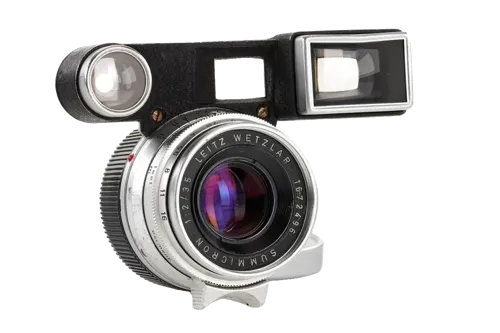
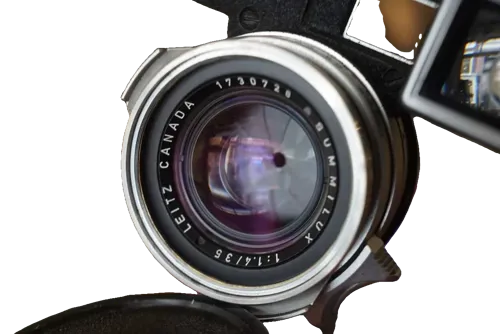
Leica Summicron 35mm F/2 for M3, 8-element with goggles
Sold by Fotohandel Delfshaven
€1,663 ≈ $1,796
The goggled Leica 35mm f/2 eight-element Summicron for the M3, catalogue 11108, with coupled focusing, E39 filters and a 16-blade diaphragm.
M mount
The Leica Summicron 35mm f/2 I 8-element with Goggles (M3) is a M-mount lens for Leica rangefinder cameras. As of October 2026, it sells from €1,663 used across 14 listings, with a 30-day median of €2,174. Leica price index →
Measured against the 76 other 35mm M-mount lenses in the catalogue.
The Leica Summicron 35mm f/2 I 8-element with Goggles is the M3-specific version of the first 35mm Summicron, introduced in 1958. The chrome production lens became catalogue number 11108 and carried the Leitz code SAMWO, having initially been designated SAWOO-MW. Its integrated optical viewing attachment allowed the 35mm lens to be used with the Leica M3, whose finder did not contain native 35mm frame lines. The goggles alter the apparent finder magnification so that the M3's existing framelines provide the appropriate field of view.
Optically, the lens uses the celebrated first-generation Summicron construction of eight elements in six groups, designed under Walter Mandler at Leitz Canada. It takes E39 filters and uses a 16-blade diaphragm. The M3 version focuses to approximately 0.65 metres, slightly closer than the 0.7 metre non-goggled M version. The lens remains mechanically rangefinder coupled, with the viewing attachment forming an integral part of its intended M3 operation.
The standard 11108 is normally encountered in silver chrome and was manufactured in both Wetzlar and Midland. Some examples were constructed around a screw-mount-type chassis fitted at the factory with a secured screw-to-bayonet adapter. This is a documented production construction and should not automatically be interpreted as a later private conversion. The goggled 11108 should remain separate in a collector database from the non-goggled 11308 and the 11008 LTM lens because the mechanical configuration, focusing limit, aperture mechanism and catalogue identity differ.
Rendering
The first 35mm Summicron uses a largely symmetrical eight-element, six-group optical design. Contemporary optical analysis describes relatively low overall contrast at f/2, with good fine-detail reproduction near the image centre but softer definition toward the outer image field. Contrast and definition improve noticeably when the lens is stopped down.
Sharpness
At maximum aperture, centre detail is stronger than the outer zones. Performance improves markedly at f/2.8 and continues to become more even through the middle apertures. Erwin Puts' analysis found the eight-element version particularly strong at moderate apertures, although the extreme corners remain less well corrected than the central image field.
Flare resistance
The design shows a noticeable tendency toward flare at wider apertures. Condition is especially relevant today because haze, cleaning marks, coating degradation and separation can further reduce contrast in surviving lenses.
Distortion and vignetting
Distortion is documented as negligible, one of the notable characteristics of the nearly symmetrical optical formula. Vignetting is substantial at f/2, with published optical analysis placing light falloff at approximately 2.5 to 2.6 stops. It decreases as the lens is stopped down.
Development and Launch
Leitz introduced the first 35mm f/2 Summicron at Photokina in 1958. Its optical design originated with Walter Mandler and the Leitz optical department in Midland, Canada. The lens represented a major increase in speed over Leica's existing 35mm rangefinder lenses while remaining unusually compact.
Because the Leica M3 did not provide 35mm framelines, Leitz created a dedicated version fitted with an optical viewing unit. This version was initially known as SAWOO-MW and later as SAMWO, with catalogue number 11108 for the standard chrome lens.
Production Evolution
Some bayonet lenses were assembled using a screw-mount-derived chassis with a factory-secured bayonet adapter. These should not be automatically classified as converted LTM lenses.
The goggled version remained associated with the first-generation eight-element design throughout its production. Leica references place bayonet production of the first version broadly between 1958 and 1969, although the 11108 continued to appear in Leitz catalogues after active production had largely ended.
Special Editions/Variants
The principal rare factory variant is the black-finish M3 version, catalogue number 11104. Several mechanical and engraving subvariants of the black 11104 are documented, including differences in bayonet finish, infinity-lock construction and scale coloring.
Special Editions/Variants
11104, black finish: Rare factory black version of the goggled M3 Summicron. Multiple production subvariants are documented.
Prototype and pre-series goggled lenses are also known, but these do not have a normal production catalogue number.
Collector Notes
The most important distinction is between the 11108 goggled M3 version and the visually related non-goggled 11308. The viewing unit is not simply an optional hood or finder accessory. It forms part of the dedicated M3 configuration and is associated with different focusing mechanics.
Collectors should inspect the optical viewing unit as carefully as the taking lens. Haze, separation, scratches or misalignment in the goggles can compromise the finder image even when the photographic optics remain clean.
Good time to buy. The lowest listing is 24% below the 30-day average.
Lowest price Click a mark to open that listing · arrow keys to step, Enter to open
Price against condition for 14 listings of Leica Summicron 35mm f/2 I 8-element with Goggles (M3), €1,663 to €4,172, median €2,106. Excellent: 4 at €1,871, €1,982, €2,336, €2,900. Good: 4 at €1,663, €2,028, €2,081, €2,312. Fair: 2 at €1,871, €4,172. Used: 4 at €1,819, €2,130, €2,218, €2,593. The full table follows.
| Condition | Lowest | Median |
|---|---|---|
| Excellent | €1,871 | €2,159 |
| Good | €1,663 | €2,054 |
| Fair | €1,871 | €3,021 |
| Other | €1,819 | €2,174 |
Over the last 18 weeks the median price for the Leica Summicron 35mm f/2 I 8-element with Goggles (M3) has risen, ranging from €1,883 to €2,174 (now €2,174).
Weekly price (EUR). Median (Good or better) and lowest (Good or better) across 18 weeks. The full figures follow in the table below.
| Week | Median | Lowest |
|---|---|---|
| Jun 1, 2026 | €2,312 | €1,674 |
| Jun 8, 2026 | €2,312 | €1,674 |
| Jun 15, 2026 | €2,202 | €1,674 |
| Jun 22, 2026 | €2,092 | €1,674 |
| Jun 29, 2026 | €2,065 | €1,674 |
| Jul 6, 2026 | €2,039 | €1,674 |
| Jul 13, 2026 | €2,039 | €1,674 |
| Jul 20, 2026 | €1,961 | €1,674 |
| Jul 27, 2026 | €1,961 | €1,674 |
| Aug 3, 2026 | €1,883 | €1,674 |
| Aug 10, 2026 | €2,088 | €1,674 |
| Aug 17, 2026 | €2,088 | €1,674 |
| Aug 24, 2026 | €2,088 | €1,674 |
| Aug 31, 2026 | €2,061 | €1,674 |
| Sep 7, 2026 | €2,088 | €1,674 |
| Sep 14, 2026 | €2,088 | €1,674 |
| Sep 21, 2026 | €2,088 | €1,674 |
| Sep 28, 2026 | €2,054 | €1,663 |
Every shop grades differently. Leica Classic uses letters, Ffordes uses E++ and E+, German dealers write "Zustand B", Japanese dealers write A−. We map all of them onto the one ladder below. Where a shop states its own grade, we print it under ours.
As of October 2026, the Leica Summicron 35mm f/2 I 8-element with Goggles (M3) sells from €1,663 used, with a 30-day median of €2,174, across 14 active listings.
As of October 2026, the Leica Summicron 35mm f/2 I 8-element with Goggles (M3) is sold by 4 sources (14 listings), from €1,663 used: all compared cheapest-first on this page.
Similar lenses you might be interested in
Comments