Best price
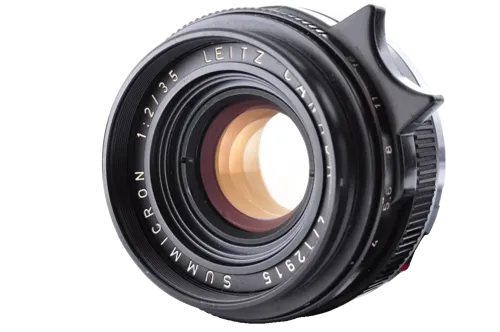
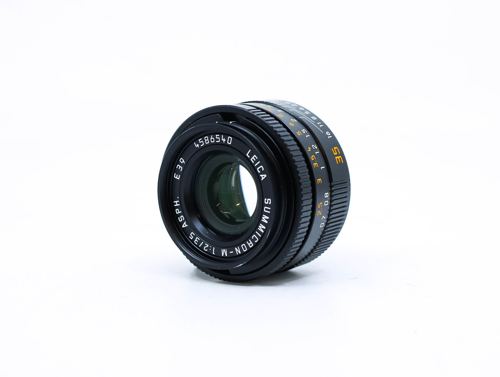
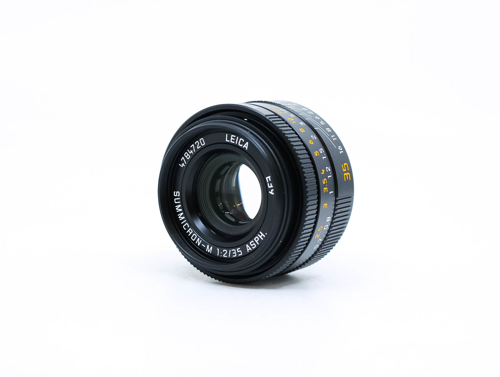
Leica Summicron-M 35mm 2.0 "King of Bokeh" - 11310
Sold by Fotohandel.de
€1,658 ≈ $1,790
The Leica Summicron-M 35mm f/2 IV is a compact M-mount wide-angle prime nicknamed "King of Bokeh," prized by collectors for its smooth rendering.
![Summicron-M 35mm f/2 V4 [IV]](https://assets.leicalenslist.com/images/lenses/331_medium.webp)
M mount
The Leica Summicron-M 35mm f/2 IV is a M-mount lens for Leica rangefinder cameras. As of October 2026, it sells from €1,658 used across 26 listings, with a 30-day median of €2,888. Leica price index →
Measured against the 76 other 35mm M-mount lenses in the catalogue.
Few Leica lenses carry a nickname as widely repeated as the Summicron-M 35mm f/2 version IV, known among collectors and photographers as the "King of Bokeh." The label is something of an accident: it traces back to a single reviewer, generally credited as Mike Johnston, who used the phrase in a magazine caption, after which sellers and enthusiasts adopted it and it stuck [2]. In Chinese-speaking circles the lens is affectionately called the "seven elements" or 七枚/七妹, a reference to its optical layout. Despite never being designed as a deliberately "special" lens, it became one of the most discussed 35mm Summicrons and continues to command a premium on the used market, with sought-after copies fetching high prices decades after production.
The optical design uses seven elements in five groups, a relatively complex arrangement for a compact 35mm of its era [1]. The lens is among the smallest and lightest full-frame 35mm lenses Leica produced, measuring about 26 mm long and 52 mm in diameter, with a black version weighing roughly 160 grams[3]. It focuses to 0.7 m, uses a ten-blade diaphragm, accepts E39 filters, and is rangefinder-coupled on the Leica M bayonet, with screw-mount examples available by special order. The aperture runs from f/2 to f/16, and handling is via the characteristic Leica focusing tab, which photographers familiar with the M system tend to operate quickly once accustomed to it[4]. The compact size and consistent performance across the aperture range made it popular with street and travel photographers.
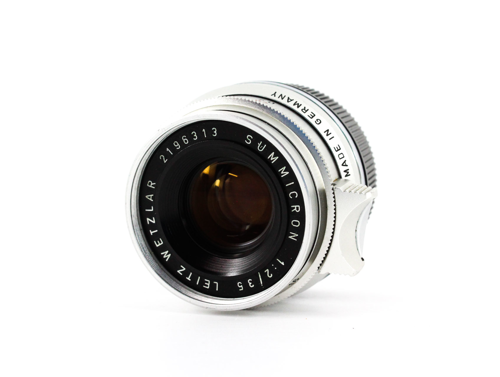
The version IV was produced from 1979 to 1999, with more than 52,000 examples made. It was offered in black lacquered alloy (order number 11310) and silver lacquered brass (11311), the brass chrome version being noticeably heavier at about 260 grams. Documented variants include yellow/white and red/white scale markings, differing focusing tab shapes, and an ELC version. Production began in Canada at Leica's Midland, Ontario facility and later moved to Germany, with some collectors regarding the German-made examples as more desirable. The earliest copies from 1979 to 1980 carried a distinctive "Tiger Paw" focusing tab that was produced for only about two years before being changed to the more familiar standard tab, and these early examples are particularly prized.
Rendering The lens is best known for the smooth, slightly painterly quality of its out-of-focus areas, sometimes described as a "fish-scale" bokeh, which is the basis for its nickname. Center sharpness is good even wide open at f/2, while edge and corner performance is weaker and improves on stopping down, with the frame tightening up around f/4 to f/5.6. Reviewers note pleasant, slightly warm color rendering that is less saturated than modern Leica 35mm designs, and the lens is regarded as working well on both film and digital bodies. Several users describe the wide-open look as gentle toward the edges with a sharp center, giving images a distinctive character rather than clinical correctness.
Collector and user notes The lens retains a strong following, and chrome examples in particular can sell for several thousand US dollars depending on condition and variant. Its reputation rests as much on rendering character and compact size as on technical perfection.
Development and Launch The version IV replaced the earlier 35mm Summicron designs and was introduced at the end of the 1970s, entering production in 1979. It was developed within Leica's Canadian operation, and the optical work of this period is associated with Walter Mandler, who oversaw lens design at the Midland, Ontario plant. The seven-element, five-group formula gave the lens its distinctive rendering and its Chinese nickname.
Production Evolution Over its roughly two decades in production the lens saw several detail changes, including different scale color schemes, changes to the focusing tab shape, and a move of manufacturing from Canada to Germany. The early "Tiger Paw" tab of 1979 to 1980 is the most noted of these variations among collectors.
Special editions Beyond the standard black and chrome finishes and the documented scale and tab variants, no widely recognized military or major commemorative factory editions of the version IV are commonly cited. Screw-mount examples were available by special order.
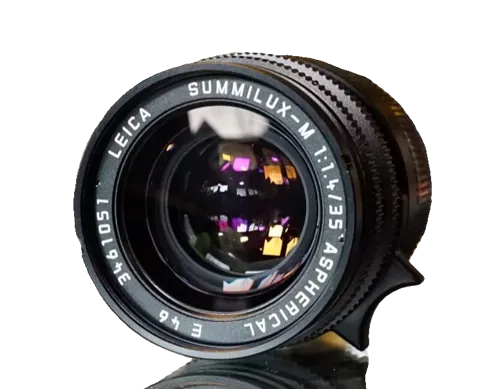
Collector Notes Buyers typically check whether a lens is the earlier Canadian or later German production, the focusing tab style, and the scale markings, since these affect both identification and value. As with any Leica lens of this age, condition of the coatings and glass and originality of finish are worth verifying. Documented hood options for the version IV include the 12524, 12526, 12504, and 12585. Note that the version IV should not be confused with the later aspherical 35mm Summicron-M (ASPH) that succeeded it, nor with the Summilux-M 35mm reissue that Leica has marketed using a similar "King of Bokeh" theme.
Good time to buy. The lowest listing is 43% below the 30-day average.
Lowest price Click a mark to open that listing · arrow keys to step, Enter to open
Price against condition for 26 listings of Leica Summicron-M 35mm f/2 IV, €1,658 to €5,706, median €2,824. Mint: 2 at €2,036, €3,586. Excellent: 15 at €2,027, €2,565, €2,810, €2,838, €2,838, €3,044, €3,199, €3,326, €3,533, €3,633, €3,782, €4,087, €4,589, €5,706, €5,706. Good: 3 at €2,270, €2,696, €2,799. Fair: 1 at €2,125. Unknown: 5 at €1,658, €1,974, €2,117, €2,490, €2,495. The full table follows.
| Condition | Lowest | Median |
|---|---|---|
| Mint | €2,036 | €2,811 |
| Excellent | €2,027 | €3,326 |
| Good | €2,270 | €2,696 |
| Fair | €2,125 | €2,125 |
| Other | €1,658 | €2,117 |
Over the last 18 weeks the median price for the Leica Summicron-M 35mm f/2 IV has risen, ranging from €2,773 to €3,348 (now €2,888).
Weekly price (EUR). Median (Good or better) and lowest (Good or better) across 18 weeks. The full figures follow in the table below.
| Week | Median | Lowest |
|---|---|---|
| Jun 1, 2026 | €2,931 | €2,097 |
| Jun 8, 2026 | €3,024 | €2,097 |
| Jun 15, 2026 | €3,024 | €2,097 |
| Jun 22, 2026 | €3,009 | €2,097 |
| Jun 29, 2026 | €3,011 | €2,097 |
| Jul 6, 2026 | €2,853 | €1,955 |
| Jul 13, 2026 | €2,931 | €1,955 |
| Jul 20, 2026 | €2,853 | €1,955 |
| Jul 27, 2026 | €2,835 | €1,955 |
| Aug 3, 2026 | €2,818 | €1,955 |
| Aug 10, 2026 | €2,884 | €1,955 |
| Aug 17, 2026 | €2,851 | €1,955 |
| Aug 24, 2026 | €2,884 | €1,955 |
| Aug 31, 2026 | €2,877 | €1,955 |
| Sep 7, 2026 | €3,046 | €2,036 |
| Sep 14, 2026 | €2,891 | €2,036 |
| Sep 21, 2026 | €2,850 | €2,036 |
| Sep 28, 2026 | €3,044 | €2,027 |
Every shop grades differently. Leica Classic uses letters, Ffordes uses E++ and E+, German dealers write "Zustand B", Japanese dealers write A−. We map all of them onto the one ladder below. Where a shop states its own grade, we print it under ours.
As of October 2026, the Leica Summicron-M 35mm f/2 IV sells from €1,658 used, with a 30-day median of €2,888, across 26 active listings.
As of October 2026, the Leica Summicron-M 35mm f/2 IV is sold by 5 sources (26 listings), from €1,658 used: all compared cheapest-first on this page.
Similar lenses you might be interested in
Comments