Best price Excellent
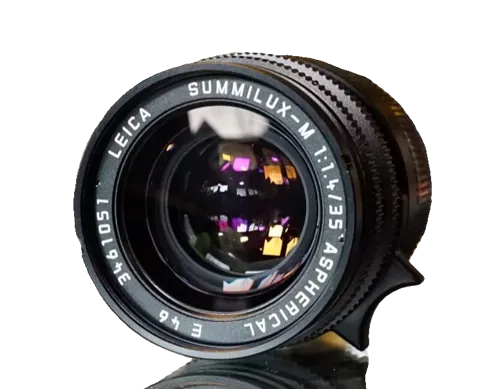
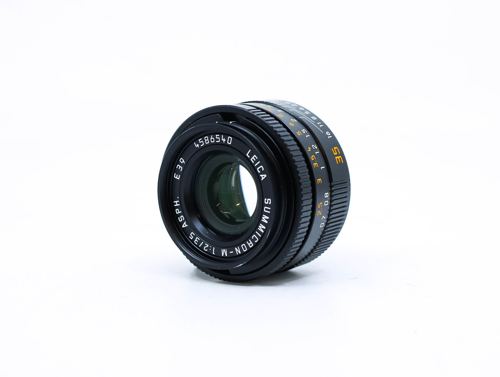
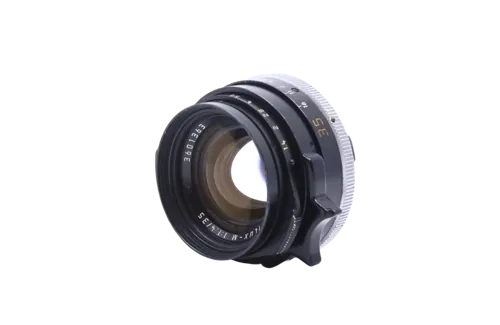
Leica Summilux-M 35mm/F1.4 Aspherical 11873 AA 11873 #11120
Sold by M&K Kamera
€17,463 ≈ $18,860
The Leica Summilux-M 35mm f/1.4 Aspherical (11873), an M-mount double-aspheric lens of cult status, sought by collectors for rarity and rendering.
M mount
The Leica Summilux-M 35mm f/1.4 Double ASPH. is a M-mount lens for Leica rangefinder cameras. As of October 2026, it sells from €17,463 used across 3 listings, with a 30-day median of €17,479. Leica price index →
Measured against the 76 other 35mm M-mount lenses in the catalogue.
Known among collectors as the "AA" or "double aspherical," the Summilux-M 35mm f/1.4 Aspherical, model 11873, occupies a near-mythical place in the Leica catalogue. Its nickname comes from its use of two aspherical glass elements, an unusual feature when the lens appeared, and the difficulty of making it became central to its reputation. Because producing a lens with two aspherical surfaces was elaborate and costly, Leica kept output small, and the lens acquired a modern "cult" status as one of the rarest and most expensive Leica lenses [1]. One frequently cited figure puts total production at fewer than 1,000 examples.
Optically the lens is built from nine elements in five groups and carries a ten-blade aperture, giving a rounded opening across the f/1.4 to smaller-aperture range. It is a compact M-mount design, roughly 44 mm long and 53 mm in diameter, weighing about 275 g, with a 46 mm filter thread and a minimum focusing distance of 0.7 m. The barrel is rangefinder coupled and finished in black. The 11873 is not factory six-bit coded, but its profile is recognized in Leica's digital bodies; on the M9, for example, the lens can be selected manually from the camera menu by its product code even though the barrel carries no six-bit pattern. The lens uses a clip-on hood, in contrast to the screw-in metal hood of its later successor.
The 11873 was eventually replaced by the Summilux-M 35mm f/1.4 ASPH with a floating element (the "FLE"), which arrived years later and combined aspherical and floating elements to reduce aberrations and focus shift. Despite the technical advances of the newer design, the two lenses are very close in physical size and handling, to the point that they can be hard to tell apart by feel; the later lens has a larger focusing tab and the different hood already noted. The double-aspherical version remains prized not only for scarcity but for a rendering character that many users distinguish from the modern lens.
Rendering Reviewers describe the double-aspherical Summilux as having a distinctive, somewhat "dreamier" look rather than a clinically corrected one, consistent with its film-era origins.
Sharpness At f/1.4 the lens is strong centrally but does not match the later floating-element design at the extreme edges, where the newer lens is sharper.
Contrast and color Contrast is slightly lower than the modern ASPH FLE, a trait typical of lenses from this period.
Bokeh and transitions Out-of-focus areas are rendered in a softer, "dreamier" manner that contributes to the lens's reputation among users.
Aberrations In one direct comparison the older double-aspherical lens showed less chromatic aberration wide open than the modern FLE, though such observations come from individual samples rather than formal testing.
Distortion and vignetting Wide open the lens shows visible vignetting on a digital body when its profile is not selected in the camera menu; corrections applied in software or via the lens profile reduce this.
Development and Launch The Summilux-M 35mm f/1.4 Aspherical introduced two aspherical elements into a fast 35 mm M lens, a demanding optical step for its time. The expense and difficulty of manufacturing such a lens led Leica to restrict production, which is the main reason for its later rarity and high value.
Production Evolution The 11873 was succeeded by the Summilux-M 35mm f/1.4 ASPH with a floating element, a redesign that aimed to control aberrations and focus shift more thoroughly while keeping a similar overall size and handling. The newer lens adopted a screw-on metal hood and a larger focusing tab, useful identification points when distinguishing the generations.
Special editions No widely documented factory special editions of the standard black 11873 are established here. The lens is itself effectively a limited production item rather than a variant of a larger run.
Collector Notes The 11873 is among the most sought-after Leica M lenses, and its scarcity has made it both expensive and a target of strong collector interest. Buyers should confirm that the barrel carries the original clip-on hood arrangement rather than parts borrowed from later versions, and should note that the lens is not factory six-bit coded; on digital bodies it is identified by selecting the 11873 profile manually. Because production figures are often quoted approximately, published counts vary, and the commonly cited "fewer than 1,000" should be treated as an estimate rather than a confirmed total.
About the usual price. The lowest listing is around the 30-day average.
Lowest price Click a mark to open that listing · arrow keys to step, Enter to open
Price against condition for 3 listings of Leica Summilux-M 35mm f/1.4 Double ASPH., €17,463 to €26,903, median €24,074. Excellent: 3 at €17,463, €24,074, €26,903. The full table follows.
Over the last 18 weeks the median price for the Leica Summilux-M 35mm f/1.4 Double ASPH. has risen, ranging from €15,764 to €18,093 (now €17,479).
Weekly price (EUR). Median (Good or better) and lowest (Good or better) across 18 weeks. The full figures follow in the table below.
| Week | Median | Lowest |
|---|---|---|
| Jun 1, 2026 | €14,074 | €14,074 |
| Jun 8, 2026 | €14,892 | €14,074 |
| Jun 15, 2026 | €14,892 | €14,074 |
| Jun 22, 2026 | €14,892 | €14,074 |
| Jun 29, 2026 | €16,181 | €14,074 |
| Jul 6, 2026 | €16,153 | €14,074 |
| Jul 13, 2026 | €16,095 | €14,074 |
| Jul 20, 2026 | €16,030 | €14,074 |
| Jul 27, 2026 | €16,110 | €14,074 |
| Aug 3, 2026 | €17,233 | €14,098 |
| Aug 10, 2026 | €17,188 | €14,137 |
| Aug 17, 2026 | €17,343 | €14,299 |
| Aug 24, 2026 | €20,580 | €14,230 |
| Aug 31, 2026 | €26,926 | €26,926 |
| Sep 7, 2026 | €22,198 | €17,475 |
| Sep 14, 2026 | €22,189 | €17,468 |
| Sep 21, 2026 | €22,192 | €17,470 |
| Sep 28, 2026 | €22,183 | €17,463 |
Every shop grades differently. Leica Classic uses letters, Ffordes uses E++ and E+, German dealers write "Zustand B", Japanese dealers write A−. We map all of them onto the one ladder below. Where a shop states its own grade, we print it under ours.
As of October 2026, the Leica Summilux-M 35mm f/1.4 Double ASPH. sells from €17,463 used, with a 30-day median of €17,479, across 3 active listings.
As of October 2026, the Leica Summilux-M 35mm f/1.4 Double ASPH. is sold by 2 sources (3 listings), from €17,463 used: all compared cheapest-first on this page.
Similar lenses you might be interested in
Comments