Best price
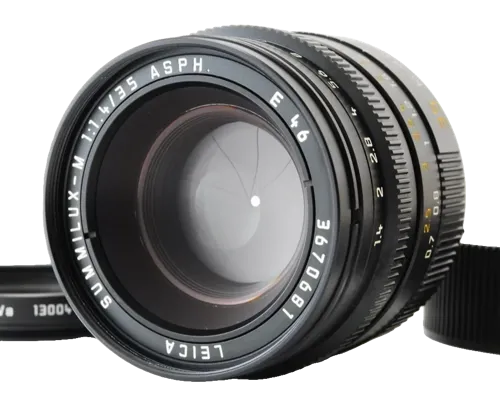
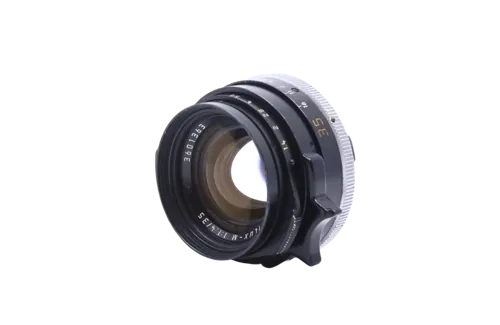
Leica 35mm f/1.4 Summilux-M ASPH (11874)
Sold by Camera Tweedehands
€1,766 ≈ $1,907
The Leica Summilux-M 35mm f/1.4 ASPH. II is the 1994 single-aspherical M-mount fast wide-angle, prized by collectors for its rendering despite focus shift.
M mount
The Leica Summilux-M 35mm f/1.4 ASPH. v1 / pre-FLE is a M-mount lens for Leica rangefinder cameras. As of October 2026, it sells from €1,766 used across 30 listings, with a 30-day median of €3,946. Leica price index →
Measured against the 76 other 35mm M-mount lenses in the catalogue.
Often called the "pre-FLE" by collectors, this is the second aspherical 35mm Summilux for the Leica M system and the one that put a manufacturable aspherical design into volume production. It replaced the earlier double-aspherical 35mm Summilux of 1990, a costly and difficult-to-build lens of which only a few thousand were made, by using a single aspherical surface that achieved most of the optical benefit at a far more practical cost [1][3]. Designed by Walter Watz in 1993 and brought to market in 1994, it remained Leica's fast 35mm M lens until the floating-element FLE version arrived in 2010. Within the long line of 35mm Summilux lenses that began with the 1961 "steel rim," this generation is remembered both for its distinctive drawing and for the focus shift that eventually prompted its redesign[4].
The optical layout uses nine elements in five groups with one aspherical surface, and the diaphragm has nine blades closing from f/1.4 to f/16 with half-stop click positions. It is a compact lens for its speed, taking 46mm screw-in filters, and it is rangefinder coupled with a focusing range down to 0.7 m. The barrel is the longer, chunkier industrial style Leica used before it modernized its M lenses, and reviewers note it focuses smoothly and feels dense in the hand while remaining relatively small next to later f/1.4 designs [2]. The lens shipped without six-bit coding from the factory, though later examples and service updates could carry a manual code; LeicaLensList records this entry's code as 011101.
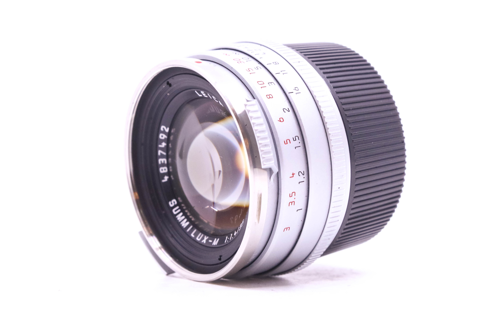
The lens was offered in black anodized aluminum, silver chrome, and a titanium finish, with the chrome and titanium versions noticeably heavier owing to their brass construction. Leica assigned separate order numbers to the black (11874) and silver (11883) versions, with the titanium carrying its own number. Production ran from 1994 to 2010, with the Leica Wiki citing more than 18,000 units across all finishes. A frequent point of comparison for buyers is the later FLE (11663): the pre-FLE is slimmer in the barrel, used a clip-on rather than screw-in hood, and is softer and less corrected than its successor, which is why some shooters prefer it for character while others choose the FLE for consistency.
Rendering This generation is known for an expressive, slightly under-corrected signature rather than clinical perfection. Wide open it is softer than the later FLE, with bokeh that can show onion-ring structure but an organic, three-dimensional roll-off that many users value for portraits and street work. Transitions from sharp to out of focus are gentle rather than abrupt.
Contrast and color At maximum aperture native contrast is comparatively low, and rendering is often described as warmer and less clinical than the more neutral FLE, with strong micro-contrast that gives mid-tones bite. Backlit scenes can bloom and lose contrast in a way reviewers describe as painterly rather than broken.
Aberrations The defining technical weakness of this design is focus shift: the point of best focus moves as the lens is stopped down, a trait widely discussed by users and the main reason Leica introduced the floating-element redesign in 2010. Copy-to-copy variation and factory calibration can affect how visible the shift is in practice.
Collector and user notes On high-resolution digital bodies the softer, less corrected rendering and the focus shift are easier to see, while on film the same traits tend to read as atmosphere rather than fault.
Development and Launch The aspherical Summilux 35mm story begins with the 1990 double-aspherical version, a technically ambitious but expensive lens made in small numbers. To make an aspherical fast 35mm practical for series production, Leica adopted a design with a single aspherical surface; Walter Watz is credited with the design dated 1993, and the lens entered production in 1994. It served as the standard fast wide-angle in the M lineup for roughly sixteen years.
Production Evolution Across its 1994 to 2010 run the lens was produced in black, silver chrome, and titanium finishes, with weight varying significantly between the anodized aluminum and the brass-bodied chrome and titanium versions. Its successor, the 2010 FLE (11663), addressed the focus shift with a floating rear group, a wider metal barrel, and a screw-in metal hood, changes that reviewers contrast directly with this earlier lens.
Special editions A documented factory special is the 1996 "Ein Stück Leica" edition, a 504-unit run tied to Leica's stock-market flotation that was paired with a specially engraved "Börsengang" M6.
Collector Notes Buyers commonly weigh this pre-FLE version against the later FLE; the two share a 46mm filter thread but differ in barrel width, hood design, and rendering. Because focus shift and copy variation are real concerns, a Leica-calibrated example or one verified to focus accurately is a meaningful advantage. The original clip-on hood is plastic and prone to damage, so an intact factory hood and caps are worth confirming, and the finish (black, silver chrome, or the heavier titanium) should be matched to the documented order number when assessing originality. One sourced note of caution on figures: the Leica Wiki lists a slightly heavier anodized weight than the value LeicaLensList records for this entry; the verified specification is authoritative here.
Good time to buy. The lowest listing is 55% below the 30-day average.
Lowest price Click a mark to open that listing · arrow keys to step, Enter to open
Price against condition for 30 listings of Leica Summilux-M 35mm f/1.4 ASPH. v1 / pre-FLE, €1,766 to €6,184, median €3,003. New: 1 at €4,630. Mint: 1 at €4,021. Excellent: 19 at €2,336, €2,391, €2,453, €2,572, €2,789, €2,933, €2,962, €3,044, €3,056, €3,198, €3,325, €3,378, €3,516, €3,870, €4,100, €4,677, €5,440, €5,676, €6,184. Good: 4 at €2,235, €2,546, €2,627, €2,677. Unknown: 5 at €1,766, €2,598, €2,720, €2,905, €4,572. The full table follows.
| Condition | Lowest | Median |
|---|---|---|
| New | €4,630 | €4,630 |
| Mint | €4,021 | €4,021 |
| Excellent | €2,336 | €3,198 |
| Good | €2,235 | €2,587 |
| Other | €1,766 | €2,720 |
Over the last 18 weeks the median price for the Leica Summilux-M 35mm f/1.4 ASPH. v1 / pre-FLE has risen, ranging from €3,025 to €3,946 (now €3,946).
Weekly price (EUR). Median (Good or better) and lowest (Good or better) across 18 weeks. The full figures follow in the table below.
| Week | Median | Lowest |
|---|---|---|
| Jun 1, 2026 | €3,166 | €2,560 |
| Jun 8, 2026 | €3,166 | €2,560 |
| Jun 15, 2026 | €3,166 | €2,560 |
| Jun 22, 2026 | €3,166 | €2,545 |
| Jun 29, 2026 | €3,166 | €2,545 |
| Jul 6, 2026 | €3,166 | €2,545 |
| Jul 13, 2026 | €3,166 | €2,545 |
| Jul 20, 2026 | €3,185 | €2,545 |
| Jul 27, 2026 | €3,086 | €2,446 |
| Aug 3, 2026 | €3,046 | €2,296 |
| Aug 10, 2026 | €3,067 | €2,337 |
| Aug 17, 2026 | €3,067 | €2,337 |
| Aug 24, 2026 | €3,060 | €2,339 |
| Aug 31, 2026 | €3,057 | €2,338 |
| Sep 7, 2026 | €3,053 | €2,338 |
| Sep 14, 2026 | €3,045 | €2,337 |
| Sep 21, 2026 | €3,045 | €2,337 |
| Sep 28, 2026 | €3,050 | €2,235 |
Every shop grades differently. Leica Classic uses letters, Ffordes uses E++ and E+, German dealers write "Zustand B", Japanese dealers write A−. We map all of them onto the one ladder below. Where a shop states its own grade, we print it under ours.
As of October 2026, the Leica Summilux-M 35mm f/1.4 ASPH. v1 / pre-FLE sells from €1,766 used, with a 30-day median of €3,946, across 30 active listings.
As of October 2026, the Leica Summilux-M 35mm f/1.4 ASPH. v1 / pre-FLE is sold by 5 sources (30 listings), from €1,766 used: all compared cheapest-first on this page.
Similar lenses you might be interested in
Comments