Best price Excellent
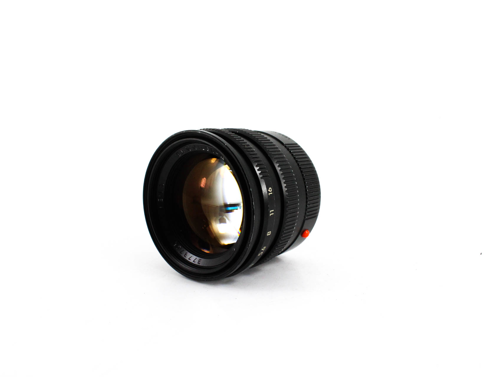
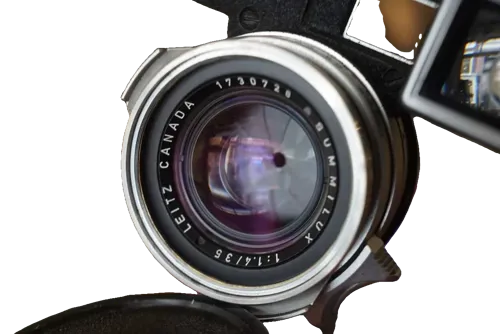
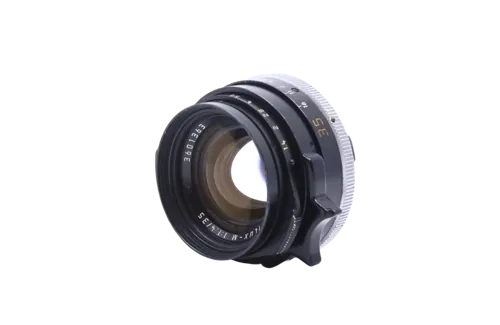
Leica 35mm F1.4 Classic Summilux M - Silver
Sold by Ffordes Photographic
€3,360 ≈ $3,629
The Leica Summilux-M 35mm f/1.4 Steel Rim is a 2022 M-mount reissue of the 1961 Mandler design, prized by collectors for its vintage rendering.
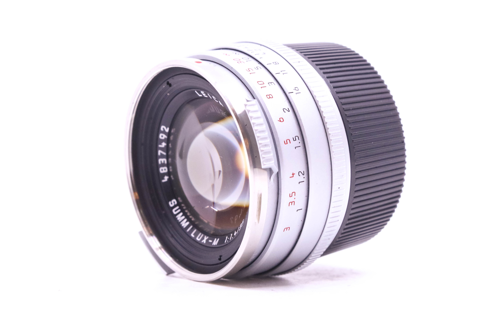
M mount
The Leica Summilux-M 35mm f/1.4 Steel Rim (Reissue) is a M-mount lens for Leica rangefinder cameras. As of October 2026, it sells from €3,360 used across 11 listings, with a 30-day median of €4,147. Leica price index →
Measured against the 76 other 35mm M-mount lenses in the catalogue.
This lens revives one of the most coveted optics in Leica's M catalogue, the first-generation 35mm Summilux. The original 35mm f/1.4 Summilux Version 1 was produced from 1961 to 1966, in a silver-chrome finish and in black anodized aluminium, with brass internals in both cases. Designed by Walter Mandler, it was, at launch, the fastest wide-angle lens in the world, and surviving examples in good condition trade for very large sums, which placed the original well out of reach for most photographers who simply wanted to shoot with it [1][2]. The 2022 reissue joined Leica's Classic Line, a series of faithful remakes that already included the Summaron-M 28mm f/5.6, the Thambar-M 90mm f/2.2 and the Noctilux-M 50mm f/1.2 ASPH.
The reissue keeps the original seven-element optical calculation but is built with modern production techniques, mechanics and coatings, and it is six-bit coded for use on current digital M bodies. True to the original, it features a brass barrel with silver chrome finish and the namesake stainless steel front rim, and the dimensions are so close that a vintage OLLUX lens shade fits. Handling follows the vintage pattern: a focus tab with an infinity lock, and an aperture ring whose tabs sit beneath the hood, which takes some acclimatisation but soon feels natural [3]. The lens couples to the rangefinder and focuses to one metre, in line with the goggle-less M2-pattern original rather than the closer-focusing goggled version. A modern addition is a 46mm filter capability provided through a new round screw-in hood, since the bare original barrel had no filter thread.
Two finishes have been offered. The standard silver chrome version carries order number 11301. In 2024 Leica added a black anodized finish, model 11300, described as a strictly numbered limited edition, with a front engraving reading "Leitz Wetzlar," a black painted brass focus-lock button intended to patina with use, and a foot-and-metre scale arrangement swapped to more closely match the original; optically it performs identically to the silver version [4]. The lens ships with two hoods, a rectangular clip-on modelled on the classic OLLUX and a ventilated round E46 hood, plus front and rear caps.
Rendering Because the reissue uses the original optical formula, its character mirrors the 1961 lens, offering what reviewers describe as a best-of-both-worlds behaviour across the aperture range.
Sharpness Wide open the lens is dreamy and never quite sharp, but stopping down even to f/2.8 makes it sharper, and by f/5.6 the centre is very sharp; the edges are sharp by f/4, while the furthest corners never quite reach the same level. Erwin Puts characterised the original as low in overall contrast at full aperture, improving markedly on stopping down and becoming excellent around f/8.
Bokeh and transitions The lens is marketed by Leica as the "King of Bokeh," and reviewers note that the out-of-focus rendering depends heavily on the subject. With very detailed backgrounds it can look busy and nervous, though never nasty, and more often it is described as sumptuous and creamy.
Flare resistance The lens is rather prone to flare, sometimes appearing as a rainbow, an effect some users exploit creatively.
Collector and user notes Wide open the lens evokes a Noctilux-like look, with painterly rendering and glowing highlights, while past f/4 it produces crisp, defined results with low distortion. A practical advantage over a vintage original is that the reissue avoids the sample variation and ageing problems of sixty-year-old glass and is correctly six-bit coded.
Development and Launch The reissue, released in October 2022, recreates the seven-element Summilux-M 35mm f/1.4 Version 1 first introduced in 1961, a Mandler-designed lens of which fewer than 1,500 were originally produced between 1961 and 1966 before a slight redesign for a different Series VII filter shade produced the Version 2, which ran for nearly three decades until the 1995 aspherical replacement. It was launched alongside the reintroduced film M6 and positioned as the fourth lens in Leica's Classic Line. Production estimates for the original vary between sources; one Leica review citing historian Lars Netopil places total original output at around 8,000 lenses across the goggled and goggle-less variants.
Special editions The black anodized finish, model 11300, is the principal documented variant of the reissue and is a numbered limited edition; reporting at its 2024 announcement described a run of roughly 200 units. The standard silver chrome lens, model 11301, is a regular catalogue item rather than a limited edition.
Collector Notes Buyers should distinguish the reissue from the genuine vintage Version 1, which it deliberately resembles in barrel form and steel front rim; the reissue is identifiable by its modern six-bit coding, 46mm filter capability via the round hood, and current engravings, while the black 11300 carries the distinguishing "Leitz Wetzlar" front engraving and a swapped scale layout. The two supplied hoods, the rectangular OLLUX-style clip-on (12487) and the round E46 hood (12486), are worth confirming as present, since the rectangular hood is known to detach easily, a trait inherited from the original OLLUX. Prospective buyers should also be aware that this reissue attracted online discussion of quality-control complaints among early units, a point worth checking when inspecting an individual copy [5].
Good time to buy. The lowest listing is 19% below the 30-day average.
Lowest price Click a mark to open that listing · arrow keys to step, Enter to open
Price against condition for 11 listings of Leica Summilux-M 35mm f/1.4 Steel Rim (Reissue), €3,360 to €20,290, median €4,277. New: 6 at €3,602, €4,251, €4,277, €4,493, €4,537, €4,563. Excellent: 2 at €3,360, €4,147. Good: 1 at €20,290. Unknown: 2 at €3,481, €18,830. The full table follows.
| Condition | Lowest | Median |
|---|---|---|
| New | €3,602 | €4,385 |
| Excellent | €3,360 | €3,754 |
| Good | €20,290 | €20,290 |
| Other | €3,481 | €11,155 |
Over the last 18 weeks the median price for the Leica Summilux-M 35mm f/1.4 Steel Rim (Reissue) has fallen, ranging from €3,979 to €25,784 (now €4,147).
Weekly price (EUR). Median (Good or better) and lowest (Good or better) across 18 weeks. The full figures follow in the table below.
| Week | Median | Lowest |
|---|---|---|
| Jun 1, 2026 | €4,460 | €3,635 |
| Jun 8, 2026 | €4,492 | €3,635 |
| Jun 15, 2026 | €4,492 | €3,635 |
| Jun 22, 2026 | €4,460 | €3,635 |
| Jun 29, 2026 | €4,384 | €3,403 |
| Jul 6, 2026 | €4,384 | €3,398 |
| Jul 13, 2026 | €4,384 | €3,398 |
| Jul 20, 2026 | €4,384 | €3,398 |
| Jul 27, 2026 | €4,384 | €3,398 |
| Aug 3, 2026 | €4,324 | €3,398 |
| Aug 10, 2026 | €4,324 | €3,398 |
| Aug 17, 2026 | €4,537 | €3,463 |
| Aug 24, 2026 | €4,473 | €3,442 |
| Aug 31, 2026 | €4,401 | €3,421 |
| Sep 7, 2026 | €4,383 | €3,396 |
| Sep 14, 2026 | €4,332 | €3,397 |
| Sep 21, 2026 | €4,294 | €3,373 |
| Sep 28, 2026 | €4,277 | €3,360 |
Every shop grades differently. Leica Classic uses letters, Ffordes uses E++ and E+, German dealers write "Zustand B", Japanese dealers write A−. We map all of them onto the one ladder below. Where a shop states its own grade, we print it under ours.
As of October 2026, the Leica Summilux-M 35mm f/1.4 Steel Rim (Reissue) sells from €3,360 used, with a 30-day median of €4,147, across 11 active listings.
As of October 2026, the Leica Summilux-M 35mm f/1.4 Steel Rim (Reissue) is sold by 5 sources (11 listings), from €3,360 used: all compared cheapest-first on this page.
Similar lenses you might be interested in
Comments