Best price Good
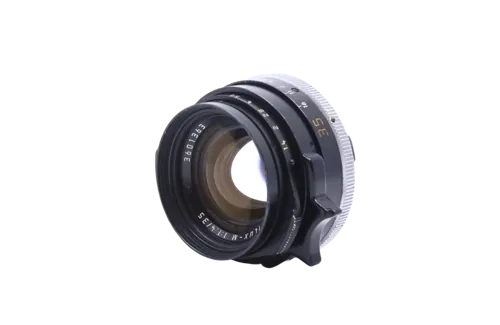
Leica 35mm f2 Summicron (Type II) (11309)
Sold by Kamerastore
€1,236 ≈ $1,335
The Leica Summicron 35mm f/2 III (11309) is a compact six-element M-mount rangefinder lens made from 1971 to 1979, prized by collectors for its character.
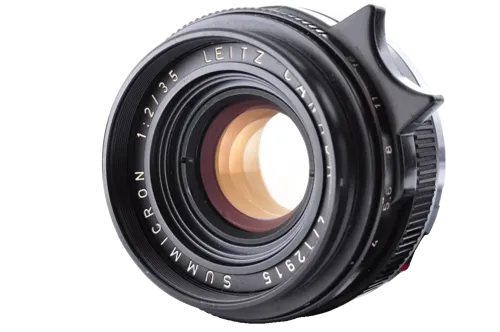
M mount
The Leica Summicron 35mm f/2 III is a M-mount lens for Leica rangefinder cameras. As of October 2026, it sells from €1,236 used across 17 listings, with a 30-day median of €1,702. Leica price index →
Measured against the 76 other 35mm M-mount lenses in the catalogue.
The third version of the 35mm Summicron is the smallest of Leica's pre-aspherical 35mm f/2 lenses, a short barrel of only 33 mm that carries a six-element optical design in a body weighing 170 g [1][2]. It belongs to the family of compact wide-angle Summicrons that replaced the original eight-element design of 1958, and it shares its optical layout with the immediately preceding second version, so the two are frequently grouped together as the 6-element Summicrons. For collectors and users it is valued less for clinical performance than for its compact handling and its distinctive rendering, which sits between the glow-prone early lenses and the more corrected fourth version that followed [3].
Optically the lens uses six elements in four groups and a ten-blade diaphragm, with a maximum aperture of f/2 and a minimum focusing distance of 0.7 m, the standard close limit shared across the Summicron 35mm line. The barrel takes 39 mm (E39) filters and couples to the rangefinder on the Leica M bayonet. Because the lens is so short, Leica fitted a slim focusing tab, and the focusing action is generally praised as smooth. Aperture is set by a click ring at the front of the barrel. The lens predates Leica's six-bit coding system, so it carries no factory coding for digital M bodies.
The chief difference between this third version and the otherwise identical second version is a handling detail rather than an optical one: the type II carries an aperture control lever, while the type III omits it. Both versions were produced during the same 1969 to 1979 window and use the same six-element formula, which can make them hard to tell apart at a glance, so the presence or absence of the lever, together with the barrel engraving style, is the most reliable identifier. The lens was offered in black and silver finishes and assigned model number 11309. Many examples of these lenses were manufactured at Leitz Canada, a point worth confirming against the engraving on a given copy.
Rendering Documented impressions of the third version describe a lens that is subjectively sharp at normal viewing and print sizes, with pleasing micro-contrast that picks out fine detail without rendering it harshly. Reviewers also note that the lens has a strong character and is comparatively prone to flare, an effect that can be unpredictable when shooting toward bright light, which some users treat as part of its appeal rather than a fault. Detailed laboratory data for this specific version is limited, and most accounts are based on film use and subjective comparison rather than rigorous bench testing.
Development and Launch The 35mm Summicron line began with the multi-element 8-element design of 1958. By the end of the 1960s Leica had moved to a simpler and more compact six-element formula, introduced with the second version and continued in the third, which was produced between 1971 and 1979. These compact 6-element lenses bridged the gap between the original design and the seven-element fourth version that arrived in 1979.
Production Evolution Across the 35mm Summicron family the optical formula changed from eight elements in the first version, to six elements in the second and third versions, then seven elements in the fourth. Within the six-element generation the second and third versions are optically the same; the visible change from type II to type III was the removal of the aperture control lever. Production took place in this era partly at Leitz Canada, and finish and engraving styles varied over the run.
Special editions No widely documented factory special editions are specifically associated with the third version of this lens. It was a standard catalogue item offered in black and silver under model number 11309.
Collector Notes The main point of confusion is distinguishing the third version from the second, since both are 6-element lenses made in the same period; the aperture lever and engraving fonts are the practical tells. Buyers should also confirm whether a given copy was made in Canada or Germany, as production origin affects collector preference within the broader Summicron range. As with any lens of this age, internal haze and cleaning marks on the coatings are worth checking before purchase, and the E39 filter thread and original caps and hood are accessories worth verifying for completeness.
Good time to buy. The lowest listing is 27% below the 30-day average.
Lowest price Click a mark to open that listing · arrow keys to step, Enter to open
Price against condition for 17 listings of Leica Summicron 35mm f/2 III, €1,236 to €2,254, median €1,658. Excellent: 7 at €1,370, €1,628, €1,628, €1,628, €1,702, €1,891, €1,964. Good: 6 at €1,236, €1,557, €1,658, €1,751, €1,808, €2,027. Fair: 1 at €2,168. Unknown: 3 at €1,335, €1,484, €2,254. The full table follows.
| Condition | Lowest | Median |
|---|---|---|
| Excellent | €1,370 | €1,628 |
| Good | €1,236 | €1,704 |
| Fair | €2,168 | €2,168 |
| Other | €1,335 | €1,484 |
Over the last 18 weeks the median price for the Leica Summicron 35mm f/2 III has risen, ranging from €1,491 to €1,702 (now €1,702).
Weekly price (EUR). Median (Good or better) and lowest (Good or better) across 18 weeks. The full figures follow in the table below.
| Week | Median | Lowest |
|---|---|---|
| Jun 1, 2026 | €1,691 | €1,366 |
| Jun 8, 2026 | €1,691 | €1,347 |
| Jun 15, 2026 | €1,694 | €1,347 |
| Jun 22, 2026 | €1,685 | €1,347 |
| Jun 29, 2026 | €1,685 | €1,347 |
| Jul 6, 2026 | €1,685 | €1,347 |
| Jul 13, 2026 | €1,685 | €1,347 |
| Jul 20, 2026 | €1,694 | €1,366 |
| Jul 27, 2026 | €1,698 | €1,366 |
| Aug 3, 2026 | €1,629 | €1,366 |
| Aug 10, 2026 | €1,629 | €1,366 |
| Aug 17, 2026 | €1,629 | €1,366 |
| Aug 24, 2026 | €1,629 | €1,366 |
| Aug 31, 2026 | €1,629 | €1,366 |
| Sep 7, 2026 | €1,657 | €1,366 |
| Sep 14, 2026 | €1,685 | €1,366 |
| Sep 21, 2026 | €1,657 | €1,248 |
| Sep 28, 2026 | €1,658 | €1,236 |
Every shop grades differently. Leica Classic uses letters, Ffordes uses E++ and E+, German dealers write "Zustand B", Japanese dealers write A−. We map all of them onto the one ladder below. Where a shop states its own grade, we print it under ours.
As of October 2026, the Leica Summicron 35mm f/2 III sells from €1,236 used, with a 30-day median of €1,702, across 17 active listings.
As of October 2026, the Leica Summicron 35mm f/2 III is sold by 3 sources (17 listings), from €1,236 used: all compared cheapest-first on this page.
Similar lenses you might be interested in
Comments