Best price
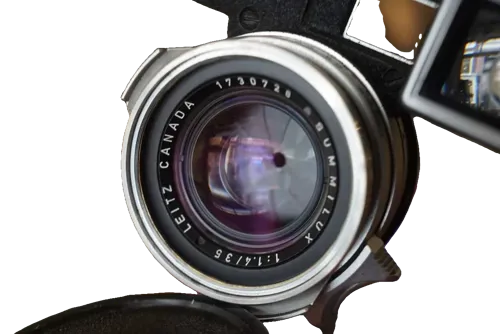
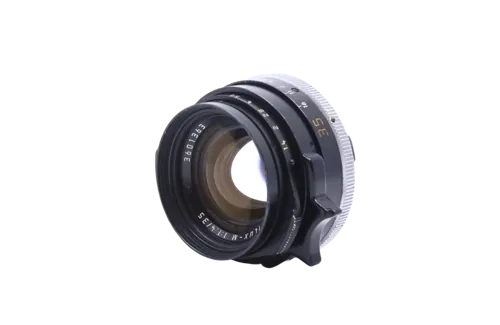
Leica Summicron 11108 chrome 2/35mm M3
Sold by classic.leica-camera.com
€1,608 ≈ $1,736
The Leica Summicron 35mm f/2 8-element is the rare first-version M-mount wide-angle, prized by collectors for its symmetrical Mandler design and classic rendering.
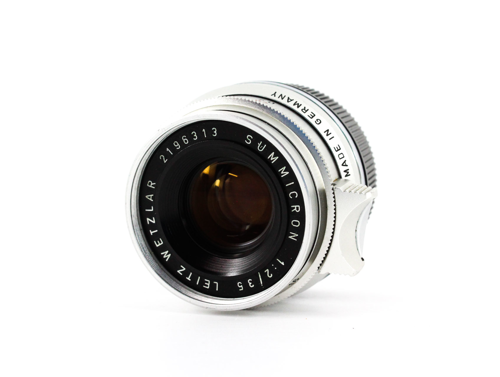
M mount
The Leica Summicron 35mm f/2 8-element is a M-mount lens for Leica rangefinder cameras. As of August 2026, it sells from €1,608 used across 35 listings, with a 30-day median of €4,904. Leica price index →
Measured against the 71 other 35mm M-mount lenses in the catalogue.
Among Leica's most coveted classic wide-angles, the first Summicron 35mm is defined by the eight-element optical layout that gives it its nickname. Designed by Walter Mandler and introduced in 1958, it was the first 35mm Summicron Leica produced, and it remained the only version of the line built around an eight-element formula before later types moved to six and then seven elements [1][2]. The lens uses a symmetrical Double Gauss configuration with rare-earth lanthanum glasses, a design Leica's optical research lab had pursued to obtain high-index, low-dispersion glass without radioactive thorium. Built in M mount with full rangefinder coupling, it is a compact lens, roughly 29 mm long and 51 mm in diameter, weighing about 170 g, and it takes 39 mm filters.
Construction is typical of Leitz's classic era, with a brass barrel and a double-helicoid focusing system whose front and back helicoids could be adjusted independently during assembly, a labor-intensive arrangement that often left hand-filing marks on the internal threads. Focusing runs down to 0.7 m and the diaphragm uses 16 blades, giving a rounded aperture opening. The coatings are single-layer, consistent with its late-1950s origins, and the optics were among the early photographic designs to rely on thorium-free rare-earth glass. The lens couples to the rangefinder on all M bodies; it is not six-bit coded, reflecting its pre-digital production.
Three sub-variants of this first type are commonly described: a screw-mount (LTM) version, a bayonet version for the M2 and other M bodies, and a goggled version for the M3, whose finder did not carry 35 mm frame lines and so required the spectacle attachment to reframe the view. Reference and dealer sources record related Leitz catalogue codes for these variants, including the LTM version (SAWO, 11008) and a silver metal-bodied bayonet version (11108), with the goggled M3 lens sometimes built on the screw-mount chassis using a factory screw-to-bayonet adapter [3]. Production spanned Wetzlar, Germany and Midland, Canada, and collectors have long debated whether the German or Canadian examples are better made, without firm consensus. The model number recorded for this entry is 11307.
Rendering The eight-element Summicron is valued for its classic, lower-contrast rendering rather than the higher microcontrast and saturation of later versions. Users describe relatively modest contrast wide open with a characteristic highlight glow at f/2, sharpening and gaining definition as the lens is stopped down, with notably better fine detail from about f/5.6 to f/8[4]. Out-of-focus areas are not the swirly type associated with some other 35mm Summicrons but instead tend toward a busier, less uniform structure. It is widely regarded as a strong black-and-white lens, while its color rendering is gentler and less saturated than the multicoated aspherical successors.
Contrast and color Contrast improves noticeably on stopping down, and the single-coated optics favor monochrome work; reviewers note the lens is less suited to vivid, saturated color than the later seven-element type IV.
Collector and user notes Some users observe that rendering and flare behavior can vary with serial-number batch, attributing differences to coating variations across the production run.
Development and Launch Leica introduced the eight-element Summicron 35mm f/2 in 1958 as the first 35mm Summicron, the work of Walter Mandler. The symmetrical Double Gauss layout, paired with high-index lanthanum elements near the diaphragm to control chromatic aberration, was intended to deliver high sharpness and low distortion in a compact wide-angle for the M system. It served alongside the M2, which carried 35 mm frame lines, while the goggled variant adapted the lens to the M3.
Production Evolution The eight-element formula was unique to this first type; it was succeeded by a six-element type II in 1969 and a six-element type III in 1971, and later by the seven-element type IV, before the aspherical types of the 1990s. The lens was produced in both Wetzlar and Midland (Canada) facilities over its run.
Special editions No widely documented factory special editions are specific to the eight-element Summicron; the principal documented variations are the LTM, M2-bayonet, and goggled M3 forms rather than commemorative or limited releases.
Collector Notes The eight-element type is among the most sought-after classic Leica wide-angles, and its desirability has prompted careful attention to originality and condition. Buyers should verify the optical formula and version, confirm whether a goggled M3 example retains its original spectacles, and check the single-coated glass for haze or cleaning marks given the lens's age. Some published references differ from the confirmed specifications on details such as aperture-blade count and minimum focus distance; one collector account, for example, cites a ten-blade diaphragm, whereas the verified record for this lens lists 16 blades and a 0.7 m close-focus distance.
Good time to buy. The lowest listing is 67% below the 30-day average.
Lowest price Click a mark to open that listing · arrow keys to step, Enter to open
Price against condition for 35 listings of Leica Summicron 35mm f/2 8-element, €1,608 to €23,144, median €2,928. Mint: 3 at €3,953, €6,485, €23,144. Excellent: 12 at €1,929, €1,983, €2,337, €2,573, €2,680, €2,842, €3,564, €3,754, €4,464, €5,002, €5,002, €5,847. Good: 13 at €1,715, €1,715, €2,068, €2,121, €2,357, €2,840, €2,928, €3,400, €3,584, €3,644, €3,644, €3,859, €5,649. Fair: 2 at €1,929, €4,301. For Parts / Repair: 1 at €1,758. Unknown: 4 at €1,608, €1,876, €2,674, €3,210. The full table follows.
| Condition | Lowest | Median |
|---|---|---|
| Mint | €3,953 | €6,485 |
| Excellent | €1,929 | €3,203 |
| Good | €1,715 | €2,928 |
| Fair | €1,929 | €3,115 |
| For Parts / Repair | €1,758 | €1,758 |
| Other | €1,608 | €2,275 |
Over the last 12 weeks the median price for the Leica Summicron 35mm f/2 8-element has risen, ranging from €2,671 to €4,904 (now €4,904).
Weekly price (EUR). Median (Good or better) and lowest (Good or better) across 12 weeks. The full figures follow in the table below.
| Week | Median | Lowest |
|---|---|---|
| Jun 1, 2026 | €2,890 | €1,710 |
| Jun 8, 2026 | €2,882 | €1,710 |
| Jun 15, 2026 | €2,751 | €1,710 |
| Jun 22, 2026 | €2,671 | €1,710 |
| Jun 29, 2026 | €2,848 | €1,710 |
| Jul 6, 2026 | €2,855 | €1,691 |
| Jul 13, 2026 | €2,834 | €1,691 |
| Jul 20, 2026 | €3,166 | €1,691 |
| Jul 27, 2026 | €3,166 | €1,691 |
| Aug 3, 2026 | €2,839 | €1,691 |
| Aug 10, 2026 | €2,838 | €1,714 |
| Aug 17, 2026 | €3,482 | €1,715 |
Every shop grades differently. Leica Classic uses letters, Ffordes uses E++ and E+, German dealers write "Zustand B", Japanese dealers write A−. We map all of them onto the one ladder below. Where a shop states its own grade, we print it under ours.
As of August 2026, the Leica Summicron 35mm f/2 8-element sells from €1,608 used, with a 30-day median of €4,904, across 35 active listings.
As of August 2026, the Leica Summicron 35mm f/2 8-element is sold by 5 sources (35 listings), from €1,608 used: all compared cheapest-first on this page.
Similar lenses you might be interested in
Comments