Best price Heavily Used
Leica 13.5cm f4.5 Hektor 853951
Sold by Camera West
€46 ≈ $50
The Leica Hektor 135mm f/4.5, a four-element LTM rangefinder telephoto built from 1933 to 1960, is a long-running and affordable classic Leitz lens.
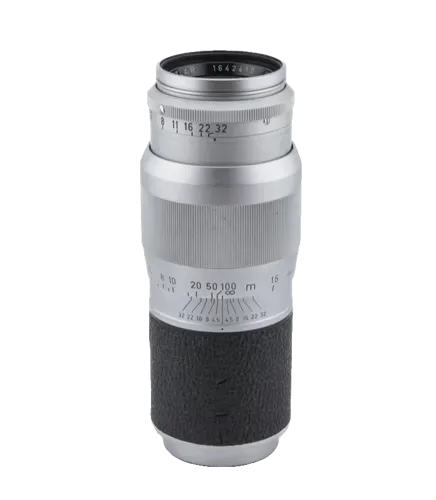
LTM mount
The Leica Hektor 135mm f/4.5 "Fat" is a LTM-mount lens for Leica rangefinder cameras. As of October 2026, it sells from €46 used across 30 listings, with a 30-day median of €139. Leica price index →
Measured against the 23 other 135mm LTM-mount lenses in the catalogue.
Among the longest-serving lenses Leitz ever offered, the Hektor 135mm f/4.5 was sold in screw mount for nearly three decades and remains one of the most accessible vintage Leica lenses for collectors and users [1][2]. The "Fat" name is a collector nickname for the early, heavier-bodied screw-mount version, distinguishing it from the slimmer, lighter Hektor that Leitz introduced later in the run. It followed Leica's first 135mm lens, the f/4.5 Elmar of 1931, and the Hektor itself was eventually replaced by the Elmar 135mm f/4 in 1960.
Optically the lens uses a conventional four-element, three-group long-focus design rather than a true telephoto layout, so the barrel is long and the diaphragm sits roughly one focal length from the film plane. The aperture is a 15-blade unit that keeps the opening nearly circular through the range to f/32, an unusual feature even for Leitz. It focuses to 1.5 m and takes 39mm screw-in filters in its later form. The lens is rangefinder coupled and works in the M39 / Leica Thread Mount, so on an M body it requires an LTM-to-M adapter; on modern mirrorless cameras the same adapter, plus focus peaking or magnification, makes manual focusing practical [3][4]. The focusing helicoid has a long throw of roughly 340 degrees, which aids precision but slows handling, and the lens carries its own tripod foot for balance.
Several running changes help with identification. Lenses made before 1946 were uncoated, with single coating introduced after the war. Filter threads also changed across the production span; collector references note an earlier 36mm filter thread giving way to the 39mm thread on later examples. Cosmetic variations are common across the long run, and the lens exists in both screw-mount and later M-bayonet forms. Documented Leitz catalogue codes include the screw-mount HEFAR (later catalogue number 11035) and the M-bayonet OHEBO (11040), along with chrome and other listed variants.
Rendering The Hektor is a moderate-aperture classic that is valued more for character than for clinical performance. It is generally described as soft wide open, sharpening as it is stopped down.
Sharpness The lens is not especially sharp except in the center wide open, with sharpness improving on stopping down; one reviewer found peak results around f/5.6 to f/8, holding through about f/16. Stopped down a couple of stops it noticeably sharpens while keeping its gentle look.
Contrast and color Contrast and color saturation are modest compared with modern multi-coated lenses, an expected trait of the design and era, and uncoated early examples are even lower in contrast.
Bokeh and transitions The combination of the 15-blade circular diaphragm and the long focal length yields smooth, rounded out-of-focus rendering, and the lens can throw backgrounds out of focus even at its modest f/4.5 maximum aperture.
Flare resistance Flare can be pronounced when light strikes the front element directly, which is more acute on uncoated pre-war examples; using the hood and avoiding direct light helps.
Distortion and vignetting The lens shows essentially no distortion and very even illumination across the frame.
Digital use The lens adapts readily to digital bodies. On a Leica M9 there is no dedicated lens profile, so the closest available 135mm f/4 setting is used, and with an LTM adapter it can also be fitted to mirrorless systems for manual-focus use.
Development and Launch Leitz brought out the Hektor 135mm f/4.5 in 1933, after the 135mm f/4.5 Elmar that had been the company's first lens of this focal length from 1931. It remained in the catalogue through 1960, a span that crossed both the screw-mount era and the introduction of the M system.
Production Evolution Over its long life the lens passed through several changes. Coating was added after 1946, with earlier lenses left uncoated. The filter thread changed from an earlier 36mm to 39mm on later examples, and the lens was offered in screw mount and later M-bayonet versions with numerous cosmetic differences.
Special editions No major factory special editions of the Hektor 135mm f/4.5 are widely documented; the notable variations are the running production changes in coating, filter thread, finish, and mount rather than distinct limited models. Black-paint examples are sought after by collectors as a more affordable route to a black-finish Leitz lens.
Collector Notes This is among the least expensive Leica rangefinder lenses on the used market, which makes it an easy entry point, but condition matters. Haze and fungus in the glass are the most common faults, so the elements should be inspected and a service or cleaning factored in; aperture blades and the focus helicoid should be checked for free movement. Buyers should verify the filter thread (36mm versus 39mm) and whether a given copy is coated, since both vary by production period, and should confirm screw-mount versus M-bayonet form before purchase. Worthwhile accessories to look for include the reversible lens hood and matching cap.
Good time to buy. The lowest listing is 67% below the 30-day average.
Lowest price Click a mark to open that listing · arrow keys to step, Enter to open
Price against condition for 30 listings of Leica Hektor 135mm f/4.5 "Fat", €46 to €301, median €139. Excellent: 4 at €122, €139, €222, €301. Good: 10 at €69, €86, €88, €94, €116, €116, €139, €146, €156, €181. Fair: 3 at €69, €139, €181. Heavily Used: 3 at €46, €88, €104. Used: 10 at €88, €104, €125, €144, €148, €156, €156, €207, €207, €259. The full table follows.
| Condition | Lowest | Median |
|---|---|---|
| Excellent | €122 | €180 |
| Good | €69 | €116 |
| Fair | €69 | €139 |
| Heavily Used | €46 | €88 |
| Other | €88 | €152 |
Over the last 21 weeks the median price for the Leica Hektor 135mm f/4.5 "Fat" has risen, ranging from €112 to €139 (now €139).
Weekly price (EUR). Median (Good or better) and lowest (Good or better) across 21 weeks. The full figures follow in the table below.
| Week | Median | Lowest |
|---|---|---|
| Jun 1, 2026 | €121 | €73 |
| Jun 8, 2026 | €133 | €86 |
| Jun 15, 2026 | €133 | €86 |
| Jun 22, 2026 | €133 | €86 |
| Jun 29, 2026 | €133 | €86 |
| Jul 6, 2026 | €116 | €69 |
| Jul 13, 2026 | €119 | €69 |
| Jul 20, 2026 | €112 | €69 |
| Jul 27, 2026 | €116 | €69 |
| Aug 3, 2026 | €119 | €69 |
| Aug 10, 2026 | €119 | €69 |
| Aug 17, 2026 | €121 | €69 |
| Aug 24, 2026 | €121 | €69 |
| Aug 31, 2026 | €119 | €69 |
| Sep 7, 2026 | €119 | €69 |
| Sep 14, 2026 | €119 | €69 |
| Sep 21, 2026 | €121 | €69 |
| Sep 28, 2026 | €121 | €69 |
| Oct 5, 2026 | €130 | €69 |
| Oct 12, 2026 | €131 | €69 |
| Oct 19, 2026 | €131 | €69 |
Every shop grades differently. Leica Classic uses letters, Ffordes uses E++ and E+, German dealers write "Zustand B", Japanese dealers write A−. We map all of them onto the one ladder below. Where a shop states its own grade, we print it under ours.
As of October 2026, the Leica Hektor 135mm f/4.5 "Fat" sells from €46 used, with a 30-day median of €139, across 30 active listings.
As of October 2026, the Leica Hektor 135mm f/4.5 "Fat" is sold by 5 sources (30 listings), from €46 used: all compared cheapest-first on this page.
The Leica Hektor 135mm f/4.5 "Fat" takes 39 mm screw-in filters (E39).
The Leica Hektor 135mm f/4.5 "Fat" focuses down to 1.5 m, and the rangefinder stays coupled over the whole range.
The Leica Hektor 135mm f/4.5 "Fat" weighs 459 g, lighter than 36% of the 11 other 135mm LTM-mount lenses in the catalogue.
The Leica Hektor 135mm f/4.5 "Fat" is a Leica screw-mount (M39/LTM) lens. It fits Leica M bodies with a screw-to-M adapter, which keeps rangefinder coupling, and mirrorless cameras with an M39 adapter. It carries no 6-bit code, so select the lens profile by hand on a digital M.
The Leica Hektor 135mm f/4.5 "Fat" was produced from 1933 to 1960.
Similar lenses you might be interested in
Comments