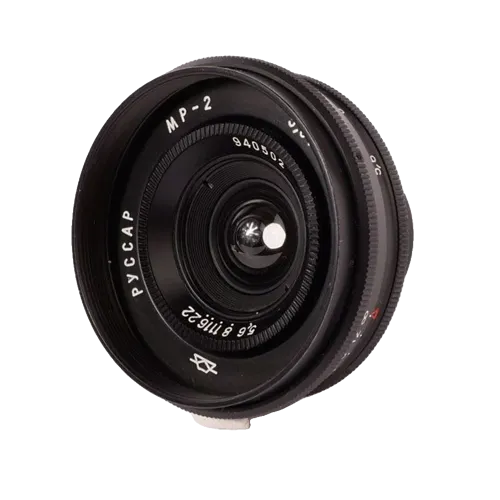
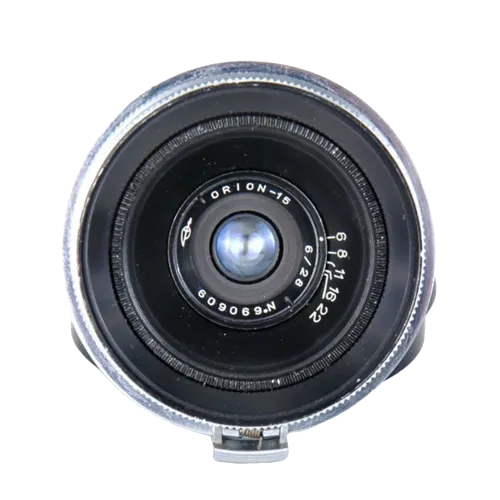
A prototype 20mm f/5.6 Russar optical module on an Arsenal Contax/Kiev adapter, scale focused without usable rangefinder coupling.
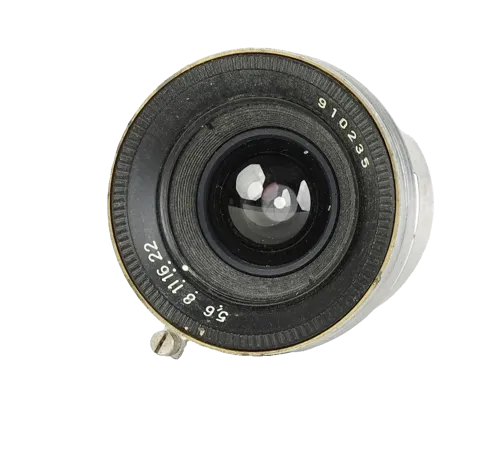
KMZ Russar MR-2 20mm f/5.6 (Contax RF)
Contax RF mount
No listings tracked for this lens right now.
The KMZ Russar MR-2 20mm f/5.6 (Contax RF) is a Contax RF-mount lens for Leica rangefinder cameras. Leica price index →
Specification
About this lens
KMZ Russar MR-2 20mm f/5.6 (Contax RF)
The KMZ Russar MR-2 20mm f/5.6 (Contax RF) is an exceptionally rare Kiev adaptation of the Soviet Russar ultra-wide lens. KMZ supplied the 20mm optical module, while Arsenal produced the special adapter for the Contax/Kiev inner bayonet.
The adapter engages the focusing helicoid inside the camera body. Unlike an ordinary coupled 50mm inner-bayonet lens, however, the Russar adaptation does not provide usable rangefinder coupling. Focusing must therefore be performed from the engraved distance scale and the lens's extensive depth of field.
Documentation shows two prototype configurations. One adapter lacks a distance scale, while another carries its own focusing scale. Both are distinct from the standard M39 Russar, which has an integrated focusing mount. Exact dimensions, weight and focusing limit of the complete adapted assembly have not been documented consistently, so those fields remain Unknown.
The lens retains the six-element, four-group Russar optical module, seven-blade diaphragm and 49mm front accessory thread of the original KMZ lens. It is intended for Contax/Kiev bodies retaining the conventional inner-bayonet lock. It is not suitable for the Kiev-5, which lacks that inner-bayonet locking arrangement.
This profile concerns the documented KMZ optical module with Arsenal adapter, not a routine factory production mount. The six-element, four-group Russar design is scale focused because usable rangefinder coupling is absent. The projecting rear section and prototype adapter require careful clearance checks.
Optical qualities
Rendering
The symmetrical 20mm Russar construction produces an exceptionally wide field of view in a very compact optical package. The moderate f/5.6 maximum aperture and short focal length provide extensive depth of field, making scale focusing practical despite the absence of usable rangefinder coupling.
Sharpness
Period specifications describe good central and mid-field resolution. Edge performance is more dependent on aperture, optical alignment and the condition of the strongly projecting rear element.
Contrast and flare
The original lens uses single-layer coating. Clean examples can deliver good contrast, but direct light may cause flare and veiling. Haze, coating damage and internal contamination have a substantial effect on surviving examples.
Distortion and vignetting
The Russar scheme was developed to provide a very wide rectilinear field while controlling distortion and illumination loss more effectively than many earlier symmetrical wide-angle designs.
At maximum aperture
Maximum-aperture performance should be evaluated with a correctly calibrated camera. A coupled rangefinder measures distance through a mechanical cam and does not inspect the image plane directly. Small errors in the body, mount or lens can therefore shift the sharp plane. Subject movement and field curvature may also be mistaken for optical softness. A clean, properly assembled lens should be tested at several distances before conclusions are drawn.
The widest setting provides the greatest light transmission and the least depth of field available from the design. Contrast can be reduced by residual aberrations, internal reflections or aged coatings. Bright point sources may show glow or flare. These effects vary between examples and should not be presented as a fixed signature of every surviving lens.
Stopped down
Closing the diaphragm increases depth of field and generally improves consistency across the 35mm frame. Middle apertures are often the practical choice for documentary work, landscapes and architecture. The smallest aperture provides more depth but is not automatically the sharpest setting because diffraction gradually reduces fine contrast.
Aperture shape depends on blade count and mechanical condition. Oil, bent blades or an incorrectly assembled iris can change both operation and out-of-focus highlights. Published blade counts should remain tied to the exact barrel version rather than copied between mounts.
Handling and compatibility
Contax and Kiev rangefinder lenses use either the internal standard-lens bayonet or the external bayonet. These interfaces serve different mechanical purposes even though they belong to the same camera system. Similarity to Nikon S or another rangefinder mount does not guarantee correct registration, coupling or infinity focus. A suitable adapter must reproduce the required focusing mechanism and keep the rear assembly clear of internal camera parts.
History
Development and Launch
The Russar optical scheme was developed by Soviet optical designer Mikhail Mikhailovich Rusinov. GOI completed the prototype lens during the 1950s, and the commercial M39 version entered KMZ production shortly before its international recognition at the 1958 Brussels exhibition.
Production Evolution
The normal Russar MR-2 was manufactured as an M39 scale-focus lens. The Contax/Kiev version was not a conventional production mount variant. It combined a KMZ optical module with an Arsenal-made inner-bayonet adapter.
Special Editions/Variants
Two prototype adapter forms are documented: one without a distance scale and one with a dedicated scale. No regular production series or confirmed factory catalogue number for the complete adaptation has been established.
Collector Notes
A genuine example should be distinguished from later private conversions. The Arsenal adapter, its engagement with the camera helicoid and the absence of usable rangefinder coupling are the defining mechanical features. Rear-element condition and the authenticity of the adapter are particularly important.
Sources
Where to buy
Related lenses
Similar lenses you might be interested in
Comments