Best price Fair
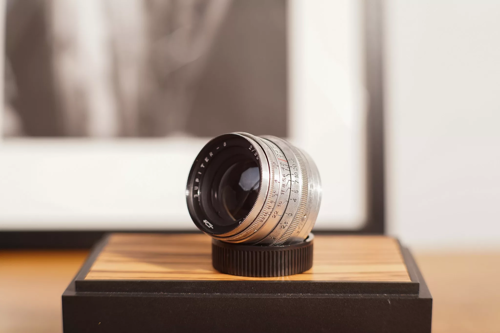
Jupiter-9 2 / 85mm in Leica screw mount
Sold by Fotohandel Delfshaven
€104 ≈ $112
The KMZ Jupiter-9 85mm f/2 is a Soviet Sonnar-derived portrait lens produced in M39 and Contax/Kiev rangefinder mounts, combining a seven-element optical design with a rounded 15-blade diaphragm.
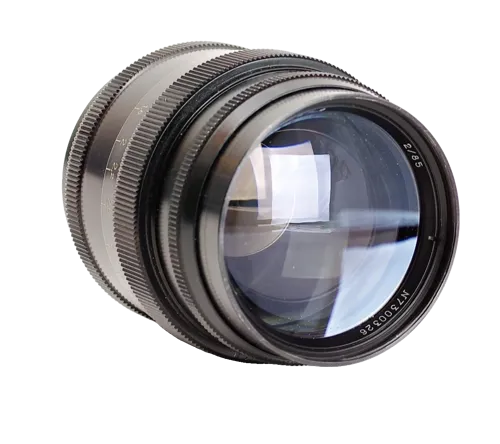
M39 / Contax RF mount
The KMZ Jupiter-9 85mm f/2 is a M39 / Contax RF-mount lens for Leica rangefinder cameras. As of October 2026, it sells from €104 used across 2 listings, with a 30-day median of €108. Leica price index →
Measured against the 4 other 85mm lenses in the catalogue.
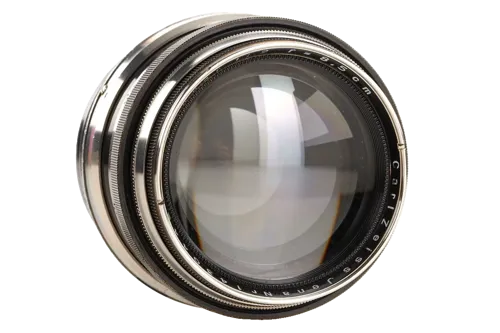
The KMZ Jupiter-9 85mm f/2 is a Soviet short telephoto lens based on the pre-war Carl Zeiss Sonnar 8.5cm f/2. Its seven elements are arranged in three groups, including two cemented triplets, giving it the compact optical layout and characteristic rendering associated with the Sonnar family.
This profile covers the rangefinder versions produced in M39 and Contax/Kiev mounts. Both versions are rangefinder coupled, contain their own focusing helicoid and normally focus to approximately 1.15 metres. The Contax/Kiev version uses the external bayonet and should not be confused with the internal body-focused mount used by standard 50mm Contax lenses.
The M39 and Contax/Kiev barrels differ slightly in size, weight and external construction. These physical differences are mount-specific and do not indicate a separate optical generation.
SLR versions in M42 and other mounts are not covered by this profile. They use materially different barrels and can have different minimum focusing distances and diaphragm mechanisms.
Rendering
The Jupiter-9 is primarily associated with portrait photography. At f/2 it produces moderate contrast, gentle fine-detail rendering and strong subject separation. Sharpness improves visibly after stopping down, with many examples becoming substantially crisper by approximately f/2.8 to f/4.
Bokeh and transitions
Most rangefinder versions use a 15-blade diaphragm that maintains a nearly circular aperture through much of the range. Background highlights therefore remain comparatively round when the lens is stopped down. The Sonnar construction also produces gradual transitions between focused and unfocused areas.
Contrast and flare
Contrast is lower than that of a modern telephoto lens, particularly at maximum aperture. Strong light can produce flare, ghosting and veiling. Coating colour and effectiveness vary with production period and factory, while haze and cleaning damage can further reduce contrast.
Aberrations
Residual spherical aberration contributes to the softer appearance at f/2. Coma and longitudinal colour fringing can also be visible at maximum aperture. These effects generally decrease when the lens is stopped down.
No consistent optical distinction between M39 and Contax/Kiev rangefinder examples has been demonstrated. Condition and sample variation remain more significant than mount choice.
Development and Launch
The earliest Soviet version appeared around 1948 under the ZK-85 designation. Early production used Zeiss-derived documentation, tooling and, in some cases, German optical glass or barrel components transferred after the Second World War.
The Jupiter-9 name was adopted around 1951. M39 versions were produced for FED and Zorki rangefinders, while Contax/Kiev versions were made for the Kiev system.
Production Evolution
Production involved several Soviet factories, including KMZ, LZOS and Arsenal. Early examples generally have polished aluminium barrels. Later production includes black-finished lenses and changes to engraving, coating and mechanical construction.
The rangefinder versions normally retain the seven-element, three-group construction and 15-blade diaphragm. Published physical measurements vary by mount. Documented examples measure approximately 70 × 60mm and 318g in M39, compared with approximately 68 × 62mm and 334g in Contax/Kiev mount.
M42, Kiev Automat, Narciss and other mechanically different versions share the Jupiter-9 name but should be catalogued separately from these rangefinder lenses.
Collector Notes
Sample variation is common. Before purchasing, check rangefinder calibration, focusing smoothness, aperture movement, internal haze and evidence of element separation.
M39 examples may not track perfectly on every Leica body without calibration. The Contax/Kiev version should be inspected for damage to its external bayonet, focusing helicoid and rangefinder cam.
The frequently published 0.8-metre minimum focusing distance belongs to later or SLR-related versions and should not be used for the M39 or Contax/Kiev rangefinder lens documented here.
No conventional factory special edition is confirmed. Early ZK-85 lenses, German-glass examples and the different silver or black factory versions are historically important production variants, not separately marketed special editions.
About the usual price. The lowest listing is around the 30-day average.
Lowest price Click a mark to open that listing · arrow keys to step, Enter to open
Price against condition for 2 listings of KMZ Jupiter-9 85mm f/2, €104 to €110, median €107. Fair: 1 at €104. For Parts / Repair: 1 at €110. The full table follows.
| Condition | Lowest | Median |
|---|---|---|
| Fair | €104 | €104 |
| For Parts / Repair | €110 | €110 |
Over the last 15 weeks the median price for the KMZ Jupiter-9 85mm f/2 has fallen, ranging from €108 to €208 (now €108).
Weekly price (EUR). Median (Good or better) and lowest (Good or better) across 15 weeks. The full figures follow in the table below.
| Week | Median | Lowest |
|---|---|---|
| Jun 1, 2026 | €179 | €150 |
| Jun 8, 2026 | €179 | €150 |
| Jun 15, 2026 | €150 | €150 |
| Jun 22, 2026 | €150 | €150 |
| Jun 29, 2026 | €208 | €208 |
| Jul 6, 2026 | €184 | €184 |
| Jul 13, 2026 | €184 | €184 |
| Jul 20, 2026 | €184 | €184 |
| Jul 27, 2026 | €184 | €184 |
| Aug 24, 2026 | €110 | Unknown |
| Aug 31, 2026 | €110 | Unknown |
| Sep 7, 2026 | €108 | Unknown |
| Sep 14, 2026 | €108 | Unknown |
| Sep 21, 2026 | €108 | Unknown |
| Sep 28, 2026 | €108 | Unknown |
Every shop grades differently. Leica Classic uses letters, Ffordes uses E++ and E+, German dealers write "Zustand B", Japanese dealers write A−. We map all of them onto the one ladder below. Where a shop states its own grade, we print it under ours.
As of October 2026, the KMZ Jupiter-9 85mm f/2 sells from €104 used, with a 30-day median of €108, across 2 active listings.
As of October 2026, the KMZ Jupiter-9 85mm f/2 is sold by 1 source (2 listings), from €104 used: all compared cheapest-first on this page.
Similar lenses you might be interested in
Comments