Best price Fair
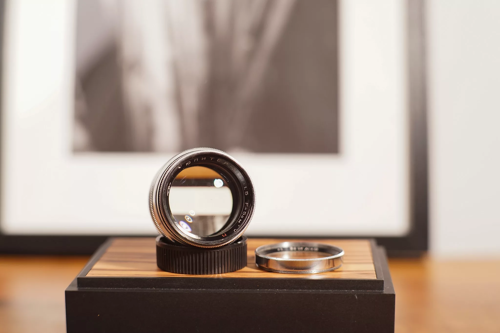
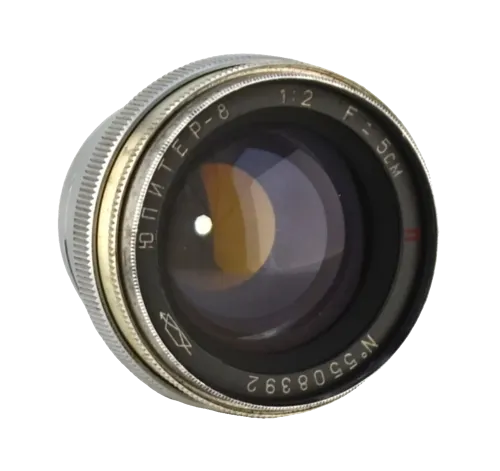
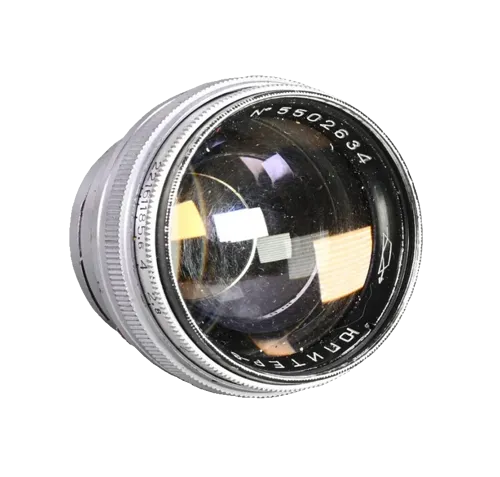
Jupiter-8 2 / 50mm in Leica screw mount
Sold by Fotohandel Delfshaven
€52 ≈ $56
The KMZ Jupiter-8 50mm f/2 is a Soviet Sonnar-derived M39 rangefinder lens, prized by collectors for classic rendering and very low cost.
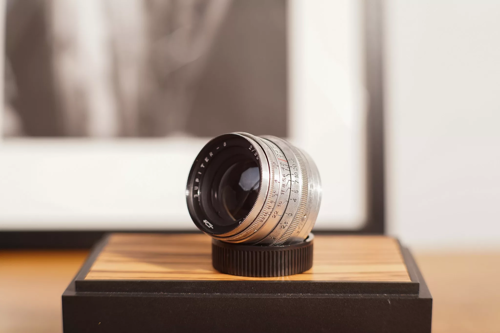
M39 mount
The KMZ Jupiter-8 50mm f/2 is a M39-mount lens for Leica rangefinder cameras. As of October 2026, it sells from €52 used across 6 listings, with a 30-day median of €62. Leica price index →
Measured against the 13 other 50mm M39-mount lenses in the catalogue.
The Jupiter-8 is a Soviet rendering of the prewar Carl Zeiss Sonnar 50mm f/2, built to the optical data the Soviet Union acquired from Zeiss as part of postwar reparations [1][3]. Like the original Sonnar, it uses a six-element design arranged in three groups, a layout that keeps the lens compact while limiting internal reflections in an era of simple coatings. It became one of the most widely produced standard lenses behind the Iron Curtain and remains a popular, inexpensive entry point for photographers wanting a vintage rangefinder normal lens [2].
In its M39 screw-mount form the Jupiter-8 is small and light, with a polished silver barrel, a nine-blade diaphragm, and rangefinder coupling that links the focusing helicoid to the camera's mechanism for focus down to one metre. A notable handling quirk is the aperture ring, which on the early lenses runs smoothly without click stops, so the chosen f-number can shift if the ring is brushed during use. The lens was designed first for the Contax-mount Kiev cameras and then offered in M39 for the Zorki rangefinder series, where it appeared on the Zorki 3 from 1953 and served as the standard lens on the Zorki 3S; it was also fitted to GOMZ's Leningrad rangefinder of the late 1950s. Because it follows the Sonnar's focal length and registration conventions rather than the Leica standard, focus accuracy on Leica thread-mount bodies can vary between samples, a point repeatedly raised by users of the M39 version.
Production spanned decades, and KMZ output was far from uniform. The earliest USSR Sonnar-type lenses from the late 1940s were assembled using German glass, and a small number of early examples are reported to carry the original Zeiss formula and imported optics. The barrel was made in polished aluminium, with some examples in stainless steel, and from the 1970s the lens was also produced in a black finish over an aluminium barrel. A later Jupiter-8M version in Contax rangefinder mount added click stops to the aperture ring. Collectors classify the many factory designs by code numbers, and sample-to-sample variation in both build feel and optical performance is widely acknowledged.
Rendering The Jupiter-8 produces the gentle, classic look associated with the Sonnar lineage rather than modern clinical sharpness. Reviewers describe smooth, pleasant background blur, ample resolution for general use, and natural rather than punchy contrast.
Sharpness It is generally less biting than its German and Japanese contemporaries but can be sharp enough for most work, with usable results even at wider apertures and clear improvement on stopping down.
Collector and user notes Performance is not consistent across the range, and individual copies vary, so condition and sample quality matter when judging a given lens.
Development and Launch The Jupiter-8 originated from the optical data, equipment, and in some cases personnel that the Soviet Union took from Zeiss after the Second World War. The Sonnar 50mm f/2 had been the standard fast lens for the Contax, so its Soviet copy naturally became the standard lens for the Kiev, the USSR's Contax derivative. KMZ built the lens, and the first Sonnar-formula lenses made in the USSR date to the late 1940s, using confiscated German glass.
Production Evolution KMZ made the Jupiter-8 in both Contax and M39 screw mounts, the latter for the Zorki rangefinders, with both versions already listed in a 1949 Soviet lens catalogue. Barrel construction shifted over time from polished aluminium, with rarer stainless-steel examples, to a black finish from the 1970s. The aperture mechanism also changed: the clickless ring of the original was given click stops in the Jupiter-8M variant for Contax rangefinder mount.
Collector Notes Buyers should expect significant variation between examples and check focus accuracy carefully, particularly when mounting an M39 Jupiter-8 on a Leica thread-mount body, since the design follows Sonnar rather than Leica conventions. Early lenses said to carry German glass or the original Zeiss formula are uncommon and of particular interest. As with most older Soviet optics, verify smooth focusing, clean glass free of haze or fungus, and the aperture action before buying. One note on filters: some general references cite a 40.5mm filter thread for the Jupiter-8, whereas LeicaLensList records a 40mm filter diameter for this entry; the verified figure should be treated as authoritative.
Good time to buy. The lowest listing is 17% below the 30-day average.
Lowest price Click a mark to open that listing · arrow keys to step, Enter to open
Price against condition for 6 listings of KMZ Jupiter-8 50mm f/2, €52 to €133, median €58. Good: 2 at €52, €62. Fair: 3 at €52, €55, €133. Used: 1 at €62. The full table follows.
| Condition | Lowest | Median |
|---|---|---|
| Good | €52 | €57 |
| Fair | €52 | €55 |
| Other | €62 | €62 |
Over the last 18 weeks the median price for the KMZ Jupiter-8 50mm f/2 has fallen, ranging from €56 to €64 (now €62).
Weekly price (EUR). Median (Good or better) and lowest (Good or better) across 18 weeks. The full figures follow in the table below.
| Week | Median | Lowest |
|---|---|---|
| Jun 1, 2026 | €64 | €53 |
| Jun 8, 2026 | €64 | €53 |
| Jun 15, 2026 | €64 | €53 |
| Jun 22, 2026 | €64 | €53 |
| Jun 29, 2026 | €64 | €53 |
| Jul 6, 2026 | €64 | €53 |
| Jul 13, 2026 | €60 | €50 |
| Jul 20, 2026 | €64 | €50 |
| Jul 27, 2026 | €60 | €53 |
| Aug 3, 2026 | €64 | €53 |
| Aug 10, 2026 | €64 | €54 |
| Aug 17, 2026 | €60 | €54 |
| Aug 24, 2026 | €59 | €54 |
| Aug 31, 2026 | €59 | €54 |
| Sep 7, 2026 | €59 | €54 |
| Sep 14, 2026 | €56 | €53 |
| Sep 21, 2026 | €58 | €53 |
| Sep 28, 2026 | €57 | €52 |
Every shop grades differently. Leica Classic uses letters, Ffordes uses E++ and E+, German dealers write "Zustand B", Japanese dealers write A−. We map all of them onto the one ladder below. Where a shop states its own grade, we print it under ours.
As of October 2026, the KMZ Jupiter-8 50mm f/2 sells from €52 used, with a 30-day median of €62, across 6 active listings.
As of October 2026, the KMZ Jupiter-8 50mm f/2 is sold by 2 sources (6 listings), from €52 used: all compared cheapest-first on this page.
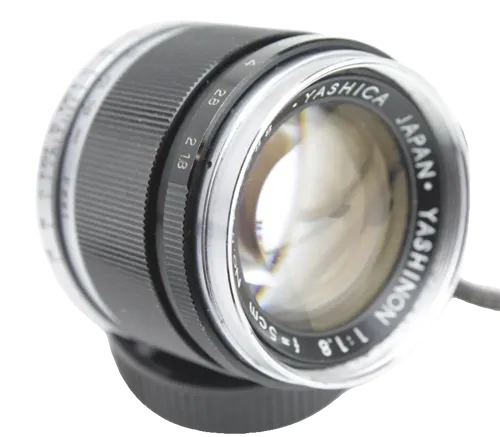
Similar lenses you might be interested in
Comments