Best price Fair
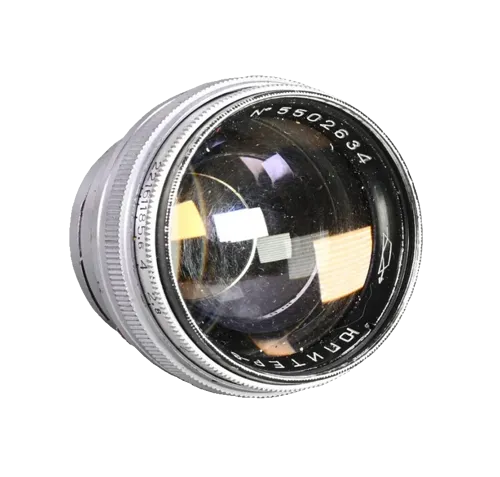
Jupiter-3 1:1.5 / 50mm lens, Leica screw mount
Sold by Fotohandel Delfshaven
€156 ≈ $168
The KMZ Jupiter-3 50mm f/1.5 is a Soviet Sonnar-derived rangefinder lens in M39 mount, prized by Leica thread-mount collectors for its classic glow.
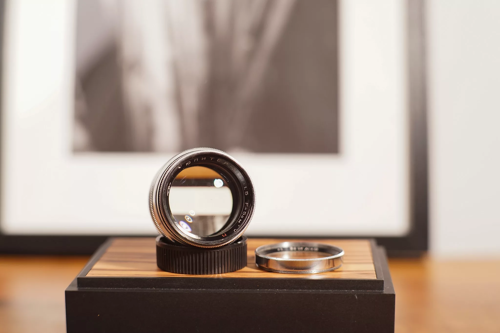
M39 mount
The KMZ Jupiter-3 50mm f/1.5 is a M39-mount lens for Leica rangefinder cameras. As of October 2026, it sells from €156 used across 2 listings, with a 30-day median of €280. Leica price index →
Measured against the 13 other 50mm M39-mount lenses in the catalogue.
The Jupiter-3 is the Soviet descendant of the Zeiss Sonnar 50mm f/1.5, one of the most influential fast normal lenses of the rangefinder era. Built around a seven-element layout in three groups, it carried the prewar Sonnar formula into Soviet production, and early examples are often discussed as having been assembled partly with German glass that reached the USSR after the Second World War [1][2]. For collectors of Leica thread-mount optics it occupies a particular niche: one of the very few inexpensive fast rangefinder lenses, offering Sonnar rendering at a fraction of the cost of its Western contemporaries.
Optically the lens follows the compact Sonnar template, a seven-element, three-group design that keeps the barrel short and the weight modest. It uses the M39 Leica thread mount and is rangefinder coupled, so it focuses and meters correctly on Leica screw-mount bodies and on Soviet copies such as FED and Zorki cameras, and via adapters on later mirrorless cameras. The aperture is a many-bladed iris that keeps the opening close to circular through the range, which contributes to the smooth out-of-focus rendering the design is known for. Minimum focus is one meter, typical for a coupled rangefinder lens of this generation, and reviewers note that nailing focus wide open at f/1.5 can be demanding because depth of field is very shallow. Build is simple but functional; the chrome barrels are machined from aluminium, which keeps mass low but scratches easily, while later black-painted examples resist marking better.
Versions vary considerably because the lens was made over a long span and at more than one plant, including Krasnogorsk (KMZ) and the Zagorsk optical works (ZOMZ); production ran from the late 1940s into the late 1980s. Most examples are chrome, with black-barrel versions appearing in the later period. Coatings changed over time, and the outer appearance was revised more than once, so two lenses of different years can handle flare and contrast somewhat differently. Among collectors, examples marked with a red Cyrillic П are associated with earlier, single-coated runs that tend to enjoy a better online reputation, though this is anecdotal rather than firmly documented. The serial number conventionally encodes the production year in its first two digits.
Rendering The Jupiter-3 renders in the classic Sonnar manner: gentle and atmospheric wide open, tightening up quickly on stopping down. It is a character lens rather than a clinical performer, and behavior varies between samples because of build consistency and coating differences.
Sharpness Wide open at f/1.5 sharpness and contrast are modest, partly due to residual spherical aberration in the design and sometimes worsened by veiling haze in older samples. By f/2.0 the center reaches quite good levels, and from f/2.8 the central resolution is very good, though the corners need around f/11 to catch up.
Contrast and color Wide-open contrast is dampened, and the softening sometimes shows the so-called Sonnar glow. Stopping down restores contrast in the center fairly quickly.
Bokeh and transitions At f/1.5 the lens is, as one reviewer puts it, all about the background. With distant, simple backgrounds it can produce very smooth blur, but busy backgrounds can show strong outlining that makes the rendering look nervous.
Distortion and vignetting Unusually for a 50mm lens, the Jupiter-3 shows visible pincushion distortion, which is worth correcting for architectural work. Vignetting is about what the f/1.5 aperture would suggest and is no longer a concern from roughly f/4 onward.
Collector and user notes Opinions on overall image quality differ. Some users find the lens an unremarkable everyday performer with average wide-open sharpness, while others value precisely the soft, glowing character it gives when used wide open.
Development and Launch The lens descends directly from the Zeiss Sonnar 50mm f/1.5, with Soviet production beginning in the postwar years; sources place the start of manufacture in the late 1940s. The wartime transfer of Zeiss optical resources to the USSR underlies the early lenses, and the design preserved the seven-element Sonnar configuration rather than adopting a newer formula.
Production Evolution The Jupiter-3 was produced over several decades and at more than one optical plant, with examples running into the late 1980s. Most are chrome-finished, while black-barrel versions belong to the later period. Coatings and external details were revised across the production run, so flare control and contrast can differ between an early and a late example.
Special editions Beyond the standard M39 rangefinder lens, the Sonnar formula was also offered in mounts for Contax and Kiev rangefinder bodies. In modern times the design was revived commercially as the Lomography New Jupiter 3+ 50mm f/1.5 Art, a reissue aimed at Leica M and thread-mount users; reviewers describe it as faithful to the original character while noting quirks such as a clickless aperture and a long focusing throw [3].
Collector Notes Because the lens spanned many years and several plants, condition and consistency vary widely, so it is worth checking a candidate for haze, separation, and focus accuracy rather than assuming a given year performs to a standard. The first two digits of the serial number generally indicate the production year, a useful check when dating a lens. Chrome barrels mark easily, so cosmetic wear is common; black examples tend to look cleaner. Red-П marked early lenses are sought after for their reputed single-coated rendering, though buyers should treat that reputation as collector lore rather than confirmed fact. Note that some Sonnar-formula lenses sold to Leica users were converted or recalibrated from Contax-mount stock, so verifying that an M39 example is correctly coupled before purchase is sensible.
Good time to buy. The lowest listing is 44% below the 30-day average.
Lowest price Click a mark to open that listing · arrow keys to step, Enter to open
Price against condition for 2 listings of KMZ Jupiter-3 50mm f/1.5, €156 to €404, median €281. Fair: 1 at €156. Unknown: 1 at €404. The full table follows.
| Condition | Lowest | Median |
|---|---|---|
| Fair | €156 | €156 |
| Other | €404 | €404 |
Over the last 18 weeks the median price for the KMZ Jupiter-3 50mm f/1.5 has risen, ranging from €150 to €340 (now €280).
Weekly price (EUR). Median (Good or better) and lowest (Good or better) across 18 weeks. The full figures follow in the table below.
| Week | Median | Lowest |
|---|---|---|
| Jun 1, 2026 | €249 | Unknown |
| Jun 8, 2026 | €150 | Unknown |
| Jun 15, 2026 | €150 | Unknown |
| Jun 22, 2026 | €268 | Unknown |
| Jun 29, 2026 | €268 | Unknown |
| Jul 6, 2026 | €268 | Unknown |
| Jul 13, 2026 | €268 | Unknown |
| Jul 20, 2026 | €268 | Unknown |
| Jul 27, 2026 | €340 | Unknown |
| Aug 3, 2026 | €268 | Unknown |
| Aug 10, 2026 | €268 | Unknown |
| Aug 17, 2026 | €292 | Unknown |
| Aug 24, 2026 | €291 | Unknown |
| Aug 31, 2026 | €290 | Unknown |
| Sep 7, 2026 | €289 | Unknown |
| Sep 14, 2026 | €286 | Unknown |
| Sep 21, 2026 | €285 | Unknown |
| Sep 28, 2026 | €280 | Unknown |
Every shop grades differently. Leica Classic uses letters, Ffordes uses E++ and E+, German dealers write "Zustand B", Japanese dealers write A−. We map all of them onto the one ladder below. Where a shop states its own grade, we print it under ours.
As of October 2026, the KMZ Jupiter-3 50mm f/1.5 sells from €156 used, with a 30-day median of €280, across 2 active listings.
As of October 2026, the KMZ Jupiter-3 50mm f/1.5 is sold by 2 sources (2 listings), from €156 used: all compared cheapest-first on this page.
Similar lenses you might be interested in
Comments