The KMZ Industar-22 is a collapsible 50mm f/3.5 Tessar-type M39 rangefinder lens, an Elmar-style Soviet standard prized by collectors of early KMZ optics.
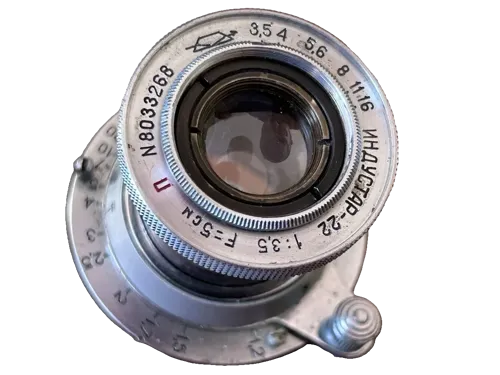
KMZ Industar-22 50mm f/3.5
M39 mount
No listings tracked for this lens right now.
The KMZ Industar-22 50mm f/3.5 is a M39-mount lens for Leica rangefinder cameras. Leica price index →
How it compares
Measured against the 13 other 50mm M39-mount lenses in the catalogue.
Specification
About this lens
KMZ Industar-22 50mm f/3.5
The Industar-22 was one of the first photographic lenses to come out of the Krasnogorsk Mechanical Plant (KMZ), and it carries the visual and mechanical DNA of the German Leitz Elmar that the Soviet optical industry took as its model [1][2]. Built around the classic four-element, three-group Tessar formula, it served as the standard normal lens for early Zorki and FED rangefinders and was first produced as a collapsible barrel in Leica 39mm screw mount that closely resembles Leica's own collapsible Elmar. KMZ began series production in 1948, and the optical design itself was calculated in 1945.
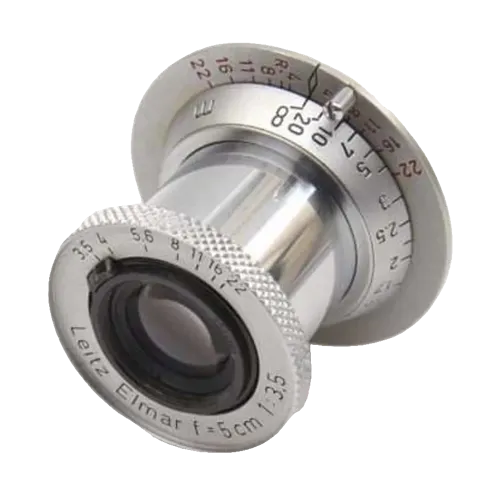
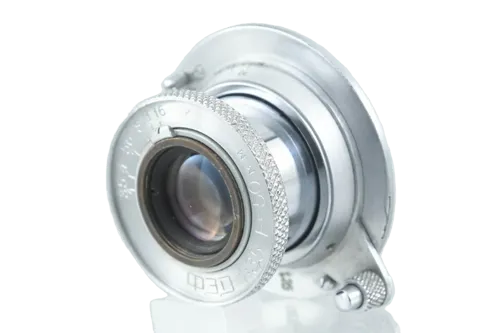
In handling it behaves much like the Elmar it imitates. The lens collapses into the camera body to make the package pocketable, and focus is performed by rotating the entire optical unit, with an infinity focus lock on the focusing tab that has often worn smooth on surviving examples. The barrel is built from nickel-plated brass, giving the small lens a noticeable heft for its size. The aperture ring sits at the very front of the lens, which makes it slow and slightly fiddly to adjust, so many users set a working aperture and leave it, controlling exposure through shutter speed instead [3]. The cramped distance and depth-of-field scales reflect how much information had to be fitted onto a tiny barrel. Because it is rangefinder coupled in M39, the collapsible version focuses correctly on Leica thread mount bodies, while a related rigid version was made shorter for the deeper-bodied Zenit 1 SLR and could be adapted to a rangefinder with a short extension tube. Both collapsible and rigid lenses accept the 36mm slip-on or clamp-on hoods and filters of Leica's A36 fitting, and the rigid model adds an M33 x 0.5 filter thread.
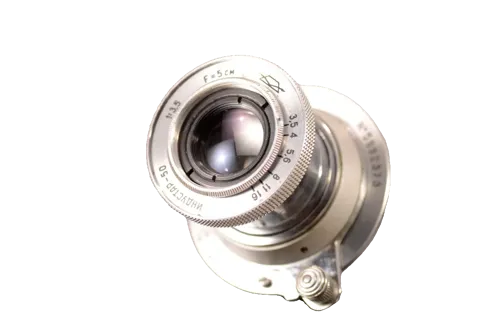
One notable point of identification is that the Industar-22 name actually covers more than one optical generation. The original lens was joined around 1950 by a modernized Industar-22m, which is reported to have improved manufacturability and optical performance, and the elements of the two are not interchangeable. Early examples can be dated by the form of the factory logo and sometimes carry the inscription "Moscow," which may have been used to distinguish KMZ lenses from the externally similar Industar-10 (FED 50/3.5) built in Kharkov. In the late 1950s the design was superseded by the recalculated Industar-50, generally described as the higher-quality successor.
Optical qualities
Rendering Documented impressions of the Industar-22 vary, partly because the name spans several production variants of differing quality. A tested example of the earliest 1948-era version showed low overall contrast, faded color, and very poor flare resistance, with a strong veiling haze whenever the sun was in frame. By contrast, a collector reviewing a later collapsible example found it a fine performer with good sharpness and color that compared favorably to the later rigid Industar-50 and Industar-26M. The practical takeaway is that rendering depends heavily on the specific variant, the state of the coatings, and the condition of the internal blackening, which is prone to deterioration on Soviet optics of this period.
Flare resistance The early example tested struggled badly against backlight, producing flare and a dense veil with the sun in the frame, consistent with the limited single-layer coatings of the late 1940s.
Aberrations Used in close focus and macro work, the early version showed pronounced chromatic aberration with visible red and blue color fringing and spherical aberration, indicating modest correction by later standards.
History
Development and Launch The Industar-22 grew directly out of the postwar Soviet adoption of the Leitz Elmar layout. Its Tessar-type optical scheme was calculated in 1945, and KMZ put it into series production in 1948 as the standard lens for Zorki cameras. As one of the plant's first camera lenses, it marked Krasnogorsk's entry into small-format photographic optics.
Production Evolution The lens went through more than one optical revision under the same name. The original design was followed around 1950 by the Industar-22m, with reportedly better build and optical quality and non-interchangeable elements. A rigid version was produced for the Zenit 1 SLR, shorter than the collapsible to suit the camera's deeper body, and in the late 1950s the whole design was recalculated and replaced by the Industar-50. Aperture mechanisms differ across variants, and at least one early collapsible version used a ten-blade diaphragm.
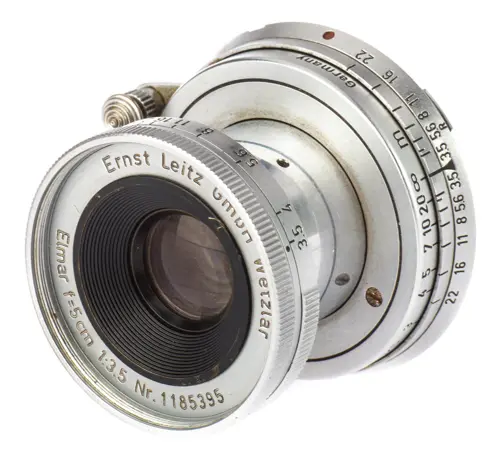
Special editions No widely documented military, export, or commemorative factory editions are recorded for this lens. Collectors do note, however, that Soviet collapsible lenses of this type have sometimes been re-engraved and passed off as genuine Leitz Elmars, so Elmar-marked fakes built on Industar barrels appear at auction.
Collector Notes Identification of early examples relies on details such as the shape of the factory logo and city inscriptions like "Moscow," and the lens is easily confused with the very similar Kharkov-built Industar-10 (FED 50/3.5). Because the Industar-22 and Industar-22m share a name but not their optics, buyers should be aware which generation they are handling. Common condition issues include worn infinity locks, stiff or out-of-round diaphragms from poor mechanism tolerances, and degraded internal blackening or coatings that reduce contrast. There were numerous minor production variations over the lens's long run, and many surviving lenses have been serviced or rebuilt, so originality is worth checking before purchase.
Sources
Where to buy
Related lenses
Similar lenses you might be interested in
Comments